I suppose I have to write something about the biggest business news story on the planet yesterday- the convictions of Jeff Skilling and Ken Lay for their Enron crimes.
Here's what I find noteworthy on this "morning after."
Watching Sharon Watkins appear on CNBC this morning, I found myself wondering what the cost to our economy will be, in terms of future dynamism and creative growth, from Sarbanes-Oxley?
Several commentators yesterday solemnly intoned how the Enron verdicts provided the matching "bookend" to the decade of greed and excess that was the 1990s. Then, some other pundits, in response to questions from the talking (air)heads on CNBC's afternoon programs about "is this finally the end of corporate wrongdoing and scandals?" noted that all periods of explosive economic activity and growth beget some excesses. Excesses which are typically found, later, to be illegal.
What concerns me is this. Do we know, empirically, that the illegal "excesses" of the 1990s were above-average in the damage they caused? Can anyone really legislate a priori the total proscription of illegal behavior?
Doesn't it really boil down to the ethical values of the CEOs in charge of public companies? Sharon Watkins spoke about being a "whistleblower" with real passion and angst. I've never worked in a company which commited fraud while I was there. But I can attest to the general climate of which Watkins spoke. She told of being pulled aside by Andy Fastow, Enron's CFO, and told to keep her nose out of accounting business that was not her job. She thereupon transferred to another division. Charlie Gasparino then chastised Watkins by asking something like, 'shouldn't you have really done more, gone public, instead of transferring at that point?'
How presumptuous and pompous of Gasparino to be so judgmental. Anyone who's put serious time in with a large company knows that it is far harder to explicitly and vocally tack away from the corporate course and risk dismissal and loss of income, than it is to just find another place to hang out and do something for a paycheck. Nobody who is not independently wealthy, and does not actually commit a crime, deserves to be questioned and judged like Gasparino and a few of his colleagues did with Sharon Watkins this morning on CNBC. I hate to put it this way, but watching her this morning, it was hard not to compare CNBC's treatment of her to a rape victim being asked if she didn't conspire in the crime.
Drawing these themes together, I simply wonder if we are not making Enron, Worldcom, et al, into mountains of larger size than they actually were. Are we sure that, given the business activity and benefits of the 1990s, the consequent damage done by these corporate frauds is historically "excessive?" Their faults were, at bottom, unethical CEOs and sleepy boards. Now, several CEOs will be in jail for a very long time. If this doesn't give pause to sitting CEOs, will Sarbanes-Oxley? Which, as we all know, was not in existence when the crimes for which Ebbers, Skilling and Lay have been convicted were commited.
Our dynamic economy creates explosive, creative growth. Sometimes, things get out of hand. Nobody can stop white-collar crime before it even gets started. Even whistleblowers like Sharon Watkins are sceptically treated after the fact. It's just not philosophically compatible with our American system to presume people guilty of unethical or criminal behavior before the fact. We punish when we find the crime- not before it's commited. And who among us believes you can somehow legislate a person to have better ethics than they already have as they become a CEO?
Let's hope the effect of Sarbanes-Oxley is not to starve our better new ventures of capital in the public markets. Let's hope it doesn't drive creative enterprise into private equity forever, damping publicly-accessible returns for the average American investor. And, most of all, let's hope Sarbanes-Oxley doesn't have a long term dampening effect upon American entrepreneurship, creativity, and economic value creation. Because if it does, we've just handed the rest of the world our heretofore economic leadership on a silver platter.
Friday, May 26, 2006


Actual Volatility in Equity Markets
I saw an interesting exchange the other day on CNBC. Dylan Ratigan was cross-examining some poor analyst or CEO in connection with avian flu worries and pharma or food stocks. I really don't recall which it was.
What I do recall, however, was Ratigan's comment that flustered his poor guest. It was something very close to this, "....c'mon, the stock moved 6% in one day! Stocks don't usually do that!...what's going on there?"
Well, actually, yes, I think they do "do that," Dylan. Maybe you need to watch individual stock volatilities more often, to stay in touch with how wild the equity markets have become lately.
For example, I have a portfolio of twenty-one equities. Looking at yesterday's results, one rose over 4%, and another over 5%. Neither had particularly significant news that day. Another stock was within a hair of a 4% gain.
I've seen 6% daily moves, too. Recently. Especially with the large market moves of the past few weeks. I don't keep daily change records, but my point is this. Daily price volatility can actually be pretty large now. Remember Microsoft's loss of 11% of its value in just one day, for reporting higher-than-expected expenses?
I find it rather ironic that an anchor for a business entertainment network, CNBC, which stressed daily reporting, if not hourly reporting, would be so insensitive to the realities of daily stock price volatility in this environment.
What I do recall, however, was Ratigan's comment that flustered his poor guest. It was something very close to this, "....c'mon, the stock moved 6% in one day! Stocks don't usually do that!...what's going on there?"
Well, actually, yes, I think they do "do that," Dylan. Maybe you need to watch individual stock volatilities more often, to stay in touch with how wild the equity markets have become lately.
For example, I have a portfolio of twenty-one equities. Looking at yesterday's results, one rose over 4%, and another over 5%. Neither had particularly significant news that day. Another stock was within a hair of a 4% gain.
I've seen 6% daily moves, too. Recently. Especially with the large market moves of the past few weeks. I don't keep daily change records, but my point is this. Daily price volatility can actually be pretty large now. Remember Microsoft's loss of 11% of its value in just one day, for reporting higher-than-expected expenses?
I find it rather ironic that an anchor for a business entertainment network, CNBC, which stressed daily reporting, if not hourly reporting, would be so insensitive to the realities of daily stock price volatility in this environment.
Thursday, May 25, 2006
Toyota's & GM's Texas Plants
Wednesday's Wall Street Journal featured an article comparing the Texas production plants of GM and Toyota. The overall conclusion was that, although GM's facility is its most "efficient" one, it is still running behind Toyota's newer one.
I have a couple of observations.
The first one involves barriers to entry. If you don't already see auto production and marketing as a low barrier-to-entry business, and, thus, a business tending toward commoditization, this piece ought to be your wake-up call.
It reminds me of a business in which I was engaged to troubleshoot at Chase Manhattan Bank years ago. The master trust and custody business was primarily an IT activity. It involved electronic record-keeping of pension funds and the associated assets, as well as handling the interfaces for trustees (the companies with the pension plans) with their designated asset managers (the money management funds actually managing the pension assets). What we found back in the 1980s was that any bank could, if it so chose, invest sufficiently to develop a newer, more feature-laden system, and begin to take share from existing providers with older, more antiquated capabilities. At the time, Bankers Trust was doing just that, and taking share from the weaker players in the marketplace.
This awareness informed us, the corporate planning strategic troubleshooters for the bank, that the pension trust and custody business was going to have some natural limits to ROI, due to the need for ongoing investment. Thus, any value-adding edge we hoped to create and sustain was going to have to be from growth. Margins were always going to be under pressure due to significant ongoing systems developments and upgrades.
The WSJ piece on the auto plants reminded me of this. If all it took to best GM's best plant was a slightly more forward-looking perspective by Toyota, then GM investors crowing about this week's temporary stock price reprieve should take a really good look at this story about the Texas facilities.
Legacy issues are fact. I've written about this in connection with technology companies last fall. Now, we see it in something as mundane as auto production.
A related topic mentioned in the article is how the writers chose to treat the "productivity" of the two plants. For my views, see this post, and this one as well.
In one paragraph, they discuss the labor hours per vehicle at the GM plant. Later, they note that, when actual labor rates, meaning unionized wages and substantial GM overhead, are applied, Toyota's newer plant wins, hands down.
My question is, why even bother with hours/vehicle? That's "efficiency," not "productivity." Productivity implies value, and even adding labor costs doesn't totally reflect the "productivity" in terms of value-added to the vehicle, and its salability. For arguments' sake, let's agree that the GM vehicles in question are very salable, for now.
My overall impression is that the article provides a rather useful anecdote as to just how much continuing trouble GM has on its hands. Like it or not, being the one-time share leader in a business that benefits from at least one entrant's continuing drive for improvements- in product, production processes, etc- can cause existing market leaders to simply crumple from inertia.
So, for what it's worth.....that GM stock price rise this week? Well, I don't hold the stock to begin with. If I did, after reading this WSJ piece, I'd be thinking profit taking. There are plenty of better opportunities for less-risky investment gains than GM right now.
But maybe that's just me....
I have a couple of observations.
The first one involves barriers to entry. If you don't already see auto production and marketing as a low barrier-to-entry business, and, thus, a business tending toward commoditization, this piece ought to be your wake-up call.
It reminds me of a business in which I was engaged to troubleshoot at Chase Manhattan Bank years ago. The master trust and custody business was primarily an IT activity. It involved electronic record-keeping of pension funds and the associated assets, as well as handling the interfaces for trustees (the companies with the pension plans) with their designated asset managers (the money management funds actually managing the pension assets). What we found back in the 1980s was that any bank could, if it so chose, invest sufficiently to develop a newer, more feature-laden system, and begin to take share from existing providers with older, more antiquated capabilities. At the time, Bankers Trust was doing just that, and taking share from the weaker players in the marketplace.
This awareness informed us, the corporate planning strategic troubleshooters for the bank, that the pension trust and custody business was going to have some natural limits to ROI, due to the need for ongoing investment. Thus, any value-adding edge we hoped to create and sustain was going to have to be from growth. Margins were always going to be under pressure due to significant ongoing systems developments and upgrades.
The WSJ piece on the auto plants reminded me of this. If all it took to best GM's best plant was a slightly more forward-looking perspective by Toyota, then GM investors crowing about this week's temporary stock price reprieve should take a really good look at this story about the Texas facilities.
Legacy issues are fact. I've written about this in connection with technology companies last fall. Now, we see it in something as mundane as auto production.
A related topic mentioned in the article is how the writers chose to treat the "productivity" of the two plants. For my views, see this post, and this one as well.
In one paragraph, they discuss the labor hours per vehicle at the GM plant. Later, they note that, when actual labor rates, meaning unionized wages and substantial GM overhead, are applied, Toyota's newer plant wins, hands down.
My question is, why even bother with hours/vehicle? That's "efficiency," not "productivity." Productivity implies value, and even adding labor costs doesn't totally reflect the "productivity" in terms of value-added to the vehicle, and its salability. For arguments' sake, let's agree that the GM vehicles in question are very salable, for now.
My overall impression is that the article provides a rather useful anecdote as to just how much continuing trouble GM has on its hands. Like it or not, being the one-time share leader in a business that benefits from at least one entrant's continuing drive for improvements- in product, production processes, etc- can cause existing market leaders to simply crumple from inertia.
So, for what it's worth.....that GM stock price rise this week? Well, I don't hold the stock to begin with. If I did, after reading this WSJ piece, I'd be thinking profit taking. There are plenty of better opportunities for less-risky investment gains than GM right now.
But maybe that's just me....
Wednesday, May 24, 2006
More Confusion from the WSJ: Creativity vs. Management
Yesterday's Wall Street Journal was a motherlode of interesting articles on which to comment.
The first is Lee Gomes' follow up to the Gates-Otellini op-ed letter in the Journal last week. That letter was their "reply" to comments by Journal technology reviewer Walt Mossberg's comments on the relative merits and status of Apple's "closed" design system vs. WinTel's "open" system. I wrote some thoughts about the Gatellini letter here.
Gomes stated that he would "like to play the peacemaker in a debate kicking around in these pages over the past few weeks." He then goes on to describe the prior written pieces, and their positions.
I don't like to seem to be harsh on any one person, but I have to say, this is the second article in a row from Gomes, whom I usually enjoy reading, that simply contains shallow thinking.
Consider the title of his piece yesterday, "Above All Else, Rivals of Apple Mostly Need Some Design Mojo."
Really? Indeed! How wonderfully simple to fix. Just call a few industrial designers, and Microsoft is back on track to consistently superior return performance for the rest of this decade. Same for intel, eh?
I don't think so. No, it runs far deeper. Like product strategy, choice of arenas in which to compete, and corporate sizes so large as to insulate the senior executives from a meaningful appreciation of the amount of value destruction that continued mediocrity will cause.
I found Gomes' last paragraph to be the most telling evidence of his misunderstanding of what has been going on in this situation. He writes,
"Apple has worked hard in recent years to adopt some of the business-process efficiencies that the Wintel companies have long taken for granted. Its rivals, then, ought to be able to make themselves a little more creative."
Again, it's not that simple. I have undertaken proprietary research on the occurences and sources of consistently superior total return performance among large-cap companies. My findings have shown that innovation and creativity are the most unique, important attribute of such companies. Whereas expense and process management are fairly easy to hire and implement, true innovation and creative product development, which drive consistently superior revenue growth, appear to be the rare talents.
Therefore, it's not going to be very easy for Microsoft and Intel, at their size, and with their bloated bureaucracies, to simply "make themselves a little more creative." Not when Chairman Bill is the self-ordained "chief software architect" of his software empire. As I have written prior to this, if Microsoft is to break historic patterns, it probably has to seed entirely new companies. For more on this, see my piece on new style corporate governance.
To close, I remain disappointed that the WSJ continues to pump out such shallow and badly-conceived ideas about business strategy. I doubt it would have taken more than a few phone calls to business colleagues for Lee Gomes to be disabused of his notion that, just like process efficiency improvements, creativity can be easily hired or "managed" on demand.
It cannot. And that, dear readers, is why Steve Jobs' Apple is running (profitably) loose among product/markets no other PC software or hardware providers can even begin to consider. He has a natural flair and appreciation for design and usage that Bill Gates has never displayed. And in the current environment, that now matters.
The first is Lee Gomes' follow up to the Gates-Otellini op-ed letter in the Journal last week. That letter was their "reply" to comments by Journal technology reviewer Walt Mossberg's comments on the relative merits and status of Apple's "closed" design system vs. WinTel's "open" system. I wrote some thoughts about the Gatellini letter here.
Gomes stated that he would "like to play the peacemaker in a debate kicking around in these pages over the past few weeks." He then goes on to describe the prior written pieces, and their positions.
I don't like to seem to be harsh on any one person, but I have to say, this is the second article in a row from Gomes, whom I usually enjoy reading, that simply contains shallow thinking.
Consider the title of his piece yesterday, "Above All Else, Rivals of Apple Mostly Need Some Design Mojo."
Really? Indeed! How wonderfully simple to fix. Just call a few industrial designers, and Microsoft is back on track to consistently superior return performance for the rest of this decade. Same for intel, eh?
I don't think so. No, it runs far deeper. Like product strategy, choice of arenas in which to compete, and corporate sizes so large as to insulate the senior executives from a meaningful appreciation of the amount of value destruction that continued mediocrity will cause.
I found Gomes' last paragraph to be the most telling evidence of his misunderstanding of what has been going on in this situation. He writes,
"Apple has worked hard in recent years to adopt some of the business-process efficiencies that the Wintel companies have long taken for granted. Its rivals, then, ought to be able to make themselves a little more creative."
Again, it's not that simple. I have undertaken proprietary research on the occurences and sources of consistently superior total return performance among large-cap companies. My findings have shown that innovation and creativity are the most unique, important attribute of such companies. Whereas expense and process management are fairly easy to hire and implement, true innovation and creative product development, which drive consistently superior revenue growth, appear to be the rare talents.
Therefore, it's not going to be very easy for Microsoft and Intel, at their size, and with their bloated bureaucracies, to simply "make themselves a little more creative." Not when Chairman Bill is the self-ordained "chief software architect" of his software empire. As I have written prior to this, if Microsoft is to break historic patterns, it probably has to seed entirely new companies. For more on this, see my piece on new style corporate governance.
To close, I remain disappointed that the WSJ continues to pump out such shallow and badly-conceived ideas about business strategy. I doubt it would have taken more than a few phone calls to business colleagues for Lee Gomes to be disabused of his notion that, just like process efficiency improvements, creativity can be easily hired or "managed" on demand.
It cannot. And that, dear readers, is why Steve Jobs' Apple is running (profitably) loose among product/markets no other PC software or hardware providers can even begin to consider. He has a natural flair and appreciation for design and usage that Bill Gates has never displayed. And in the current environment, that now matters.
Carly Fiorina, H-P & Corporate Governance
Alan Murray of the Wall Street Journal wrote an excellent piece this morning about H-P's recent performance, and how it relates to the firm's ex-CEO.
In further comments on CNBC this morning, as Alan usually does to follow-up on his weekly column, he aptly fended off inquiries from the guest-host, Herb Greenberg, regarding the wisdom of the Compaq-H-P merger. What Alan pointed out is that, while sales may not have increased by more than simple addition because of the merger, expenses clearly fell from scale economies.
My ears perked at this, because it dovetails with my own research. In slower-growth companies, ROI matters a lot for achieving consistently superior total returns. And a big part of that comes from expense base management, since, by definition in a slower-growth company, it won't be coming from revenue growth.
Alan further pointed out that the board members backed the merger, but not, ultimately, Carly's personal and professional management style.
I again perked at this. What Alan Murray is really saying, without naming it, is that H-P's board did the unheralded right thing of dumping a problematic CEO and replacing her with one who focused on what they felt was critical for H-P at this time. That's a rare thing, despite the recent years of lackluster total returns at H-P.
So, for once, we have actually witnessed some effective "corporate governance" by a board that took action to benefit shareholders, without some scandal forcing them to do it. Maybe the system can work- it just takes the right board.
In further comments on CNBC this morning, as Alan usually does to follow-up on his weekly column, he aptly fended off inquiries from the guest-host, Herb Greenberg, regarding the wisdom of the Compaq-H-P merger. What Alan pointed out is that, while sales may not have increased by more than simple addition because of the merger, expenses clearly fell from scale economies.
My ears perked at this, because it dovetails with my own research. In slower-growth companies, ROI matters a lot for achieving consistently superior total returns. And a big part of that comes from expense base management, since, by definition in a slower-growth company, it won't be coming from revenue growth.
Alan further pointed out that the board members backed the merger, but not, ultimately, Carly's personal and professional management style.
I again perked at this. What Alan Murray is really saying, without naming it, is that H-P's board did the unheralded right thing of dumping a problematic CEO and replacing her with one who focused on what they felt was critical for H-P at this time. That's a rare thing, despite the recent years of lackluster total returns at H-P.
So, for once, we have actually witnessed some effective "corporate governance" by a board that took action to benefit shareholders, without some scandal forcing them to do it. Maybe the system can work- it just takes the right board.
Maria Bartiromo's Fed Appointment Reversed
It's official. In testimony before a Senate committee earlier this week, Ben Bernanke retracted his remarks to Maria Bartiromo, upon specific questioning of the incident by Senator (former perfect game hurler) Jim Bunning of Kentucky.
In a rather muted moment, Bernanke muttered that he had a lapse of judgment concerning speaking to the CNBC talking head about his and the Fed's true intentions with respect to rate hikes.
Thank goodness! Sanity prevails, and Maria's not un unofficial member of the Open Market Committee after all.
In a rather muted moment, Bernanke muttered that he had a lapse of judgment concerning speaking to the CNBC talking head about his and the Fed's true intentions with respect to rate hikes.
Thank goodness! Sanity prevails, and Maria's not un unofficial member of the Open Market Committee after all.
Monday, May 22, 2006
Some Common Sense About Interest Rates & Current Market Conditions
Rick Santelli, CNBC's Chicago reporter on the commodities and options markets there, has been in its New Jersey studios recently. What a breath of fresh air! I swear, this guy should be anchored there all the time.
I periodically castigate the network for focusing on the "action" on the floor of the NYSE, when the real decisions regarding equities are made in institutional money management offices across the country and globe. However, with fixed income, it's slightly different.
Bonds, particularly Treasuries, are a mathematical play. Pure and simple. In fact, one business partner of mine, my friend Bob, has opined that equities are the wild west, where any valuation can happen, without a clear cause. Fixed income, on the other hand, which is where Bob spent much of his productive career, are all math, and very understandable.
Santelli does a really wonderful job explaining the market forces at work while the camera shows the trading pits of Chicago in the background. Unlike, say, Bob Pisani, who looks up at some market stats board on the floor of the NYSE, then makes up his own story about why "the market" is doing something, Santelli calmly explains how the math of interest rates and inflation are pushing bond prices around, and affecting the term structure of the yield curve.
Thus, his remarks over the past few days have been calming, albeit delivered from a desk on CNBC's New Jersey set. He essentially said that a rise in rates from 5% to 5 1/2% was hardly enough to justify all the carnage recently seen as a result of inflation expectations. I think he is right. His calm explanation of the recent moves, and probably long term affects, seemed very reasoned and sensible.
Later that same day, CNBC had Gail Dudak, one-time frequent guest of the late Lou Rukeyser, on as an equity markets commentator. She made a number of clear and reasonable points as well. In particular, when asked if we are now seeing the beginning of a bear market, she said, "no." She likened these past few weeks to last Spring and October, when there were temporary market drops due to unfounded worries over various economic problems. I recall October's roiled markets clearly, as they came as a partial result of Katrina's then-uncertain effect on the US economy.
Overall, these two people, Santelli and Dudak, provided with clear, reasoned and believable analysis. Admittedly, it reinforced my own beliefs, but they had different perspectives, which was important.
I think that, once again, we are witnessing a market which is in the throes of misinterpretation of economic data by a lot of inept seat-warmers in the money management sector.
I periodically castigate the network for focusing on the "action" on the floor of the NYSE, when the real decisions regarding equities are made in institutional money management offices across the country and globe. However, with fixed income, it's slightly different.
Bonds, particularly Treasuries, are a mathematical play. Pure and simple. In fact, one business partner of mine, my friend Bob, has opined that equities are the wild west, where any valuation can happen, without a clear cause. Fixed income, on the other hand, which is where Bob spent much of his productive career, are all math, and very understandable.
Santelli does a really wonderful job explaining the market forces at work while the camera shows the trading pits of Chicago in the background. Unlike, say, Bob Pisani, who looks up at some market stats board on the floor of the NYSE, then makes up his own story about why "the market" is doing something, Santelli calmly explains how the math of interest rates and inflation are pushing bond prices around, and affecting the term structure of the yield curve.
Thus, his remarks over the past few days have been calming, albeit delivered from a desk on CNBC's New Jersey set. He essentially said that a rise in rates from 5% to 5 1/2% was hardly enough to justify all the carnage recently seen as a result of inflation expectations. I think he is right. His calm explanation of the recent moves, and probably long term affects, seemed very reasoned and sensible.
Later that same day, CNBC had Gail Dudak, one-time frequent guest of the late Lou Rukeyser, on as an equity markets commentator. She made a number of clear and reasonable points as well. In particular, when asked if we are now seeing the beginning of a bear market, she said, "no." She likened these past few weeks to last Spring and October, when there were temporary market drops due to unfounded worries over various economic problems. I recall October's roiled markets clearly, as they came as a partial result of Katrina's then-uncertain effect on the US economy.
Overall, these two people, Santelli and Dudak, provided with clear, reasoned and believable analysis. Admittedly, it reinforced my own beliefs, but they had different perspectives, which was important.
I think that, once again, we are witnessing a market which is in the throes of misinterpretation of economic data by a lot of inept seat-warmers in the money management sector.
What An Analyst Does
Today's Wall Street Journal features a section on "star" equity analysts.
As I read the first page of the section, seeking to understand the bases on which analysts were evaluated, I learned the following. Analysts are apparently judged on their ability to produce a best "buy" or "sell" recommendation, in terms of total return.
At first glance, this might seem appropriate. But it seems to me to run counter to what I have been led to believe analysts are supposed to do.
First, measuring an analyst on their one best recommendation seems akin to awarding a batting title in baseball to the hitter with the single longest home run. It doesn't count the other recommendations, or the average performance of all recommendations, etc. Or adjust the best recommendation for some sort of riskiness of the analyst's worst recommendation. How anyone is supposed to make use of such information stymies me. Which one, of many recommendations, should I have followed from each analyst?
Wouldn't it make more sense to reward the analyst with the best overall average return on recommendations? But, wait....that would make the analyst sort of like a portfolio manager, wouldn't it?
So, maybe the notion of rewarding analysts for something investment managers are paid to do is rather awkward.
My understanding, from years in the financial services industry, was that analysts were supposed to be uniquely able to understand specific companies in depth. And that the hallmark of this was to have the least error in predicting things like earnings, or earnings per share, for companies the analysts covered. What happened to this criterion? Has it just vanished, as we admit analysts are really just junior money managers?
Of course, there's the question of how one would weight a single best recommendation from an analyst. At the same time the WSJ features articles which counsel risk management for individual and institutional portfolios, they devote an entire section to lauding analysts who made a single "best" equity buy/sell call.
Confusing, isn't it? How our largest daily business newspaper, the Wall Street Journal, can be so schizophrenic with respect to what it seems to value as good financial advice to its readers.
As I read the first page of the section, seeking to understand the bases on which analysts were evaluated, I learned the following. Analysts are apparently judged on their ability to produce a best "buy" or "sell" recommendation, in terms of total return.
At first glance, this might seem appropriate. But it seems to me to run counter to what I have been led to believe analysts are supposed to do.
First, measuring an analyst on their one best recommendation seems akin to awarding a batting title in baseball to the hitter with the single longest home run. It doesn't count the other recommendations, or the average performance of all recommendations, etc. Or adjust the best recommendation for some sort of riskiness of the analyst's worst recommendation. How anyone is supposed to make use of such information stymies me. Which one, of many recommendations, should I have followed from each analyst?
Wouldn't it make more sense to reward the analyst with the best overall average return on recommendations? But, wait....that would make the analyst sort of like a portfolio manager, wouldn't it?
So, maybe the notion of rewarding analysts for something investment managers are paid to do is rather awkward.
My understanding, from years in the financial services industry, was that analysts were supposed to be uniquely able to understand specific companies in depth. And that the hallmark of this was to have the least error in predicting things like earnings, or earnings per share, for companies the analysts covered. What happened to this criterion? Has it just vanished, as we admit analysts are really just junior money managers?
Of course, there's the question of how one would weight a single best recommendation from an analyst. At the same time the WSJ features articles which counsel risk management for individual and institutional portfolios, they devote an entire section to lauding analysts who made a single "best" equity buy/sell call.
Confusing, isn't it? How our largest daily business newspaper, the Wall Street Journal, can be so schizophrenic with respect to what it seems to value as good financial advice to its readers.
Sunday, May 21, 2006
What About The Mediocre Companies?
My friend S, a consultant, was discussing corporate performance with me recently. While debating the recent fortunes of tech companies such as Google, Intel, and Microsoft, she challenged me to articulate what I would to fix what ails the last one. I had opined that Microsoft is, essentially, finished as a company capable of generating consistently superior returns, in part, as I have written recently, because of its chairman's excessive wealth. By the way, according to S, my estimate of Gates' net worth may have been light by as much as 50% or so. He apparently was worth some $50B as recently as 6 months ago, not the $25B I thought.
In any case, I said that the first, and, for a while, only thing I would do at Microsoft would be to essentially execute the threatened anti-trust remedy of the Netscape case- split the company into three: an applications software company, an operating systems company, and an internet-related company.
I'd like to explore my friend's next major remark. She assailed me, in a friendly way, for essentially ignoring the existence of less-than-consistently-superior return-generating companies, as if they should all perish. As a consultant, I believe her tendencies and motivations lean toward fixing mediocre companies, rather than simply tossing in the towel on them. It's a laudable goal, and no doubt a profitable one for the consulting sector.
However, I approach these issues as, I believe, most of my readers do- a passive investor. Mind you, I do opine on situations which I believe can be rescued. I say whether or not I believe a company can be put back on a path to consistently superior returns, or not. For example, GM, Intel, Dell and Microsoft- almost certainly not. HP and AMD- quite possibly.
But, what is a passive investor to do now? What does a passive investor desire now?
The obvious answer to these questions is that a passive investor desires to earn total returns which exceed the market average. S/he wants, ideally, consistently superior returns, on some risk-adjusted basis. Therefore, owning the stocks of mediocre firms is probably not high on such an investor's list of things to do.
Furthermore, the investor does not have to "settle" for shares of a mediocre, below-average-return company. Because of inexpensively-marketed, passively-managed index funds from complexes such as Vanguard, an investor may easily and cheaply buy an index which represents the S&P500, or virtually any sector. There are many ways an investor may take positions in companies through these vehicles, with expectations of returns that benefit from diversification, without ever needing to actively select a single company, much less voluntarily buy a lackluster one.
However, an investor may wish to attempt to outperform the market with part of her/his funds. It so happens that my large-cap investment strategy is based upon proprietary research which has shown that the best way to increase the odds of owning consistently superior total return-generating companies is to select those who have already been doing so. Then hold them a little longer, to reap the benefits of their continuing ability to surprise other investors with their consistently superior fundamental performance. That's why I have no interest in mediocre companies.
Mediocre companies have shareholders, and employees, and produce things. They exist in our economy, and no doubt provide valuable products and services, without which you and I would probably have lives which are different as a result. These opinions of my friend S are all true.
However, that doesn't mean you, or I, should want to own stock in these mediocre purveyors of economic necessities. But someone does. And, frankly, unless they decide to take a loss, these owners may not be able to sell their shares. Of course, it's easy to see that, should they believe they have better return expectations with some other investment, they should sell. But people are not always rational about these things, by any means. For more evidence of this, just Google "behavioral finance" and sample some of the literature from this field.
So, what happens to them- the underperforming, mediocre companies? There are several possible outcomes for these companies.
For some, their stock price declines, as a result of their increasing ineptitude, until it is so low that someone actively buys up a lot of it, believing that they can modestly improve the firm, and reap the attendant total returns. An example of this in the market now is Kirk Kerkorian's long-running bet on GM's return from near-death to just "pretty sick." Eddie Lampert has gone one better at Sears, buying a controling interest in the firm, and betting on wringing some excess returns out of it, one way or another.
However, both of these are active solutions unavailable to the typical investor- even most institutional ones.
Another path for a mediocre firm is for the CEO and senior management to take the firm private, using private equity backing, in order to reap the rewards of significant restructuring away from prying eyes and quarterly demands of the investing public. In these cases, the inside management takes advantage of their better knowledge of possible outcomes for the firm, and buys it cheaply, relative to potential returns, from a lesser-informed group of shareholders. However, this removes the firm from the public markets, so, again, a passive investor won't be seeing this option until later, after the anticipated turnaround.
This leaves mediocre firms who attempt turnarounds on their own. Firms whose stock price has sunk so low that, with a modicum of better-than-average performance, their share prices may spurt up in surprised response to the unexpected results. However, by definition, this is essentially betting on aberrant behavior. It requires a lot of in-depth analysis of just the "right" opportunities. It is an exlicit timing play. The investor has to get it just right, and that usually means taking significant risks.
I actually explored these situations in my proprietary research, as one type of strategy to pursue in the equity markets. My findings were, essentially, that the likelihood of turnarounds, among all possible situations of declining performance, multiplied by the average resultant total return, provided an unfavorable expected return. It simply is not a statistically viable approach for those on the "outside" of such situations, having no special knowledge of the ensuing turnaround.
Finally, let's consider why one invests in equities. Ideally, you are in equities for their growth potential. That means valuing them for their future growth, rather than fixed-income-like steadiness of cashflows. Thus, discounted cash flow valuations are inappropriate for equities which are bought and held for, well, the potential that equities uniquely offer. This being the case, and, again, my research has supported this analytically, one would not want to buy the equities of mediocre, low-growth, or low-earnings-growth firms. It just makes no sense, when there are plenty of better alternatives out there.
So, in the final analysis, this is my reply to my friend S, as to why I ignore mediocre companies, or those formerly superior companies now lapsing into their dotage. I ignore them because, relative to currently consistently superior total return firms with the fundamental performances to sustain those returns, the mediocre companies are simply not attractive for providing the passive investor with consistently market-beating total returns.
I know someone will continue to hold the equity of mediocre companies. Some may be turned around. Others may be acquired, merged, or simply stripped and closed. But for passive investors, getting involved in mediocre firms is a high risk, low return proposition. I don't see that changing anytime soon.
In any case, I said that the first, and, for a while, only thing I would do at Microsoft would be to essentially execute the threatened anti-trust remedy of the Netscape case- split the company into three: an applications software company, an operating systems company, and an internet-related company.
I'd like to explore my friend's next major remark. She assailed me, in a friendly way, for essentially ignoring the existence of less-than-consistently-superior return-generating companies, as if they should all perish. As a consultant, I believe her tendencies and motivations lean toward fixing mediocre companies, rather than simply tossing in the towel on them. It's a laudable goal, and no doubt a profitable one for the consulting sector.
However, I approach these issues as, I believe, most of my readers do- a passive investor. Mind you, I do opine on situations which I believe can be rescued. I say whether or not I believe a company can be put back on a path to consistently superior returns, or not. For example, GM, Intel, Dell and Microsoft- almost certainly not. HP and AMD- quite possibly.
But, what is a passive investor to do now? What does a passive investor desire now?
The obvious answer to these questions is that a passive investor desires to earn total returns which exceed the market average. S/he wants, ideally, consistently superior returns, on some risk-adjusted basis. Therefore, owning the stocks of mediocre firms is probably not high on such an investor's list of things to do.
Furthermore, the investor does not have to "settle" for shares of a mediocre, below-average-return company. Because of inexpensively-marketed, passively-managed index funds from complexes such as Vanguard, an investor may easily and cheaply buy an index which represents the S&P500, or virtually any sector. There are many ways an investor may take positions in companies through these vehicles, with expectations of returns that benefit from diversification, without ever needing to actively select a single company, much less voluntarily buy a lackluster one.
However, an investor may wish to attempt to outperform the market with part of her/his funds. It so happens that my large-cap investment strategy is based upon proprietary research which has shown that the best way to increase the odds of owning consistently superior total return-generating companies is to select those who have already been doing so. Then hold them a little longer, to reap the benefits of their continuing ability to surprise other investors with their consistently superior fundamental performance. That's why I have no interest in mediocre companies.
Mediocre companies have shareholders, and employees, and produce things. They exist in our economy, and no doubt provide valuable products and services, without which you and I would probably have lives which are different as a result. These opinions of my friend S are all true.
However, that doesn't mean you, or I, should want to own stock in these mediocre purveyors of economic necessities. But someone does. And, frankly, unless they decide to take a loss, these owners may not be able to sell their shares. Of course, it's easy to see that, should they believe they have better return expectations with some other investment, they should sell. But people are not always rational about these things, by any means. For more evidence of this, just Google "behavioral finance" and sample some of the literature from this field.
So, what happens to them- the underperforming, mediocre companies? There are several possible outcomes for these companies.
For some, their stock price declines, as a result of their increasing ineptitude, until it is so low that someone actively buys up a lot of it, believing that they can modestly improve the firm, and reap the attendant total returns. An example of this in the market now is Kirk Kerkorian's long-running bet on GM's return from near-death to just "pretty sick." Eddie Lampert has gone one better at Sears, buying a controling interest in the firm, and betting on wringing some excess returns out of it, one way or another.
However, both of these are active solutions unavailable to the typical investor- even most institutional ones.
Another path for a mediocre firm is for the CEO and senior management to take the firm private, using private equity backing, in order to reap the rewards of significant restructuring away from prying eyes and quarterly demands of the investing public. In these cases, the inside management takes advantage of their better knowledge of possible outcomes for the firm, and buys it cheaply, relative to potential returns, from a lesser-informed group of shareholders. However, this removes the firm from the public markets, so, again, a passive investor won't be seeing this option until later, after the anticipated turnaround.
This leaves mediocre firms who attempt turnarounds on their own. Firms whose stock price has sunk so low that, with a modicum of better-than-average performance, their share prices may spurt up in surprised response to the unexpected results. However, by definition, this is essentially betting on aberrant behavior. It requires a lot of in-depth analysis of just the "right" opportunities. It is an exlicit timing play. The investor has to get it just right, and that usually means taking significant risks.
I actually explored these situations in my proprietary research, as one type of strategy to pursue in the equity markets. My findings were, essentially, that the likelihood of turnarounds, among all possible situations of declining performance, multiplied by the average resultant total return, provided an unfavorable expected return. It simply is not a statistically viable approach for those on the "outside" of such situations, having no special knowledge of the ensuing turnaround.
Finally, let's consider why one invests in equities. Ideally, you are in equities for their growth potential. That means valuing them for their future growth, rather than fixed-income-like steadiness of cashflows. Thus, discounted cash flow valuations are inappropriate for equities which are bought and held for, well, the potential that equities uniquely offer. This being the case, and, again, my research has supported this analytically, one would not want to buy the equities of mediocre, low-growth, or low-earnings-growth firms. It just makes no sense, when there are plenty of better alternatives out there.
So, in the final analysis, this is my reply to my friend S, as to why I ignore mediocre companies, or those formerly superior companies now lapsing into their dotage. I ignore them because, relative to currently consistently superior total return firms with the fundamental performances to sustain those returns, the mediocre companies are simply not attractive for providing the passive investor with consistently market-beating total returns.
I know someone will continue to hold the equity of mediocre companies. Some may be turned around. Others may be acquired, merged, or simply stripped and closed. But for passive investors, getting involved in mediocre firms is a high risk, low return proposition. I don't see that changing anytime soon.
Thursday, May 18, 2006
Another Example of the "Efficient Market" at Work?
If you still had any belief in an "efficient" market, Wednesday and Thursday ought to have cured you.
As I've written here in a prior post, there are two ways markets can be inefficient. I believe this week demonstrated both.
On Wednesday, some data was reported which showed a small rise in core inflation. This had even been commented on, a priori, by no less a person than Bernanke, as expected. So much for 'new information.' Never the less, it caused a market sell off.
If the information was not all that unexpected, how can one explain an "efficient" market dropping by 1.7% ? With individual stocks declining far more just on principle. Hardly very "efficient," eh?
Then, on Thursday, the continued confusion resulted in a flat market. Until Fed official Poole remarked that, at their next meeting, the Fed might raise rats half a point, or maybe, not at all.
This caused an immediate panic of selling. The market sold off to end the session roughly another .7% down.
Mind you, Poole only voiced what most pundits believed, and even Bernanke has said. That the Fed is looking at evolving data, and will make its decision at the appropriate time, on the relevant data at that time. Nothing new here.
No, this further drop was the result of a lot of mediocre, poorly-reasoning investors dumping shares on fear. Nothing more.
There's no sign yet that healthy global growth has lapsed. Any inflation is demand pull, not cost push. If global demand ebbs a little to cool the commodities price froth, so be it. That won't bring construction in Chindia to a standstill anytime soon.
Simply put, nothing "happened" this week to cause the equities of well-managed, profitable, growing large-cap US firms to drop in value by 10%. Temporary perception may be that these companies are now worth much less. But the available information on the environment, and the companies themselves, suggest otherwise.
So much, again, for "efficient" markets. How efficient can they be, if little, or no, information, can bring changes of the scale seen in just two days this week. And how "equal" can all the investors be in processing this "information," if such a stampeded is caused? And then reversed again today, by almost half a percentage point in the opposite direction?
As I've written here in a prior post, there are two ways markets can be inefficient. I believe this week demonstrated both.
On Wednesday, some data was reported which showed a small rise in core inflation. This had even been commented on, a priori, by no less a person than Bernanke, as expected. So much for 'new information.' Never the less, it caused a market sell off.
If the information was not all that unexpected, how can one explain an "efficient" market dropping by 1.7% ? With individual stocks declining far more just on principle. Hardly very "efficient," eh?
Then, on Thursday, the continued confusion resulted in a flat market. Until Fed official Poole remarked that, at their next meeting, the Fed might raise rats half a point, or maybe, not at all.
This caused an immediate panic of selling. The market sold off to end the session roughly another .7% down.
Mind you, Poole only voiced what most pundits believed, and even Bernanke has said. That the Fed is looking at evolving data, and will make its decision at the appropriate time, on the relevant data at that time. Nothing new here.
No, this further drop was the result of a lot of mediocre, poorly-reasoning investors dumping shares on fear. Nothing more.
There's no sign yet that healthy global growth has lapsed. Any inflation is demand pull, not cost push. If global demand ebbs a little to cool the commodities price froth, so be it. That won't bring construction in Chindia to a standstill anytime soon.
Simply put, nothing "happened" this week to cause the equities of well-managed, profitable, growing large-cap US firms to drop in value by 10%. Temporary perception may be that these companies are now worth much less. But the available information on the environment, and the companies themselves, suggest otherwise.
So much, again, for "efficient" markets. How efficient can they be, if little, or no, information, can bring changes of the scale seen in just two days this week. And how "equal" can all the investors be in processing this "information," if such a stampeded is caused? And then reversed again today, by almost half a percentage point in the opposite direction?
Wednesday, May 17, 2006
Dell Again: The WSJ Almost Gets It Right
Suffice to say, I feel prescient regarding my comments about Dell's performance, both recently, and beginning in the 1990s. Yesterday's Wall Street Journal "Portals" column by Lee Gomes echoed my points exactly.
What was particularly nice was his mention at the end of his piece of three pairs of companies whom I, too, have discussed recently: AMD & Intel, Google & Microsoft, HP & Dell.
However, whereas I attribute the performances to Schumpeterian dynamics, Gomes, who is primarily a technology writer, merely writes, "something seems to be in the air: Formerly bulletproof business models are fissuring under the pressure of new and unexpected competition."
Well, unexpected if you don't read Schumpeter, and/or have the benefit of my proprietary performance research using thousands of large-cap equity observations over many years. Or haven't bothered even a cursory look at the fate of top technology companies going back to even just the 1960s.
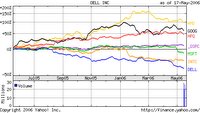
Too, Gomes only references a very short timeframe when he writes, "If you chart the stock performance of Dell vs. H-P over the past year, you get a sideways V, with the trend lines moving in opposite directions, and Dell on the bottom heading lower." He mentions the other pairs, listed above, as having similar relationships of charted performance. I've included a Yahoo-sourced chart of all pairs on the left. The S&P500, by the way, bisects the pairs, three above, three below, for the one-year view.
Now, look at a much longer term chart of the same companies, again, with the S&P500 for reference.
What was particularly nice was his mention at the end of his piece of three pairs of companies whom I, too, have discussed recently: AMD & Intel, Google & Microsoft, HP & Dell.
However, whereas I attribute the performances to Schumpeterian dynamics, Gomes, who is primarily a technology writer, merely writes, "something seems to be in the air: Formerly bulletproof business models are fissuring under the pressure of new and unexpected competition."
Well, unexpected if you don't read Schumpeter, and/or have the benefit of my proprietary performance research using thousands of large-cap equity observations over many years. Or haven't bothered even a cursory look at the fate of top technology companies going back to even just the 1960s.

Too, Gomes only references a very short timeframe when he writes, "If you chart the stock performance of Dell vs. H-P over the past year, you get a sideways V, with the trend lines moving in opposite directions, and Dell on the bottom heading lower." He mentions the other pairs, listed above, as having similar relationships of charted performance. I've included a Yahoo-sourced chart of all pairs on the left. The S&P500, by the way, bisects the pairs, three above, three below, for the one-year view.
Now, look at a much longer term chart of the same companies, again, with the S&P500 for reference.
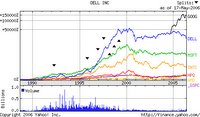
The slopes of the lines approximate the total returns for these stocks, as their dividends tend to be minimal. While it is clear that things never returned to pre-bubble levels for Dell, Intel, and Microsoft after 2000, the stories for the other three are by no means all alike.
What this view demonstrates is that Dell, Intel and Microsoft have taken their shareholders to places AMD and H-P have yet to go, and Google has been for a still-brief time. You have to give the former triumvirate their due for wringing tremendous shareholder returns out of a decade of dominance of the PC market.
To look at just the last year and pronounce them failures, and that 'something seems to be in the air,' is to misunderstand the fundamental nature of company and product lifecycles in technology sectors. Dell, Intel and Microsoft steamrolled their competitors in their heydays. But those days are over. And what is occurring now is by no means "unexpected."
Further, it's not like all three better performers have blunted the older business models of the now-worse-performing three firms. HP has only managed to regain traction in its markets, and to quote an old song, "been down so long, it looks like up to me." AMD has taken advantage of Intel's inability to now manage further technological hegemony in chip making with its resultant size and diversity of product/markets. But AMD languished for decades as a poor performer prior to this.
Google is the one company which represents a greenfield entry which has piggybacked on the environment created by Microsoft, Intel and Dell. But it is also the shortest-lived case of the six. I would say the jury is still out regarding the long term path Google will actually take.
In conclusion, Gomes does a nice job highlighting the recent, resulting total returns and business situations of these pairs of competitors. However, in expressing surprise, he unfortunately displays a shallow grasp of fundamental business dynamics discovered 80 years ago by Joseph Schumpeter. I think we can expect more from a featured columnist of the country's best business daily.
Don't you?
"Forget the S&P" as a Benchmark ?
My partner recently called my attention to Jonathan Clement's piece in the Wall Street Journal which decried the use of the S&P500 as a performance benchmark for portfolios. Actually, it's not quite that simple. Clements seemed to both lampoon the use of, and then use, anyway, the S&P500 as a performance benchmark for various fund styles, and whole portfolios of multiple instruments.
My partner lamented, and I agree, the piece was so obtusely written as to almost defy analysis, let alone understanding.
Mr. Clements begins by stating that many readers of his column have contacted him to crow about their investments having beaten the S&P recently. Clements goes on to state that,
"... I don't believe they're investment geniuses. Here's why beating the S&P 500 is no great accomplishment......In fact, if you haven't outpaced the S&P 500 over the past five or six years, something is likely seriously wrong with your investment strategy. After all, as part of a well-diversified portfolio, you ought to spread your money across large stocks, smaller companies, foreign markets and bonds. Any mix of that kind should have handily beaten the S&P 500."
Well, yes. Let's just forget about risk, and timing. And while we're at it, lets compare the return of various asset classes as if they are all equal. And the brief time period over which the observations are taken.
Clements bounces between lecturing on using the proper benchmark for each type of investment and mutual fund style, and then saying you should compare your entire investment return, across all instruments, to the S&P500. On that basis, he dismisses outperforming the S&P as child's play.
Later, in the article, he talks about how is IRA account has handily beaten the S&P, but then admits its is in "small stocks and foreign markets, both of which have easily outpaced the S&P 500."
Again, let's forget about how much more risk is typically found in foreign markets, or small stocks, too, for that matter. It's not a fair comparison by any means, and certainly not significant over very short timeframes.
Professional portfolio managers undrestand that the S&P500 is an appropriate benchmark for large-cap equity portfolios. Period. For hedged funds, it's cash. For bond funds, I would guess it's some variant on a popularly tracked bond index. Why Clements thinks anyone has implied more than this is beyond me.
What dismays and disappoints me about this muddled, wrong-headed piece by Clements about investment performance, is that it's in a large, broadly distributed, reputable business daily- the Wall Street Journal. And Clements writes a weekly column on investing.
With "help" like this, you wonder if most individuals can just preserved their capital over time, let alone actually make money. We see now just how sadly missed Lou Rukeyser will be.
My partner lamented, and I agree, the piece was so obtusely written as to almost defy analysis, let alone understanding.
Mr. Clements begins by stating that many readers of his column have contacted him to crow about their investments having beaten the S&P recently. Clements goes on to state that,
"... I don't believe they're investment geniuses. Here's why beating the S&P 500 is no great accomplishment......In fact, if you haven't outpaced the S&P 500 over the past five or six years, something is likely seriously wrong with your investment strategy. After all, as part of a well-diversified portfolio, you ought to spread your money across large stocks, smaller companies, foreign markets and bonds. Any mix of that kind should have handily beaten the S&P 500."
Well, yes. Let's just forget about risk, and timing. And while we're at it, lets compare the return of various asset classes as if they are all equal. And the brief time period over which the observations are taken.
Clements bounces between lecturing on using the proper benchmark for each type of investment and mutual fund style, and then saying you should compare your entire investment return, across all instruments, to the S&P500. On that basis, he dismisses outperforming the S&P as child's play.
Later, in the article, he talks about how is IRA account has handily beaten the S&P, but then admits its is in "small stocks and foreign markets, both of which have easily outpaced the S&P 500."
Again, let's forget about how much more risk is typically found in foreign markets, or small stocks, too, for that matter. It's not a fair comparison by any means, and certainly not significant over very short timeframes.
Professional portfolio managers undrestand that the S&P500 is an appropriate benchmark for large-cap equity portfolios. Period. For hedged funds, it's cash. For bond funds, I would guess it's some variant on a popularly tracked bond index. Why Clements thinks anyone has implied more than this is beyond me.
What dismays and disappoints me about this muddled, wrong-headed piece by Clements about investment performance, is that it's in a large, broadly distributed, reputable business daily- the Wall Street Journal. And Clements writes a weekly column on investing.
With "help" like this, you wonder if most individuals can just preserved their capital over time, let alone actually make money. We see now just how sadly missed Lou Rukeyser will be.
Tuesday, May 16, 2006
Gates' and Otelilini's WSJ Op-Ed Piece
Yesterday's Wall Street Journal featured an op-ed piece jointly written by Bill Gates, "chairman and "chief software architect of Microsoft," and Paul Otellini, president and CEO of Intel.
Their letter was apparently a rejoinder to a piece in the WSJ's technology column, written by Walt Mossberg, extolling Apple's 'closed system' approach as now edging out the older, Wintel 'open system' in terms of popularity.
What I find very telling is the authors' confusion between the continued usage of PCs, and their ability to command premium value anymore. It's not so much the "end of the PC era," anymore than the influx of Japanese imports marked the "end of the automobile" era.
As I've written previously in my blog, both Microsoft and Intel are at the end of long periods of having dominanted their respective product spaces. By virtue of their dominances, they have changed the environment within which their firms, and their products, operate.
I don't think anyone seriously believes PCs and laptops are going away anytime soon. However, just like modern automobiles, though, they will probably last longer, offer more features for less money, and, in general, work better with other devices than they have in the past. The pace of replacement of boxes and operating systems is certainly slowing now, in comparison to the past.
If these trends were not occurring, then the PC probably would become obsolete, due to its having walled itself off from the need for customers to connect various devices and media across the internet and their own systems. As it is, the value-adding damage has already been done to PC systems and their software and hardware components.
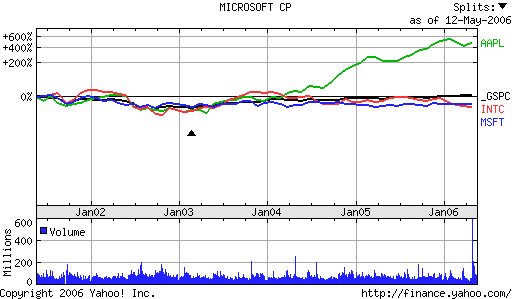
See the chart at the top of this piece for the visual confirmation. It shows Apple pulling away from Microsoft, Intel and the S&P500 beginning in 2004.
It would be fun to speculate on the discussions leading up to the WSJ letter by Gates and Otellini. Better still, to listen in on their conversations and see the drafts. Clearly, they felt a gauntlet had been thrown down, challenging their companies' relevance as being at the heart of today's digitalization trends. It's noteworthy that all it took was a guy who writes a weekly technology column in a business newspaper to spark this reaction from the two company leaders.
Gates' and Otellini's protestations notwithstanding, there is far more activity in application-specific digital devices (digital music players, cellphones, PDAs, etc) and internet connectivity than there is in necessary, but basic, PC systems. Rather than, as their piece asserted, it being the "end of the beginning" for the PC, it may simply now mark the arrival of the device as a low-priced electronic appliance with little more capacity for functionality growth that is not due to some other devices produced by other companies.
Monday, May 15, 2006
HP "vs" Dell
Last week, CNBC made much of Hewlett-Packard's recent short-term revival, and contrasted it with Dell's recent weakness. The latter's revenues have been falling short of expectations, and its total returns are no longer consistently market-beating. I even wrote recently of the positive signs in the nature of the way Mark Hurd seems to be changing HP.

As the five-year price chart from Yahoo above clearly shows, HP has been on a consistently superior total return path for nearly 5 years, and from a serious trough for the last 3-4 years. In contrast, Dell has been flat or declining, both absolutely and relatively, for about 2 1/2 years.
Yes, for the recent period, Dell has seemed played out. Exhausted in the sense of a business model with little headroom for profitably surprising the market.However, as I observed about Intel recently, let me do so for Dell now. Take a look at the Yahoo-sourced long term performance chart below.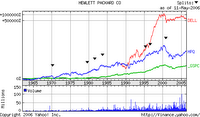
For an entire decade, Dell out-performed HP, the S&P500, and not a few other tech companies with its solid business concept and nearly-flawless execution thereof. Isn't a decade enough? This company has excelled, in what should have been, and was, a very tough product/market segment, for much longer than should have been expected. Than is the norm.
To look at just the last 5 years is to seriously misunderstand both business history, and Schumpterian dynamics. Dell is probably not "coming back," anymore than Microsoft or Intel are. That is, it's unlikely that any of the three will soon post a consistently superior total return record, versus the S&P500, on the back of consistently superior revenue growth.
But this in no way diminishes their prior accomplishments. In fact, it is those accomplishments which have brought them to this point. Microsoft has played out its "technology," for the most part. Intel is stretched amongst separating customer segments, while its once-weaker rival, AMD, focuses on profitable opportunities with laser-like precision. Dell simply has little room left to exploit its vaunted direct-sales model, amidst the increasing commoditization of its main products, desktop and laptop PCs.
The funny thing about the second chart, to me, at least, is that, if not for Dell, you'd think HP had done very well. And never really "in trouble" until these last few years. It just shows how moderated our expectations can get, and how we sometimes forget what "really" excellent performance looks like.In fact, in hindsight, you would have been happy holding both for a decade.But who knew in advance? And, of course, it's always easier in hindsight to see the end of a holding period than it is when you're actually doing it.
Saturday, May 13, 2006
More Market Reactions from the Herd
It appears that investors are now in the grip of panic, amidst a healthily growing global economy. The source of that panic is the Federal Reserve. In particular, the new chairman, Ben Bernanke, has investors paralytic with fear that each new datum of global and/or US economic growth will cause Bernanke to ratchet up US interest rates even more, choking off said growth.
Further, economists seem now to be in two camps regarding the pace of the Fed’s tightening over the last two years or so. Some feel the Fed is still “catching up” with inflation, and has to tighten even more to become “neutral.” Others, however, feel that the Fed has already over-tightened, and needs to abate its increases before killing the US and global growth now in effect.
This week’s market index performance consisted of two lightly traded, insignificant days prior to the Fed meeting. On Wednesday, although up in the morning, the market, ended the day down, on the Fed’s rate increase news. Our portfolio, however, enjoyed a nearly .5 percentage point gain. Over the next two days, however, investors apparently became gloomier and gloomier, prompting a market sell-off which resulted in the loss of 2.4 percentage points of return. Growth stocks, including those in our portfolio, primarily energy, whose prices also sank, on fears of global growth abating, fell even more in these last two days. Considering the market’s reaction, it’s surprising our large-cap growth portfolio ended Friday down less than 1% more than the index for the week.
Even non-energy issues such as Apple and Whole Foods declined. Network Appliances fell by slightly more than 10%. BJ Services, EOG and Sunoco all declined between 6% and 10% for the week.
Seriously, did anything tangible really occur last week to drive long term values of companies like these down 10% in a few days? Doubtful. Perceived "spot" values amidst confused interpretations of Fed moves, yes.
As I look at the monthly portfolio returns for this year, one thought occurs to me. Over the past nine months, the major global economic story has been the rise of many commodity prices, including forms of energy, in the face of rising, legitimate demand levels. Nobody’s turning oil spigots off, blockading copper or titanium shipments, or refusing to sell or ship other basic industrial commodities.
The past few months have seen investors apparently uncertain with respect to what the Fed will do in reaction to US housing prices and, then, overall global demand. However, absent Fed actions to permanently dent growth and throw us back into a recession, it’s only a matter of time before energy and other growth-oriented issues once again become higher valued. Overall, it seems to me that the index’s 3.4% return under-represents the true strength of economic prospects. So long as the market is in one of those “there will never be growth again that is not punished by the Fed,” neither our growth-oriented portfolio, nor the market, is likely to move up sharply.
However, when investors come to realize that strong, low-inflation global growth does, indeed, exist, the market will move up. Remember last year's spring "soft patch?" The illusionary economic pause turned out not to be reall, and by June, the market took off on a tear. Our portfolio zoomed ahead, as it typically does during periods of realized healthy economic growth. Having seen this situation time and again, I suspect it will recur this summer.
Right now, a lot of mediocre analysts are trying to interpret and guess the behavior of some really intelligent, skilled people, i.e., the Fed Governors. Thus, we'll likely see a lot more senseless volatility and navel-gazing, until the global growth data and lack of inflationary effects of energy and other commodity prices are obvious. Some things don't seem to change.
Further, economists seem now to be in two camps regarding the pace of the Fed’s tightening over the last two years or so. Some feel the Fed is still “catching up” with inflation, and has to tighten even more to become “neutral.” Others, however, feel that the Fed has already over-tightened, and needs to abate its increases before killing the US and global growth now in effect.
This week’s market index performance consisted of two lightly traded, insignificant days prior to the Fed meeting. On Wednesday, although up in the morning, the market, ended the day down, on the Fed’s rate increase news. Our portfolio, however, enjoyed a nearly .5 percentage point gain. Over the next two days, however, investors apparently became gloomier and gloomier, prompting a market sell-off which resulted in the loss of 2.4 percentage points of return. Growth stocks, including those in our portfolio, primarily energy, whose prices also sank, on fears of global growth abating, fell even more in these last two days. Considering the market’s reaction, it’s surprising our large-cap growth portfolio ended Friday down less than 1% more than the index for the week.
Even non-energy issues such as Apple and Whole Foods declined. Network Appliances fell by slightly more than 10%. BJ Services, EOG and Sunoco all declined between 6% and 10% for the week.
Seriously, did anything tangible really occur last week to drive long term values of companies like these down 10% in a few days? Doubtful. Perceived "spot" values amidst confused interpretations of Fed moves, yes.
As I look at the monthly portfolio returns for this year, one thought occurs to me. Over the past nine months, the major global economic story has been the rise of many commodity prices, including forms of energy, in the face of rising, legitimate demand levels. Nobody’s turning oil spigots off, blockading copper or titanium shipments, or refusing to sell or ship other basic industrial commodities.
The past few months have seen investors apparently uncertain with respect to what the Fed will do in reaction to US housing prices and, then, overall global demand. However, absent Fed actions to permanently dent growth and throw us back into a recession, it’s only a matter of time before energy and other growth-oriented issues once again become higher valued. Overall, it seems to me that the index’s 3.4% return under-represents the true strength of economic prospects. So long as the market is in one of those “there will never be growth again that is not punished by the Fed,” neither our growth-oriented portfolio, nor the market, is likely to move up sharply.
However, when investors come to realize that strong, low-inflation global growth does, indeed, exist, the market will move up. Remember last year's spring "soft patch?" The illusionary economic pause turned out not to be reall, and by June, the market took off on a tear. Our portfolio zoomed ahead, as it typically does during periods of realized healthy economic growth. Having seen this situation time and again, I suspect it will recur this summer.
Right now, a lot of mediocre analysts are trying to interpret and guess the behavior of some really intelligent, skilled people, i.e., the Fed Governors. Thus, we'll likely see a lot more senseless volatility and navel-gazing, until the global growth data and lack of inflationary effects of energy and other commodity prices are obvious. Some things don't seem to change.
Friday, May 12, 2006
A Corporate Governance Thought Experiment: Part 1
Since November of last year, I have written 9 pieces on this blog concerning CEO compensation, and 8 concerning "corporate governance." There was a bit of overlap between them, so it's maybe a total of 15 pieces.
In some discussions with my partner and a few other friends recently, I've begun to form a new view of the overall notion of "corporate governance." Simply put, if the "corporation" is viewed, legally, as an ongoing "person," then perhaps what is needed is an explicit articulation of when that "person" needs to be put down. And, thus, how the company should be seen as dispersing its genetic material in order to continue to grow the value of its owners' capital investments.
When I put forth this notion to a consultant friend, she replied that 'there are already spinoffs.' However, I feel these have been historically done ad hoc, sometimes from outside pressure, less often from internal calculation. Or, even worse, under pressure from investment bankers, whose focus is always fees, and rarely, if ever, sustained superior performance of businesses to which they offer their "services." The answer isn't just "spinoffs," but, rather, how the entire notion of value preservation and transference, then growth, is perceived over time for a company's shareholders.
So, let me begin with a thought experiment, the first part of which I will post here. Suppose I had empirical evidence that demonstrated, based on many researched cases, that a specific pattern of revenue and profit growth, and consistently superior total return performance, which then flattened, was statistically unlikely to ever regain its former growth rate?
In such cases, would it not be sensible for a board to plan for the point at which the company begins to consciously cease to spend its resources on the parent's poor growth prospects, and, in a conscious, organized manner, deliberately identify, spinout and exploit various attractive businesses from the parent? Not in a reactive mode, but as part of a conscious plan to provide shareholders with the best chance of continued consistently superior returns from the seeds planted by the parent company.
There is a flip side to this challenge. That is, the large company which is now in a mature product/market, generating more cash than it can invest at similar returns in its existing businesses. My partner and I discussed the most obvious example of this situation- GM in the late 1980s, when it stumbled into buying EDS and Hughes. Both moves were, at the time, criticized as questionable, given the corporate charter of GM, and its existing business focus. Now, of course, it's laughable to think that they truly made those deals. But think of how much better off GM might be today, had it put as much energy into understanding and managing its automotive business as it did in making distracting acquisitions. Other examples which come to mind are the lockstep purchase of PBMs by major pharmaceutical companies in the last decade, only to see most of them unwound later. Who knows how much that distraction cost Merck, which now struggles just to maintain momentum in its main business?
To successfully manage such explicit transitions of value sources from a parent to a spinoff, of course, compensation plans and executive selections would need to reflect the evolution of the company's focus from self-growth, to propagating offspring ventures, while slowly winding down the parent.
Again, as a thought experiment, one can envision changing the staffing and compensation, so that revenue growth in the existing company becomes secondary to launching sustainable ventures which are not in the main area of the parent's business, as well as increasing profits. In essence, rather than have a management attempt to grow a mature business, perhaps shareholders are better served by an explicit exit strategy which rewards the 'right' behaviors, including, at some point, merging or selling the parent in what would have, by then, likely become a commodity business.
Such a strategy would not necessarily, or even likely, be possible for all consistently superior-performing companies. For instance, just now, amidst this week's various technology-related stories in the business media, I would constrast Microsoft, Intel, and Dell. Based upon their technological developments over the years, I believe Microsoft and Intel would be candidates for my concept of explicit evolution of a company to propagate worthwhile spinoffs. In fact, as I discussed with my partner last week, these companies, with their internal venture capital units in the late 1990s, probably were on the right track. They just looked in the wrong places- outside, rather than inside.
Dell, however, as an assembler and retailer, is unlikely to have much in the way of value to propagate beyond its own enterprise.
At this point, I'll end the first part of this idea, and continue it in a future post.
In some discussions with my partner and a few other friends recently, I've begun to form a new view of the overall notion of "corporate governance." Simply put, if the "corporation" is viewed, legally, as an ongoing "person," then perhaps what is needed is an explicit articulation of when that "person" needs to be put down. And, thus, how the company should be seen as dispersing its genetic material in order to continue to grow the value of its owners' capital investments.
When I put forth this notion to a consultant friend, she replied that 'there are already spinoffs.' However, I feel these have been historically done ad hoc, sometimes from outside pressure, less often from internal calculation. Or, even worse, under pressure from investment bankers, whose focus is always fees, and rarely, if ever, sustained superior performance of businesses to which they offer their "services." The answer isn't just "spinoffs," but, rather, how the entire notion of value preservation and transference, then growth, is perceived over time for a company's shareholders.
So, let me begin with a thought experiment, the first part of which I will post here. Suppose I had empirical evidence that demonstrated, based on many researched cases, that a specific pattern of revenue and profit growth, and consistently superior total return performance, which then flattened, was statistically unlikely to ever regain its former growth rate?
In such cases, would it not be sensible for a board to plan for the point at which the company begins to consciously cease to spend its resources on the parent's poor growth prospects, and, in a conscious, organized manner, deliberately identify, spinout and exploit various attractive businesses from the parent? Not in a reactive mode, but as part of a conscious plan to provide shareholders with the best chance of continued consistently superior returns from the seeds planted by the parent company.
There is a flip side to this challenge. That is, the large company which is now in a mature product/market, generating more cash than it can invest at similar returns in its existing businesses. My partner and I discussed the most obvious example of this situation- GM in the late 1980s, when it stumbled into buying EDS and Hughes. Both moves were, at the time, criticized as questionable, given the corporate charter of GM, and its existing business focus. Now, of course, it's laughable to think that they truly made those deals. But think of how much better off GM might be today, had it put as much energy into understanding and managing its automotive business as it did in making distracting acquisitions. Other examples which come to mind are the lockstep purchase of PBMs by major pharmaceutical companies in the last decade, only to see most of them unwound later. Who knows how much that distraction cost Merck, which now struggles just to maintain momentum in its main business?
To successfully manage such explicit transitions of value sources from a parent to a spinoff, of course, compensation plans and executive selections would need to reflect the evolution of the company's focus from self-growth, to propagating offspring ventures, while slowly winding down the parent.
Again, as a thought experiment, one can envision changing the staffing and compensation, so that revenue growth in the existing company becomes secondary to launching sustainable ventures which are not in the main area of the parent's business, as well as increasing profits. In essence, rather than have a management attempt to grow a mature business, perhaps shareholders are better served by an explicit exit strategy which rewards the 'right' behaviors, including, at some point, merging or selling the parent in what would have, by then, likely become a commodity business.
Such a strategy would not necessarily, or even likely, be possible for all consistently superior-performing companies. For instance, just now, amidst this week's various technology-related stories in the business media, I would constrast Microsoft, Intel, and Dell. Based upon their technological developments over the years, I believe Microsoft and Intel would be candidates for my concept of explicit evolution of a company to propagate worthwhile spinoffs. In fact, as I discussed with my partner last week, these companies, with their internal venture capital units in the late 1990s, probably were on the right track. They just looked in the wrong places- outside, rather than inside.
Dell, however, as an assembler and retailer, is unlikely to have much in the way of value to propagate beyond its own enterprise.
At this point, I'll end the first part of this idea, and continue it in a future post.
Thursday, May 11, 2006
Incomes Disparity: A Silver Lining
The Wall Street Journal featured an op-ed piece last week by two members of the President's Council of Economic Advisers, Edward Lazear and Katherine Baicker. Their article discussed recent job growth, wages growth, and per capita personal disposable income growth.
What was noteworthy is that the authors debunked the notion that most of the benefits of this growth are enjoyed by "the rich," and not "the poor." Rather, they found that college-educated wage-earners saw their earnings grow by 22% since 1980, while those of high-school drop-outs declined by 3% for the same period.
Thus, not unexpectedly, becoming wealthier, or earning more money, in our society is dependent upon education-based skills. This is no bad thing. I'd be much more worried about foreign competitive pressures if we learned that most wage growth was for only high school-graduated workers.
If anything, this should renew our government's focus on how to productively engage teachers' unions to help improve education, rather than simply siphon off more public tax dollars on teacher compensation. Failure to promote competent students to the college level, and beyond, is a real threat to our economic strength.
Rather than worry about the apparent disparity in wages among "classes," which is somewhat tautological, doesn't it make more sense to understand the reason for shrinking wages, and work to eliminate the cause- lack of adequate educational quality?
What was noteworthy is that the authors debunked the notion that most of the benefits of this growth are enjoyed by "the rich," and not "the poor." Rather, they found that college-educated wage-earners saw their earnings grow by 22% since 1980, while those of high-school drop-outs declined by 3% for the same period.
Thus, not unexpectedly, becoming wealthier, or earning more money, in our society is dependent upon education-based skills. This is no bad thing. I'd be much more worried about foreign competitive pressures if we learned that most wage growth was for only high school-graduated workers.
If anything, this should renew our government's focus on how to productively engage teachers' unions to help improve education, rather than simply siphon off more public tax dollars on teacher compensation. Failure to promote competent students to the college level, and beyond, is a real threat to our economic strength.
Rather than worry about the apparent disparity in wages among "classes," which is somewhat tautological, doesn't it make more sense to understand the reason for shrinking wages, and work to eliminate the cause- lack of adequate educational quality?
Wednesday, May 10, 2006
Microsoft vs. Google- Again
Yesterday afternoon, CNBC featured a brief debate between two analysts concerning Microsoft's current attempts to "catch" Google in the online advertising business.
One analyst echoed my own feelings and analysis. He said, nearly verbatim, what I discovered and wrote about in a post last fall; that once a technology firm has peaked, it's unlikely to have a successful second act in a new technology.
The other analyst's defense was that Microsoft has large margins in desktop software products, and rakes in huge revenue streams each quarter.
Actually, the two views are not at all mutually exclusive. Consider IBM. When it began to create the desktop PC market, it had large revenue streams and dominated the mainframe market. Yet, those attributes could not save it from a failure to dominate any part of the ensuing PC market in later years.
However, I think there is another reason Microsoft will no longer reward its shareholders with consistently superior total returns. Simply put, Bill Gates is too wealthy. He has no need to worry about financial performance of Microsoft anymore. Ironically, Microsoft now suffers, not from a CEO who owns to little of his firm's stock, but one who owns far too much of it.
Think about this. Gates has, by general estimation, somewhere between $24B and $25B. Let's suppose, for argument's sake, that all of it is in Microsoft stock. Even if Gates' strategy missteps were to cause a 90% drop in the value of the stock, which is far more than would be tolerated before his ouster, he would still be worth about $2.5B. Hardly poverty. I'm not even sure any human can behave differently, once his net worth is north of, say, $500MM.
The risk, then, to Microsoft, is that it now pursues blood feuds at the behest of Gates and Ballmer. Not really feeling the cost of failure, the two leaders of the firm seem to be going after Google "just because."
In contrast to this focus, CNBC aired an interview last week with another analyst who possessed a decidedly contrarian view. He instantly caught my attention.
This analyst maintains that Microsoft made a serious blunder in entering browsers to begin with, and has doubled up on the mistake by now pursuing online advertising. He pointed out that it has had a virtually monopoly in desktop operating systems, but has left that product class poorly served. An example of his contention was the one I mentioned recently here, of my partner failing to get IE7.0 to install on his XP-run laptop. Thus, fissures have opened within the desktop world for all sorts of products that fix Microsoft operating system failings and omissions. Surely, Microsoft could have been creating smaller, additional revenue streams with subsequent version enhancements all these years, while building an ever more solid position in the desktop OS world.
Well, that ship has sailed. And, instead, Microsoft shareholders are buckled in for a wild ride, as the firm's leading billionaire, and his henchman, go tilting after the Google windmills.
As SpongeBob would say, "Good luck with that!"
One analyst echoed my own feelings and analysis. He said, nearly verbatim, what I discovered and wrote about in a post last fall; that once a technology firm has peaked, it's unlikely to have a successful second act in a new technology.
The other analyst's defense was that Microsoft has large margins in desktop software products, and rakes in huge revenue streams each quarter.
Actually, the two views are not at all mutually exclusive. Consider IBM. When it began to create the desktop PC market, it had large revenue streams and dominated the mainframe market. Yet, those attributes could not save it from a failure to dominate any part of the ensuing PC market in later years.
However, I think there is another reason Microsoft will no longer reward its shareholders with consistently superior total returns. Simply put, Bill Gates is too wealthy. He has no need to worry about financial performance of Microsoft anymore. Ironically, Microsoft now suffers, not from a CEO who owns to little of his firm's stock, but one who owns far too much of it.
Think about this. Gates has, by general estimation, somewhere between $24B and $25B. Let's suppose, for argument's sake, that all of it is in Microsoft stock. Even if Gates' strategy missteps were to cause a 90% drop in the value of the stock, which is far more than would be tolerated before his ouster, he would still be worth about $2.5B. Hardly poverty. I'm not even sure any human can behave differently, once his net worth is north of, say, $500MM.
The risk, then, to Microsoft, is that it now pursues blood feuds at the behest of Gates and Ballmer. Not really feeling the cost of failure, the two leaders of the firm seem to be going after Google "just because."
In contrast to this focus, CNBC aired an interview last week with another analyst who possessed a decidedly contrarian view. He instantly caught my attention.
This analyst maintains that Microsoft made a serious blunder in entering browsers to begin with, and has doubled up on the mistake by now pursuing online advertising. He pointed out that it has had a virtually monopoly in desktop operating systems, but has left that product class poorly served. An example of his contention was the one I mentioned recently here, of my partner failing to get IE7.0 to install on his XP-run laptop. Thus, fissures have opened within the desktop world for all sorts of products that fix Microsoft operating system failings and omissions. Surely, Microsoft could have been creating smaller, additional revenue streams with subsequent version enhancements all these years, while building an ever more solid position in the desktop OS world.
Well, that ship has sailed. And, instead, Microsoft shareholders are buckled in for a wild ride, as the firm's leading billionaire, and his henchman, go tilting after the Google windmills.
As SpongeBob would say, "Good luck with that!"
Tuesday, May 09, 2006
Wachovia's Acquisition

Wachovia Bank announced its intention to acquire Golden West Financial. It will be a non-hostile takeover.
The shareholders of GDW should be happy with their premium. By contrast, Wachovia's shares fell on the news.
Per my prior post on this topic, I wonder what long-term value will be created by this further concentration of financial businesses into an even larger utility.
As the five year chart of Wachovia's stock price demonstrates, it has, indeed, outperformed the S&P over the time period, although most of that outperformance was in the early years of the period. This causes me to think that Wachovia may, indeed, now begin to see its total return performance wind down to that of the other three large financial utilities about which I wrote recently: Chase, Citigroup and BofA.
One has to wonder what, other than money, Wachovia brings to the Golden West operation? Decentralized control of the new entity seems almost too much to ask, for such a large acquisition. Of course, centralizing more control of the new subsidiary is bound to cause some disruptions in the performance which evidently so captivated Wachovia's leadership.
Either way, it looks like there's now room for some new, more nimble mortgage lenders in the West Coast market.
Monday, May 08, 2006
"....Because the Light Is Better Over Here......"
There was a very nicely done, extended video obituary of Lou Rukeyser on CNBC last Friday night.
True to form, Maria Bartiromo added only some pensive looks and a few head bobs. No original thoughts. Rather, she seemed engaged in playing traffic cop among people like Tyler Matheson, Bill Griffiths, and selected guests. Then again, this obviated the need for a teleprompter, so she didn't squint or lean forward quite nearly so much as she usually does on camera.
I don't wish to dwell on Maria. Rather, I use her to make a point. It seems that CNBC, and most financial or business television, focus on the the stock exchange. Bartiromo's apparent claim to fame, judging from her CNBC bio, is that she was the first to report live from the floor of the exchange.
Big deal.
This so misleads people regarding "where" the action really happens. It's not on the floor of the exchange. You may as well put a camera on an Amazon warehouse to watch them fill orders off the shelf. Or maybe a Netflix distribution center.
The real action in the markets happens in the offices and at the computers of money management institutions around the globe. It's not sexy, and it's not very "active," from a television point of view.
So, the title of this piece suggests a comparison with the old joke about where to look for a lost quarter. Rather than focus on where the financial news is actually "made", CNBC chooses, instead, to cover what "looks" more like "news." Lots of people shouting and running. Earpiece tightly pressed in by the reporter, looking up at some apparent big screen, then around at the hustle and bustle. Boy, something must be going on there.
If that's true, why did John Thain go to so much trouble to get acquired by.....oops...sorry...buy Archipelago Holdings? All the news you need to know about the markets is on a realtime screen feed of your choosing, for free. Do you really think those people scurrying around the floor of the Exchange are the movers and shakers of the market?
Nope. They are the financial market's equivalent of the driver who brings the Domino pizza to your door. Better paid, but not much different functionally- the last step in an order taking/fulfillment process. And, yes, do check under the box cover to see if you're getting the right pizza...er....order fill.
So, next time you see a breathless reporter or anchor for CNBC, or CNN, etc, on the floor of the NYSE, stop and think about what is really going on in the background. And why you are interested in what the order-takers "think" about the market.
True to form, Maria Bartiromo added only some pensive looks and a few head bobs. No original thoughts. Rather, she seemed engaged in playing traffic cop among people like Tyler Matheson, Bill Griffiths, and selected guests. Then again, this obviated the need for a teleprompter, so she didn't squint or lean forward quite nearly so much as she usually does on camera.
I don't wish to dwell on Maria. Rather, I use her to make a point. It seems that CNBC, and most financial or business television, focus on the the stock exchange. Bartiromo's apparent claim to fame, judging from her CNBC bio, is that she was the first to report live from the floor of the exchange.
Big deal.
This so misleads people regarding "where" the action really happens. It's not on the floor of the exchange. You may as well put a camera on an Amazon warehouse to watch them fill orders off the shelf. Or maybe a Netflix distribution center.
The real action in the markets happens in the offices and at the computers of money management institutions around the globe. It's not sexy, and it's not very "active," from a television point of view.
So, the title of this piece suggests a comparison with the old joke about where to look for a lost quarter. Rather than focus on where the financial news is actually "made", CNBC chooses, instead, to cover what "looks" more like "news." Lots of people shouting and running. Earpiece tightly pressed in by the reporter, looking up at some apparent big screen, then around at the hustle and bustle. Boy, something must be going on there.
If that's true, why did John Thain go to so much trouble to get acquired by.....oops...sorry...buy Archipelago Holdings? All the news you need to know about the markets is on a realtime screen feed of your choosing, for free. Do you really think those people scurrying around the floor of the Exchange are the movers and shakers of the market?
Nope. They are the financial market's equivalent of the driver who brings the Domino pizza to your door. Better paid, but not much different functionally- the last step in an order taking/fulfillment process. And, yes, do check under the box cover to see if you're getting the right pizza...er....order fill.
So, next time you see a breathless reporter or anchor for CNBC, or CNN, etc, on the floor of the NYSE, stop and think about what is really going on in the background. And why you are interested in what the order-takers "think" about the market.
Sunday, May 07, 2006
Gates & Microsoft In the News Again
It was a big week for Microsoft. Well, a big ten days, if you count the 11% selloff of two Fridays ago, when Microsoft reported larger than expected expenses, sending the stock's price plunging.
But this week saw two different, but, to my mind, reinforcing glimpses of a Microsoft grown overly-large and in trouble.
The first was a Wall Street Journal piece on Thursday, detailing the company's development of its "adCenter" service. This is Microsoft's response to Google's AdSense program. The WSJ piece contained this quote from Microsoft's Senior Director Joe Doran, 'Microsoft's efforts in online advertising are equivalent to building a whole new company.' This passages was paraphrased in the WSJ, and the italics are mine. Doran was further quoted, "I feel confident we are making the right investment decisions." This is, by the way, part of the $2B investment which the article notes Microsoft will spend on development next year. The so called "far more than expected," according to analysts, which sent the stock plummeting two Friday's ago.
As I wrote last fall in a post about Gates and Steve Jobs, and their respective business efforts, I believe this entire approach by Gates and Microsoft will fail to reignite the firm's total return performance. The reason is the same as I articulated in the prior post, even considering that now the subject is a clone of Google's AdSense.
My friend S, the consultant to whom I referred in my recent Intel posts, and I discussed this point. She expressed disbelief that anything could really be different if Microsoft spent the same money on a separately-organized and funded effort that was physically and organizationally removed from the parent. I remain convinced it would.
How many of us have not worked in very large corporations, and watched how cultural forces mangle, compromise and choke the life out of new initiatives?
Microsoft is primarily a desktop software company. That is where it has made the bulk of its money, and produced the bulk of its deliverables. Trying to suddenly graft "online" onto it is a mistake.
As an example of this, my partner regaled me yesterday with his tale of attempting to install the new MS Internet Explorer browser version on his computer. It wasn't pretty. Firefox installed in a few minutes, flawlessly. He told me IE took 40 minutes, with multiple reboots every time the program failed to mesh with its own firm's registry software. Can it get much more pathetic than that? Microsoft controls both the OS and the browser, to the consternation of the regulatory authorities, and still can't get them to work together seamlessly.
This type of legacy penalty is part of the reason why I see Microsoft falling way short of its objectives of stopping Google's domination of the online advertising business. The other, of course, is simply the stifling culture of a behemoth now grown large and less nimble.
Complementing this story is what I saw in the brief clips of Bill Gates being interviewed by Donnie Deutsch on Friday. Suffice to say, Bill doesn't inspire much fear or confidence in Microsoft's new objective of taking on Google. When asked what he'd tell the Google execs, were they in the audience, Bill replied, smiling nervously, "we're going to keep them honest."
Wow, talk about killer goals. He's going to 'keep 'em honest.' I'll bet Serge is quaking in his boots after that warning!
Bill went on to babble about "having fun," how all the researchers in the Microsoft labs are "having fun" working on online and advertising services. That Bill and the whole firm are still "having fun." Nary a single word about profit, growth, or total returns.
Not being a Microsoft shareholder, this doesn't really bother me. But if I were, "having fun" would not be the main objective I'd be wanting to hear from Chairman Bill. I think his billions have finally dulled his instincts for profitable competition. Now, it looks like he's just using public funding to boost his ego and settle competitive business grudges.
But this week saw two different, but, to my mind, reinforcing glimpses of a Microsoft grown overly-large and in trouble.
The first was a Wall Street Journal piece on Thursday, detailing the company's development of its "adCenter" service. This is Microsoft's response to Google's AdSense program. The WSJ piece contained this quote from Microsoft's Senior Director Joe Doran, 'Microsoft's efforts in online advertising are equivalent to building a whole new company.' This passages was paraphrased in the WSJ, and the italics are mine. Doran was further quoted, "I feel confident we are making the right investment decisions." This is, by the way, part of the $2B investment which the article notes Microsoft will spend on development next year. The so called "far more than expected," according to analysts, which sent the stock plummeting two Friday's ago.
As I wrote last fall in a post about Gates and Steve Jobs, and their respective business efforts, I believe this entire approach by Gates and Microsoft will fail to reignite the firm's total return performance. The reason is the same as I articulated in the prior post, even considering that now the subject is a clone of Google's AdSense.
My friend S, the consultant to whom I referred in my recent Intel posts, and I discussed this point. She expressed disbelief that anything could really be different if Microsoft spent the same money on a separately-organized and funded effort that was physically and organizationally removed from the parent. I remain convinced it would.
How many of us have not worked in very large corporations, and watched how cultural forces mangle, compromise and choke the life out of new initiatives?
Microsoft is primarily a desktop software company. That is where it has made the bulk of its money, and produced the bulk of its deliverables. Trying to suddenly graft "online" onto it is a mistake.
As an example of this, my partner regaled me yesterday with his tale of attempting to install the new MS Internet Explorer browser version on his computer. It wasn't pretty. Firefox installed in a few minutes, flawlessly. He told me IE took 40 minutes, with multiple reboots every time the program failed to mesh with its own firm's registry software. Can it get much more pathetic than that? Microsoft controls both the OS and the browser, to the consternation of the regulatory authorities, and still can't get them to work together seamlessly.
This type of legacy penalty is part of the reason why I see Microsoft falling way short of its objectives of stopping Google's domination of the online advertising business. The other, of course, is simply the stifling culture of a behemoth now grown large and less nimble.
Complementing this story is what I saw in the brief clips of Bill Gates being interviewed by Donnie Deutsch on Friday. Suffice to say, Bill doesn't inspire much fear or confidence in Microsoft's new objective of taking on Google. When asked what he'd tell the Google execs, were they in the audience, Bill replied, smiling nervously, "we're going to keep them honest."
Wow, talk about killer goals. He's going to 'keep 'em honest.' I'll bet Serge is quaking in his boots after that warning!
Bill went on to babble about "having fun," how all the researchers in the Microsoft labs are "having fun" working on online and advertising services. That Bill and the whole firm are still "having fun." Nary a single word about profit, growth, or total returns.
Not being a Microsoft shareholder, this doesn't really bother me. But if I were, "having fun" would not be the main objective I'd be wanting to hear from Chairman Bill. I think his billions have finally dulled his instincts for profitable competition. Now, it looks like he's just using public funding to boost his ego and settle competitive business grudges.
Corporate Governance and Corporate Performance
With all the rage over corporate governance these days, I notice the omission of what I believe is the most important aspect of this function: oversight of the corporation's performance for shareholders. This historically has entailed some sort of "maximization of shareholder value," to use the phrase so many of us schooled at graduate schools of business were taught.
But what does that term really mean? When it's applied to a bond, the discounted cash flow formula is appropriate. It's not for equities. There are two reasons for this.
First, a very large number of equities experience growth in earnings which exceed the discount rate, causing the formula to be 'modified,' which, in essence, means it's the wrong formula for the job. Second, when applied to equities, the formula typically entails the use of an assumed "terminal value." This is done to make the math easier, as very distant cash flows begin to have apparently decreasing values, at a rather fast clip, due to the magic of compounding/discounting.
Over lunch with my partner the other day, our discussion of this topic clarified some nuanced points for me. Specifically, the concept or notion of running a company for some "maximized shareholder value" is wrong because of the terminal value implication. I've believed this for quite some time.What I believe is the proper valuation goal for a board, and a CEO, is "consistently superior (to the equity markets, i.e., S&P500) total returns over rolling 4-5 year periods." That is, ideally, a shareholder who buys a share of the firm at any time ought to have an equi-probably expectation of consistently superior total returns during a holding period of several years.
It is not sufficient, I believe, to simply choose, at some point in time, to 'maximize' the firm's value, at that time, for shareholders of record at that time. This would seem to contradict the notion of a continuing enterprise.Thus, if no single point in time is appropriate as that at which value is maximized, the firm should be managed to provide a consistently superior total return for as long a time as it can.
Saturday's Wall Street journal featured an interview with Charles Koch, CEO of the privately-held Koch Industries. Among other interesting passages was this, "...maintaining a business is, in reality, liquidating a business." He went on to refer to Schumpeterian dynamics in the internal management of a business. This is precisely my point. The business of managing a business is typically constant change- investment in, and destruction of, various parts of the business. This supposed ability to "maximize shareholder value" at some point in time is a fiction.
Rather, what should be targeted is as consistent as possible a total return performance which exceeds the market. This is because an investor can always buy the market return very inexpensively via an index fund. Thus, a CEO must offer an investor some reasonable expectation of outperformance of the index, on a consistent basis, in order to merit his company's stock being purchased, rather than the index. Stating that s/he has just "maximized shareholder value" for existing shareholders is hardlly going to attract new shareholders for the longer haul of a company's presumed existence.
Perhaps more companies would exhibit better total returns to investors if their boards focused on this challenge, rather than miscellaneous "governance" processes, or allowing a misguided focus on "maximized shareholder returns."
But what does that term really mean? When it's applied to a bond, the discounted cash flow formula is appropriate. It's not for equities. There are two reasons for this.
First, a very large number of equities experience growth in earnings which exceed the discount rate, causing the formula to be 'modified,' which, in essence, means it's the wrong formula for the job. Second, when applied to equities, the formula typically entails the use of an assumed "terminal value." This is done to make the math easier, as very distant cash flows begin to have apparently decreasing values, at a rather fast clip, due to the magic of compounding/discounting.
Over lunch with my partner the other day, our discussion of this topic clarified some nuanced points for me. Specifically, the concept or notion of running a company for some "maximized shareholder value" is wrong because of the terminal value implication. I've believed this for quite some time.What I believe is the proper valuation goal for a board, and a CEO, is "consistently superior (to the equity markets, i.e., S&P500) total returns over rolling 4-5 year periods." That is, ideally, a shareholder who buys a share of the firm at any time ought to have an equi-probably expectation of consistently superior total returns during a holding period of several years.
It is not sufficient, I believe, to simply choose, at some point in time, to 'maximize' the firm's value, at that time, for shareholders of record at that time. This would seem to contradict the notion of a continuing enterprise.Thus, if no single point in time is appropriate as that at which value is maximized, the firm should be managed to provide a consistently superior total return for as long a time as it can.
Saturday's Wall Street journal featured an interview with Charles Koch, CEO of the privately-held Koch Industries. Among other interesting passages was this, "...maintaining a business is, in reality, liquidating a business." He went on to refer to Schumpeterian dynamics in the internal management of a business. This is precisely my point. The business of managing a business is typically constant change- investment in, and destruction of, various parts of the business. This supposed ability to "maximize shareholder value" at some point in time is a fiction.
Rather, what should be targeted is as consistent as possible a total return performance which exceeds the market. This is because an investor can always buy the market return very inexpensively via an index fund. Thus, a CEO must offer an investor some reasonable expectation of outperformance of the index, on a consistent basis, in order to merit his company's stock being purchased, rather than the index. Stating that s/he has just "maximized shareholder value" for existing shareholders is hardlly going to attract new shareholders for the longer haul of a company's presumed existence.
Perhaps more companies would exhibit better total returns to investors if their boards focused on this challenge, rather than miscellaneous "governance" processes, or allowing a misguided focus on "maximized shareholder returns."
Thursday, May 04, 2006
Maria Bartiromo Joins The Fed?
Perhaps there's a divine message in the news this week. Lou Rukeyser, one of America's most respected financial media personages, passed away yesterday from cancer. Only days after Maria Bartiromo, the Barbara Walters of financial news anchors, allegedly moved markets with her dinner anecdote involving Ben Bernanke. She reported, second-hand, Fed Chairman Ben Bernanke's musings on how the markets interpreted his recent remarks. This allegedly caused a major selloff in the market earlier this week.
If any financial media reporter/commentator should have been the one to be accorded such weight, it should have been Rukeyser. Anyone who watched his public television, later, CNBC, weekly program, understood that he had a thorough command of economics and free market mechanics.
In contrast, anyone who has watched Bartiromo would see that she often has to pause interviews when she can't see her teleprompter, leaning across a table and squinting in mid-interview with some Wall Street worthy. It's as if she has no understanding of her own questions- a sort of human fax machine. The story comes out, but the source has no understanding of what it just produced.
What scares me is that, of all the people to whom Bernanke is alleged to have given such a market-moving scoop, why someone who has trouble reading her own interview questions? Someone evidently so bereft of economic and financial knowledge as to actually pause during interviews, because she doesn't understand the questions she's firing off?
What was Bernanke thinking? If he couldn't find an informed media outlet at a dinner full of them, why didn't he just keep his mouth shut? It's not like this was a taped or recorded interview. Does anyone really think Bernanke meant that apparent remark to be processed in the markets as "information?"
What this demonstrates to me, once again, is the utter meaningless of any one day's market moves. They are addled by such oddities as a financial talking head passing along a chance remark by our Fed Chairman to a financial reporter whom we can't even be sure understood his remarks.
Once again, we see that there will always be daily headlines. Yet, they don't necessarily have any lasting impact beyond a few days' trading trends.
If any financial media reporter/commentator should have been the one to be accorded such weight, it should have been Rukeyser. Anyone who watched his public television, later, CNBC, weekly program, understood that he had a thorough command of economics and free market mechanics.
In contrast, anyone who has watched Bartiromo would see that she often has to pause interviews when she can't see her teleprompter, leaning across a table and squinting in mid-interview with some Wall Street worthy. It's as if she has no understanding of her own questions- a sort of human fax machine. The story comes out, but the source has no understanding of what it just produced.
What scares me is that, of all the people to whom Bernanke is alleged to have given such a market-moving scoop, why someone who has trouble reading her own interview questions? Someone evidently so bereft of economic and financial knowledge as to actually pause during interviews, because she doesn't understand the questions she's firing off?
What was Bernanke thinking? If he couldn't find an informed media outlet at a dinner full of them, why didn't he just keep his mouth shut? It's not like this was a taped or recorded interview. Does anyone really think Bernanke meant that apparent remark to be processed in the markets as "information?"
What this demonstrates to me, once again, is the utter meaningless of any one day's market moves. They are addled by such oddities as a financial talking head passing along a chance remark by our Fed Chairman to a financial reporter whom we can't even be sure understood his remarks.
Once again, we see that there will always be daily headlines. Yet, they don't necessarily have any lasting impact beyond a few days' trading trends.
Monday, May 01, 2006
AMD & Intel: The "Big MO"
Momentum. Consistent Growth.
Who's got it? Who's lost it? What are the behavioral implications within a firm?
In my prior post, I considered why Intel is in the situation it currently faces. Now, I want to consider that situation, in contrast to its chief competitor, AMD.
For most of my early career, I had a friend at Intel. She became an early Intel millionairess, thanks to their Wall Street-style incentive compensation, at least in the early years. I believe she joined the chip maker in 1980 or thereabouts.
Back then, Jerry Sanders was the flamboyant CEO of AMD. He had a very tough job. The only reason AMD existed was that Intel's customers drew the line at being totally subservient to the chip giant. It was one thing to pay high prices to buy new chips on Intel's schedule. It was quite another to have no other option whatsoever. So device customers kept AMD on life support in order to maintain some slender thread of bargaining power with Intel.
How the worm has turned! But, let's be realistic. Today, as I pointed out in my previous post, Intel is a reasonably diversified chip maker. While its core revenue machine is still pc and laptop chips, it has substantial other applications and, thus, product lines. Which is probably what got it into its recent trouble. AMD is still largely, as I understand it, a conventional PC, server and laptop chip supplier.
So, in discussing this with my partner last night, between squash games, I arrived at an insight lost to me for over 20 years. As it struck me, memories of the years I spent at AT&T suddenly came rushing back. Being on a losing, shrinking team is no fun. Life sucks, and career prospects suddenly look very dim. There is a visceral, human behavioral reaction to momentum in business that goes, I believe unnoticed.
Think of what life at AMD must be like right now. You're in the press, more than ever before, as a charging tiger. You've just grown revenues during a period when your always-imposing, larger competitor shrunk! You're the toast of customers everywhere, for actually listening to their needs and creating product for them. How novel! Growth is abundant. Your share is growing in a stable to declining market. So, for you, it's actually a growth market. It's not the same world Intel sees. At all.
Wouldn't you love to see the electronic flow of communications and resumes from Intel employees to their AMD contacts? I can just envision the sapping of emotional energy among young Intel engineers as they face several months of internal witch-hunting...oops....cost cutting, by Paul Otellini & Co. How paralyzing this is going to be for Intel and its employees.
I would hazard to guess that there is now an intangible energy, an initiative, dare I say, advantage, with AMD. They have, as George Bush used to say early in his failed 1976 race for the Republican presidential nomination, the "big mo." I suspect that, coupled with competent management and Intel's self-inflicted wounds, it should make for continued success for the near term at AMD.
It is, once again, a Schumpterian force. It's consistent growth. For AMD, in a positive direction. For Intel, now, in a downward one. My investment style, and my research focus, have always involved consistent business performance. I have found, contrary to what others seem to believe, that it is its own reward. With this recent competitive story developing between Intel and AMD, I think I have also rediscovered an intangible reason why consistency matters. It is its effect upon humans engaged in business endeavors.
Who's got it? Who's lost it? What are the behavioral implications within a firm?
In my prior post, I considered why Intel is in the situation it currently faces. Now, I want to consider that situation, in contrast to its chief competitor, AMD.
For most of my early career, I had a friend at Intel. She became an early Intel millionairess, thanks to their Wall Street-style incentive compensation, at least in the early years. I believe she joined the chip maker in 1980 or thereabouts.
Back then, Jerry Sanders was the flamboyant CEO of AMD. He had a very tough job. The only reason AMD existed was that Intel's customers drew the line at being totally subservient to the chip giant. It was one thing to pay high prices to buy new chips on Intel's schedule. It was quite another to have no other option whatsoever. So device customers kept AMD on life support in order to maintain some slender thread of bargaining power with Intel.
How the worm has turned! But, let's be realistic. Today, as I pointed out in my previous post, Intel is a reasonably diversified chip maker. While its core revenue machine is still pc and laptop chips, it has substantial other applications and, thus, product lines. Which is probably what got it into its recent trouble. AMD is still largely, as I understand it, a conventional PC, server and laptop chip supplier.
So, in discussing this with my partner last night, between squash games, I arrived at an insight lost to me for over 20 years. As it struck me, memories of the years I spent at AT&T suddenly came rushing back. Being on a losing, shrinking team is no fun. Life sucks, and career prospects suddenly look very dim. There is a visceral, human behavioral reaction to momentum in business that goes, I believe unnoticed.
Think of what life at AMD must be like right now. You're in the press, more than ever before, as a charging tiger. You've just grown revenues during a period when your always-imposing, larger competitor shrunk! You're the toast of customers everywhere, for actually listening to their needs and creating product for them. How novel! Growth is abundant. Your share is growing in a stable to declining market. So, for you, it's actually a growth market. It's not the same world Intel sees. At all.
Wouldn't you love to see the electronic flow of communications and resumes from Intel employees to their AMD contacts? I can just envision the sapping of emotional energy among young Intel engineers as they face several months of internal witch-hunting...oops....cost cutting, by Paul Otellini & Co. How paralyzing this is going to be for Intel and its employees.
I would hazard to guess that there is now an intangible energy, an initiative, dare I say, advantage, with AMD. They have, as George Bush used to say early in his failed 1976 race for the Republican presidential nomination, the "big mo." I suspect that, coupled with competent management and Intel's self-inflicted wounds, it should make for continued success for the near term at AMD.
It is, once again, a Schumpterian force. It's consistent growth. For AMD, in a positive direction. For Intel, now, in a downward one. My investment style, and my research focus, have always involved consistent business performance. I have found, contrary to what others seem to believe, that it is its own reward. With this recent competitive story developing between Intel and AMD, I think I have also rediscovered an intangible reason why consistency matters. It is its effect upon humans engaged in business endeavors.
Intel's Insides
Friday's Wall Street Journal carried a piece concerning Intel's restructuring, amidst revenue declines. A good friend in the consulting sector had alerted me to it on Thursday night, when she read the story elsewhere. She assailed me, in a collegial manner, about the Intel situation and "corporate governance," knowing my stance on the general topic.
I am, frankly, of two minds about it. On one hand, I agree with my friend. Which is to say, 'how could the guys at Intel have messed up so totally?' They surely must track PC and laptop shipments and share. So they must have had earlier warnings of the weaknesses in those markets than just the past few months. My friend's overall attitude was, 'what are these guys being paid for, if not to manage around this type of knowable challenge?' I do agree, in part.
It's sort of inconceivable that as well-run a company as Intel has historically been could stumble so badly on demand assessment as to actually have to freeze hiring and terminate some employees. And I mean, with all the flourish and publicity of a "restructuring," to paraphrase Intel CEO Paul Otellini.
On the other hand, Intel is now long in the tooth. Its big break came from the space program. That's 40 years ago now, friends. They stomped all over the competition at the dawn of the PC era. That's roughly 25 years ago now.
At this point, I am having a serious Proustian moment. I actually recall gazing at a Business Week headline in the late '80s, featuring then-CEO John Opal, or perhaps his successor, John Akers, struggling with appalling losses. And wondering why IBM was so quickly and totally disparaged by the business press. This was very close to the time Bob Stempel got booted out for losing billions of dollars at GM. Recall, if you will, that Lou Gerstner and ex-P&G CEO John Smale stepped in at IBM and GM, respectively, to stem the losses.
What I thought then, as I do now, is that Americans simply have no sense of perspective with regard to business history. The two cases I mentioned, GM under Stempel, and IBM under Akers, literally launched the work that has resulted in this blog, a forthcoming book, and my portfolio strategy. I was shocked at how little understanding the business community, especially the media, had for prior performance. And I asked myself, "what is the mean time, in years, that a US company can sustain consistently superior total returns?" And, allied with that, what is the distribution of experiences surrounding that mean?
Suffice to say, what I subsequently learned is that it is a very, very rare firm that can sustain consistently superior performance, both in terms of total return, and the fundamental operating performances that drive the former. It's easy to sit and carp while a once-great firm, technological or not, dies. Or becomes seriously ill, aged, and never to rise again to its former dominance.
I think it's time to give Intel its due. It reigned supreme in its burgeoning sector for decades. It even managed, while doing that, to attain a time and measure of consistently superior returns for its shareholders. I have even held Intel stock in my portfolio, as a consistently superior firm.
So, while I think the current management is perhaps over-matched by circumstances, it's not, strictly speaking, their fault. If you've read much of the body of writing on this blog since the fall of last year, you may see a number of themes coming together in Intel's current travails. It is so very Schumpterian in nature, that I'm not sure even Bob Noyce could pull Intel out of the ditch this time. It very much matters whether a CEO follows a long line of consistent successes, or not.
Here, I think we have a rather traditional case of technological innovation and progress rendering Intel unable to extend its dominance anymore. Pressures of internal growth, slowing and declining internal competence and passion, coupled with commoditization pressures, and changes in their end-user market, have all combined to bring Intel to this impasse.
Within the next few days, some thoughts about AMD. Facing the same markets, why is it different, and what does that imply for both AMD and Intel?
I am, frankly, of two minds about it. On one hand, I agree with my friend. Which is to say, 'how could the guys at Intel have messed up so totally?' They surely must track PC and laptop shipments and share. So they must have had earlier warnings of the weaknesses in those markets than just the past few months. My friend's overall attitude was, 'what are these guys being paid for, if not to manage around this type of knowable challenge?' I do agree, in part.
It's sort of inconceivable that as well-run a company as Intel has historically been could stumble so badly on demand assessment as to actually have to freeze hiring and terminate some employees. And I mean, with all the flourish and publicity of a "restructuring," to paraphrase Intel CEO Paul Otellini.
On the other hand, Intel is now long in the tooth. Its big break came from the space program. That's 40 years ago now, friends. They stomped all over the competition at the dawn of the PC era. That's roughly 25 years ago now.
At this point, I am having a serious Proustian moment. I actually recall gazing at a Business Week headline in the late '80s, featuring then-CEO John Opal, or perhaps his successor, John Akers, struggling with appalling losses. And wondering why IBM was so quickly and totally disparaged by the business press. This was very close to the time Bob Stempel got booted out for losing billions of dollars at GM. Recall, if you will, that Lou Gerstner and ex-P&G CEO John Smale stepped in at IBM and GM, respectively, to stem the losses.
What I thought then, as I do now, is that Americans simply have no sense of perspective with regard to business history. The two cases I mentioned, GM under Stempel, and IBM under Akers, literally launched the work that has resulted in this blog, a forthcoming book, and my portfolio strategy. I was shocked at how little understanding the business community, especially the media, had for prior performance. And I asked myself, "what is the mean time, in years, that a US company can sustain consistently superior total returns?" And, allied with that, what is the distribution of experiences surrounding that mean?
Suffice to say, what I subsequently learned is that it is a very, very rare firm that can sustain consistently superior performance, both in terms of total return, and the fundamental operating performances that drive the former. It's easy to sit and carp while a once-great firm, technological or not, dies. Or becomes seriously ill, aged, and never to rise again to its former dominance.
I think it's time to give Intel its due. It reigned supreme in its burgeoning sector for decades. It even managed, while doing that, to attain a time and measure of consistently superior returns for its shareholders. I have even held Intel stock in my portfolio, as a consistently superior firm.
So, while I think the current management is perhaps over-matched by circumstances, it's not, strictly speaking, their fault. If you've read much of the body of writing on this blog since the fall of last year, you may see a number of themes coming together in Intel's current travails. It is so very Schumpterian in nature, that I'm not sure even Bob Noyce could pull Intel out of the ditch this time. It very much matters whether a CEO follows a long line of consistent successes, or not.
Here, I think we have a rather traditional case of technological innovation and progress rendering Intel unable to extend its dominance anymore. Pressures of internal growth, slowing and declining internal competence and passion, coupled with commoditization pressures, and changes in their end-user market, have all combined to bring Intel to this impasse.
Within the next few days, some thoughts about AMD. Facing the same markets, why is it different, and what does that imply for both AMD and Intel?
Thursday, April 27, 2006
More Sand in the Gears...and Maybe in Your Coffee?
My business partner quoted an incredible statistic the other day. He told me that Starbucks is hiring 200 people per day! According to information available on their website, they now have 3,205 company-owned stores, and recently opened 266 stores in the 21 weeks prior to February 26 of this year. The numbers are 10,985 and 744, respectively, including licensee locations.
So Howard Schultz is opening more than 10 company stores per week, which would account for the employee growth. That is, 2 company stores per day, plus 5 licensee stores per day, plus turnover. With 'more than 100,000' employees currently, they are adding roughly 1% to their employee base per week. Allow for some Kentucky windage, and they are growing like topsy.
At these rates, I would guess Schultz lies awake nights wondering how his company's culture can withstand this sort of dilution and explosion among its ranks. When the US military saw these levels of growth during WWII, they employed the "cadre" system- seeding new units with experienced combat veterans. Is Starbucks doing this? Can they afford to, if they are moving into new locales?
This exemplifies my point in a prior post regarding how rapid growth necessarily creates a counterbalancing inertia of mediocrity resulting from a tidal wave of new, "foreign" influences who are new employees. How long has Starbucks to grow before the inevitable slowdown from unmotivated human "sand" in the corporate gears occurs? Will quality suffer? Turnover rise? Margins thin to pay for adequate talent and training at breakneck speeds?
So Howard Schultz is opening more than 10 company stores per week, which would account for the employee growth. That is, 2 company stores per day, plus 5 licensee stores per day, plus turnover. With 'more than 100,000' employees currently, they are adding roughly 1% to their employee base per week. Allow for some Kentucky windage, and they are growing like topsy.
At these rates, I would guess Schultz lies awake nights wondering how his company's culture can withstand this sort of dilution and explosion among its ranks. When the US military saw these levels of growth during WWII, they employed the "cadre" system- seeding new units with experienced combat veterans. Is Starbucks doing this? Can they afford to, if they are moving into new locales?
This exemplifies my point in a prior post regarding how rapid growth necessarily creates a counterbalancing inertia of mediocrity resulting from a tidal wave of new, "foreign" influences who are new employees. How long has Starbucks to grow before the inevitable slowdown from unmotivated human "sand" in the corporate gears occurs? Will quality suffer? Turnover rise? Margins thin to pay for adequate talent and training at breakneck speeds?
To once again paraphrase Tom Wolfe from "The Right Stuff," at which "seam" will it blow?
It's only a matter of time. As I write this, I've just read of Intel's big reorganization, and Microsoft's losing 11% of its market value just today in trading.
Don't ever say "it can't happen here.....or there." Schumpeter taught us that it happens "everywhere" in time.
Wednesday, April 26, 2006
How McKinsey "Helped" EBay Ignore Google
Last week's Wall Street Journal contained an article discussing how EBay had, to its chagrin, ignored Google as a competitive threat. Of note was a passage noting that McKinsey produced a report for EBay in 2003 which allayed the latter's fears of Google moving into ecommerce.
So much for relying on one of our country's most expensive consulting firms' strategy advice. I think there is an important lesson to be learned from this situation.
When I consider which are the current leading technology firms which dominate and shape the business landscape, five names come to mind: Google, EBay, Yahoo, Apple and Microsoft.
What disappoints me is that EBay, with corporate veteran Meg Whitman at the helm, would honestly think McKinsey could possibly teach her management team anything, when her firm is already at the vanguard of business experience. Along with the other four I mentioned, EBay is virtually changing and writing the rules as they go along.
It would seem sensible for Whitman to choose 3-4 wise "greybeards" of her acquaintance to come help role play some of the other four companies with her management team at their offsite meetings. I could see EBay learning how others would think to employ the assets of Google or EBay in various scenarios.
But asking McKinsey for a "report" on Google's probable moves and intentions? I can't understand it. If Whitman and her team aren't the best-positioned people to provide these answers, with a little perspective from a few carefully-chosen individuals, how is an outside consulting firm going to do it?
My partner and I, in chatting about this story, unexpectedly swapped identical McKinsey anecdotes. He was at Merrill Lynch some years ago, and I was with Chase Manhattan Bank. We both witnessed McKinsey come in about every 4 years and recommend changing some organizational aspects of our respective firms to what they were 4 years earlier. I'm not joking about this. At Chase, McKinsey reorganized Corporate Lending between market segment and product lines about three times while I was there. They are legendary for creating revenue streams on the thinnest of rationales.
If you were the CEO of EBay, would you really have ignored Google for the last three years? In an industry sector rife with boarding house reaches such as Microsoft grabbing browsers from Netscape, and Apple jumping into applied digital music devices and online content systems, would you truly expect Google to restrict itself to search engine product/markets?
I wrote a few months ago that I believe Google understands the vulnerability of its, and any, temporal search engine. That is why they have been extending their brand like crazy onto anything remotely addressable from their current competence.
In a way, though, this WSJ story might be very good for the US business community. With such a glaring gaffe by McKinsey, on behalf of a technology leader like EBay, perhaps other companies will be more judicious in their use of, and choice of, consulting "help" when they deliberate on their strategic directions and threats thereto.
So much for relying on one of our country's most expensive consulting firms' strategy advice. I think there is an important lesson to be learned from this situation.
When I consider which are the current leading technology firms which dominate and shape the business landscape, five names come to mind: Google, EBay, Yahoo, Apple and Microsoft.
What disappoints me is that EBay, with corporate veteran Meg Whitman at the helm, would honestly think McKinsey could possibly teach her management team anything, when her firm is already at the vanguard of business experience. Along with the other four I mentioned, EBay is virtually changing and writing the rules as they go along.
It would seem sensible for Whitman to choose 3-4 wise "greybeards" of her acquaintance to come help role play some of the other four companies with her management team at their offsite meetings. I could see EBay learning how others would think to employ the assets of Google or EBay in various scenarios.
But asking McKinsey for a "report" on Google's probable moves and intentions? I can't understand it. If Whitman and her team aren't the best-positioned people to provide these answers, with a little perspective from a few carefully-chosen individuals, how is an outside consulting firm going to do it?
My partner and I, in chatting about this story, unexpectedly swapped identical McKinsey anecdotes. He was at Merrill Lynch some years ago, and I was with Chase Manhattan Bank. We both witnessed McKinsey come in about every 4 years and recommend changing some organizational aspects of our respective firms to what they were 4 years earlier. I'm not joking about this. At Chase, McKinsey reorganized Corporate Lending between market segment and product lines about three times while I was there. They are legendary for creating revenue streams on the thinnest of rationales.
If you were the CEO of EBay, would you really have ignored Google for the last three years? In an industry sector rife with boarding house reaches such as Microsoft grabbing browsers from Netscape, and Apple jumping into applied digital music devices and online content systems, would you truly expect Google to restrict itself to search engine product/markets?
I wrote a few months ago that I believe Google understands the vulnerability of its, and any, temporal search engine. That is why they have been extending their brand like crazy onto anything remotely addressable from their current competence.
In a way, though, this WSJ story might be very good for the US business community. With such a glaring gaffe by McKinsey, on behalf of a technology leader like EBay, perhaps other companies will be more judicious in their use of, and choice of, consulting "help" when they deliberate on their strategic directions and threats thereto.
Subscribe to:
Posts (Atom)


