Friday, September 08, 2006

Wal-Mart's New Store-Segmentation Strategy

I think Wal-Mart's recently unveiled strategy of breaking with its standard store format, and moving to one of six types of stores, reflecting buyer types, will fail.

Based upon the information contained in the Wall Street Journal article yesterday, I don't see how Wal-Mart can maintain the value and/or meaning of its brand as it purposely fractures that brand's image in to six different pieces this year.

There are now several aspects to the Wal-Mart dilemma. To begin with, for the past five years, the company's stock price has underperformed the S&P500, which rose modestly, as shown in the chart on the left, with a stock price decline. For comparison, Target, a competitor, saw its stock price rise 50% during the same period.
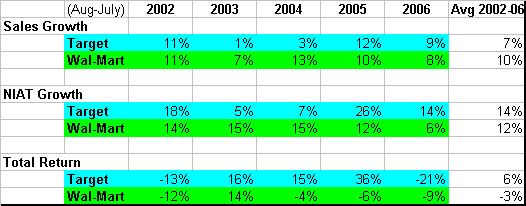


Looking more closely at the last two years, though, as the table on the left shows, Wal-Mart's Net Income After Tax growth underperformed Target's, meaning the former has suffered margin pressure or SG&A costs increases that it can't recover through its low prices.

According to the Journal article, Target's same-store sales are now outpacing Wal-Mart's, 6% vs. 3%.

If you think back to mid-2005, the general business media sentiment was that Wal-Mart was in trouble for two reasons. On the one hand, high gasoline prices were thought to be crimping the discretionary purchasing power of the average Wal-Mart customer, who is generally typified as among the lower income groups. On the other hand, when the pundits admitted that there has been a consistently healthy, growing US economy for the past three years or so, they worried that Wal-Mart's customers were moving upmarket to.....Target.

And so it seems they were. In fact, it appears as if both assessments were true.

Around that time, in mid-late 2005, Lee Scott, the CEO of Wal-Mart, heralded the company's commitment to move upmarket, too. There was a presence established on New York City's upper 5th Avenue, in order to tap into America's upscale fashion pulse.

At the time, I wrote
this post to go on record opining that it would not work. Nothing in the WSJ piece has changed my mind. If anything, it's made me even more convinced that Wal-Mart is about to commit a marketing disaster of Edsel proportions.

Here's why I think this.

First, the architect of the strategy is Eduardo Castro-Wright, the former chief of Wal-Mart stores in Mexico. He did something similar there, stratifying store types based solely on incomes. Sales rose.

Now, Mr. Castro Wright is attempting to apply consumer marketing from Mexico to the more complex US market. Interesting approach. The article states that Wal-Mart has hired various PhDs in ethnicity and food disciplines. And some types of 'research,' though precisely what type is not mentioned.

I don't think transferring a simple, one-dimensional segmentation scheme, based upon income, from the Mexican market to the much more diverse and sophisticated US market, will work. Adding the simplistic dimension of race.....er...ethnicity, won't do much better. The Journal piece lists the ethnic store variants as including those targeted at Black and Hispanic populations.

Most modern market segmentation work involves oceans of data, immense amounts of sophisticated multivariate analysis and modeling, usually done by a well-respected professor from a reputable Graduate School of Business somewhere in the US, and results in a few, less clear-cut segmentation dimensions. This is what factor analysis does- it loads many relevant segmentation bases onto a few operationally-addressable ones. But never have I seen a segmentation strategy expressed in dimensions so crude and tired as, solely, race and income.

Nevermind that Wal-Mart has enough problems with its images among certain ethnic groups already. And, am I the only person who finds it too ironic that Wal-Mart unveils a racially-oriented segmentation strategy only weeks after their now-departed ethnic ambassador, Andrew Young, embarrassed himself and the company with his on-air ethnic slurs against Koreans and Indians?

My second reason for believing Wal-Mart's new strategy will fail is that it undercuts the company's main competitive weapon, which is low cost supply. With product assortments being tailored by segment, volumes will necessarily fall, and costs, predictably, rise. The WSJ piece refers to a Bain & Co., study concluding just that. So Wal-Mart is departing from its historic strength, in quest of higher sales, while margins have already been under pressure lately.

My third reason for predicting the failure of the new store strategy is that it flies in the face of brand theory. The penultimate reason for the establishment of a brand franchise is to communicate one or two key values as identified with the brand. For Wal-Mart, it has been "every day low prices." Now, it's six different messages. Which means much of the historically-built brand value will be blurred and cease to exist. This would seem to fly in the face of most modern brand management theory.

Another related reason which I believe will lead to the multi-store concept's demise is basic consumer behavior regarding luxury and upscale goods, and "the wheel of retailing." I mentioned this latter concept in my previously linked post from last fall. The concept suggests that there is always a lowest-priced retailer, and others gradually try to move upmarket.

However, as I noted in that prior post, it's rarely, if every, been done successfully. In soft goods, both Sears and K-Mart failed with celebrity designers Cheryl Tiegs, Jaclyn Smith, and Martha Stewart. American consumers don't tend to buy luxury goods on price, or to frequent low-end stores for luxury items. Upscale consumers may, and do, head to Sam's Clubs and Costco for low prices on basic staples. But I doubt many real wine connoisseurs will be rushing to Wal-Mart for their $500 bottles of wine. Last I saw, the big move there is into online, out-of-state purchasing of wine at significant discounts.


I could go on in this vein. And I may in a later post. But for now, let me stop and suggest the following. This is one case in which I'd expect, and approve of, a company like Wal-Mart, with its in-bred, home-grown management, to hire outside market research consultants, social trend seers, and maybe even a team from Bain & Co., or McKinsey & Co., to provide some objective, experienced perspectives on the very important question of if, and how, to become a segment-oriented retailer.

Instead, I seriously believe that all Wal-Mart did was promote its most successful country manager to revamp US operations just like he did in Mexico. And being home-grown and in-bred, the senior executives in Bentonville see nothing wrong in rejiggering their marketing approaches without any outside help.

They seem to be clueless as to just how far they are departing from the formula that made them so successful. It may not be an engine of consistently superior total returns, but it is at least fulfilling its mission of dominating the low-priced retail niche.

Moving out of that niche, willy-nilly, with a crudely-designed, racially-oriented market segmentation strategy, to compete with much more nuanced marketers such as Les Wexner's Limited Brands lines, and others, seems to me like a recipe for disaster.

Nothing about this strategy makes sense to me. Not the segmentation, nor the cost implications, or the consumer behavior assumptions.

Time will tell if I am right.

Thursday, September 07, 2006

More on Viacom: Freston and Redstone

So much has happened in the business world that a few items almost slip into the cracks. Between Ford's new CEO, Intel's restructuring, and Chevron's new oil find, not to mention HP's board leak fracas, I almost forgot about Viacom's CEO, Tom Freston being fired, or retired, depending on technicalities, by his boss, Sumner Redstone.

In terms of total return performance, it would appear that Freston was giving the lie to Redstone's reason for the recent breakup of CBS and Viacom. As the Yahoo-sourced chart on the left illustrates, Viacom has plunged straight downward since its reincarnation in late 2005. It now has a -20% return, relative to the S&P500's single-digit positive gain, for the period.

Of course, with only a year's worth of separate performance, it's hard to tell if Freston really was failing at his task, or if Redstone was simply following up on reactions to his Tom Cruise dismissal, clearing out anyone who objected to his unilateral move over Freston's head.

From the details of yesterday's Wall Street Journal article, it's not clear what to expect of Viacom going forward. The two cronies that Redstone has re-installed at Viacom, CEO Phillipe Dauman and COO-like Tom Dooley, have a track record of tripling Vicacom's stock price when they last worked with him at the firm. Put that way, it's not clear Freston ever really had a chance. So I wasn't surprised to read that he had been reluctant to take the Viacom CEO job in the first place last year.

Reading further, it sounds unconvincing that Dauman is going to simply "foster innovation within the company," and stress aggressiveness with its "multiplatform" strategy. Couldn't Freston have done that? Wasn't he doing that? My sense has been that Viacom is simply another network whose assets have recently been rendered less valuable by the simple, inexpensive outflanking maneuvers of MySpace and YouTube.

Welcome to the truly "innovative" world, Mr. Dauman. Unlike the more formalized, corporate nature of old media, the new online media world seems to move much more quickly and decisively.

In the final analysis, I'm wondering now whether 82 year-old Sumner Redstone is the new Jack Welch. The cult celebrity Chairman for the decade. He is suddenly all over the papers, and even on a very flattering cable channel semi-bio a few days ago, hosted/narrated by director Brian Grazer, who has worked with Viacom and for Redstone before.


But, like Welch, he's now worried about his legacy. And this past year has apparently, at least in Redstone's mind, seriously jeopardized his image as the media mogul with the Midas touch.

Wednesday, September 06, 2006

Ford's New CEO: Pros and Cons

Yesterday, Ford announced that its Chairman and CEO, Bill Ford, is relinquishing his CEO title to Alan Mulally, late of Boeing.

It looks like my prediction of last
October has now partially come true. I thought that one of the companies would be gone within 5 years. Instead, one of the CEOs among Detroit's auto producers is gone. Oddly, in this case, by his own hand. So, technically, while there is not "one less CEO in Detroit," one of the sitting CEOs is gone.

From what I've read about Mulally, he is quite likely a good choice for Ford. Whether even he can save the company is anybody's guess. However, as noted in my post in June on Boeing v. Airbus,
here, Boeing's commercial aircraft division, with the 787 Dreamliner, executed fundamentals and out-designed Airbus. Mulally gets the credit for that.

It's easy to see why Ford wants Mulally. He successfully turned Boeing's commercial division around. Bill Ford badly needs to save his family's company, and he's not too proud to fire himself and hire the best senior exec he can find to do it. Mulally led a decidedly marketing-oriented resurgence at Boeing, and Ford is no doubt hoping there is enough time left for a similar magic act at the auto maker.

It's not too hard to see why Mulally will jump to Ford, either. He did the heavy lifting at Boeing, only to have McNerney flee 3M and replace Harry Stonecipher as CEO. Talk about ingratitude. Whether Mulally can succeed at Ford is almost immaterial. Like Lou Gerstner at IBM, or Art Ryan at Prudential, he'll get credit if he turns it around, but the company's bad shape will be blamed if he doesn't. And he'll doubtless still be handsomely rewarded. Most importantly, though, is that he is now a "CEO." And regardless of Ford's outcome, he's in the major leagues now.

It's a very interesting end to a musical chairs game that began with Jack Welch's retirement 5 years ago. As the linked post about McNerney, contained in the prior post about Boeing and Airbus, notes, McNerney hadn't really done anything to write home about while leading 3M. Now, at Boeing, the guy who rescued it prior to his arrival is gone.

So, Alan Mullaly gets to be CEO of something, if not a healthy company. Jim McNerney has to show he can stay in one place and actually create superior shareholder value. And Rick Wagoner can breathe a sigh of relief that he isn't the first automotive CEO to get canned this year. He was noticeably smug about the Mullaly news on an interview with CNBC today. Wagoner's probably just happy everyone's focusing on the other ailing Detroit-based auto company for a while.


In the final analysis, Mulally is probably as good a choice to lead Ford as anyone else, and better than most. Despite many pundits crying for a "car guy" at Ford now, Mulally has actually succeeded at producing a customer-focused new product, the Dreamliner, and then beating the hell out of his competitor, Airbus, with it. And he wants to lessen Ford's dependence on trucks and SUVs, returning to designing and building compelling cars.

I'm not at all sure Mullaly has the time and resources to pull it off, but I will enjoy seeing if he can. And I'll enjoy seeing how much more consolidation, CEO change, etc., continues to occur in the auto industry in the months ahead.

Hollywood Struggles: Tom Cruise Is Just The Tip of The Iceberg

Last week's dismissal of Tom Cruise from Viacom's stable of stars by Sumner Redstone turned heads in Hollywood, by all accounts. Once again, we were treated to a display of the glaring differences between how the financial and entertainment communities view the classic Hollywood business style of spending anything to retain and satisfy the "talent."

Saturday's Wall Street Journal carried a timely piece discussing the entertainment industry's woes regarding DVD sales. It seems they are finally cresting, and no replacement vehicle is in sight. The article quoted numerous film execs as focusing on and cutting costs, as well as being more selective in their choice of properties to develop. The role of outside investment partnerships, including hedge funds, was even blamed for bringing too much capital into the sector, causing movies to be made which were best left as only screenplays.

What really shocked me, though, was the realization that Disney studios had, only just last fall, analyzed the contribution of their non-children-oriented films to the studio's profitability, and found them unsustainable.


Which brings me to the title of this post. With this backdrop, does Sumner Redstone really seem so off his rocker? The WSJ piece alleges that Viacom barely broke even on "Mission Impossible III," while Cruise earned a reputed $80 million.

Given Wall Street's harder-nosed approach to business than Hollywood's, is it really likely that a hedge fund is going to pick up funding for Tom Cruise's ventures at the same price that Viacom did? After the allure of Tom visiting a few trading floors, I think reality will sink in.

Remember Kevin Costner's fame some years ago? He began making his own movies, irrespective of the advice of others, critics, or even box office sales. Last time I saw him, he was co-starring with the venerable Robert Duval on a cable channel western movie special. So much for lasting fame and fortune in Hollywood.

Meanwhile, back to the film companies. The other interesting development is how companies as diverse as Apple and Wal-Mart are squaring off over the prices they will pay for online distribution of video content from the studios. Everyone can see the potentials among various distribution channels, and nobody wants to be left out. Wal-Mart, with its 40% of DVD sales, has enormous clout right now. And they appear to be using it.

As I have said before about the digitalization of media, whichever ways things develop, it looks like the consumer is going to make out very well, with great product available at competitively-tested, affordable prices.

Tuesday, September 05, 2006

Ron Gettelfinger's Flawed Logic On Pensions

Friday's Wall Street Journal contained an editorial by Ron Gettelfinger, current president of the UAW.

Gettelfinger's topic is, of course, the funding of labor union worker pensions in the modern world. He begins by describing the 1950 negotiations between GM and the UAW. In Gettelfinger's world, there are only two possible positions- those of GM's Charles Wilson and the UAW's Walter Reuther. The former wanted company-based benefits, while the latter, not surprisingly, favored "universal" benefits for all workers, meaning, one supposes, a sort of societally- or governmentally-funded approach.

Actually, it turns out that both were probably wrong.

However, back to Gettelfinger. He draws exclusively on one Malcolm Gladwell, a writer who authored a piece entitled "The Risk Pool," in the August 28th issue of the New Yorker. According to Gladwell, European social policy, in which there is universal, state-run pension management and liability, is preferred to the US private system. He further alleges that "....individual companies (are) responsible for the care of their retirees. It is this fact, as much as any other, that explains the current crisis."

Near the end of the article, Gettelfinger argues, based upon Gladwell and his sources, that US companies carry a 15% cost disadvantage because of the lack of a universal pension system. Then, in his logical climax, he opines that the only way American pensions can ever be "safe" is to have a publicly-funded universal program.

The trouble with Gettelfinger's position begins at the very beginning. He puts up private pension schemes as the only straw man alternative to a public pension system.

In one of my first posts on this blog,
here, written on September 15, 2005, I argued that the real problem is that anyone ever took anyone else's IOUs, instead of cash on the barrel head in the then-present day.

Simply put, anytime any worker accepts promises of future contributions, in lieu of cash, whether accruing in a personal account or general fund, that worker is assuming counterparty funding risks that no banker would ever take for free. Or on anything like the totally unsecured terms involved in an employment agreement.

Gettelfinger is wrong. The best alternative for any worker is for him, or his union, to demand cash payments, whether as current compensation or contribution to his retirement account, from the funding entity. That way, the funder has to solvently provide the payment, and cannot promise future contributions or payments which it may never actually possess.

Both universal and private pension schemes suffer from the human tendency to promise more than one may be able to certainly deliver. And, in the case of pensions, there is no realistic alternative remedy for the funding entity's breach of contract.


No worker should have to bear the risk of funding promised retirement compensation. He might risk the investment performance of those funds, but that is not the liability of the funding organization. If employers, or the government, had to pay cash, rather than than promises, into retirement accounts, then the "risk pool" concept would evaporate.

Problem solved. Without complete universal, publicly-provided pensions.

Monday, September 04, 2006

Laptop Shopping: Dell's Miscalculation

Saturday saw the East Coast of the US hit with the monsoon-like fallout from hurricane Ernesto. With outdoor activities out of the question, my daughters and I, as many other denizens of the area did, went shopping.

As it happens, I had promised them upgraded personal computer facilities this year. This decision necessitated a long-delayed commitment to a wireless network, so that gear was also on the shopping list. With fall "back to school" sales in full flower, we set off on a rainy, overcast afternoon to buy electronics gear.

At our first stop, Costco, my daughters found several laptops their liking. Upon discussing the array of models displayed with the helpful Costco assistant, I rapidly came to realize that there was a fairly uniform set of features and capabilities available within a $200 price range. Being the first store at which we looked, we held off a purchase decision for later.

The next stop was Staples. I went there for networking gear. As I made sure that the components I selected were appropriate for the intended network setup, my daughters busied themselves with trying out the various laptops on display among the shelves in the back of the store. There must have been at least 20 different models on offer. Soon, they called out to me that they found one which they would like me to buy.

Amazingly, they had chosen a very good machine at a great price. I say "amazingly," not because my daughters chose it, but because we were at Staples. This was about the last place I expected to purchase a computer.

However, they found an HP Pavilion notebook on sale, for about $900. It had the typical 1GB of RAM, 100GB HD, wireless capability, XP operating system, DVD burner/reader, that most machines in the price range possess. Plus an in-lid camera and various additional software titles.

As I wrote in my prior post,
here, Dell has seriously miscalculated how consumers buy PCs nowadays. I am a good example. Never before have I purchased a PC in person, at a retail store. Four Gateways and one Dell were bought over the phone, after customization.

Now, however, the typical off-the-shelf notebooks contain nearly-identical features and components, at very similar prices. Thanks to the evolution of various manufacturers' distribution policies, many retailers carry a wide variety of brands: HP, Toshiba, Gateway, Lenovo, and Acer, to name just a few. With this sort of product choice at similar prices, it doesn't take a genius to realize that spending more for marginal customization, while waiting a week for the product, is hard to justify.

Really, about the only option left nowadays is your choice of how much RAM to buy. Otherwise, notebooks in the $1,000 price range are all very similar.


The conclusion which I draw from all of this is that Dell has seriously missed the boat in terms of its understanding of the consumer segment's buying behavior evolution. This notebook, on which I'm writing this post, is intended to provide my daughters with their own computing platform, as well as wireless internet access. As a second (or, in my case, more) computer purchase, sufficient information and product choices are available at retail to obviate the need to custom design a solution.

Dell did very well in the 1990s with their custom-design, fast delivery business model. Now, however, with Saturday's experience fresh in my mind, I see how and why they are outdated in their distribution methods.

One can't denigrate their prior success. But I don't really think they possess any unique competitive advantages anymore to drive further consistently superior total return performance in the years to come.

Friday, September 01, 2006

Dell's Collapse No Mystery, Just Simple Marketing Mistakes

Wednesday's front-page column in the Wall Street Journal recounted Dell's recent missteps. Sad to say, much of what is related in the piece describes a simple failure of sensible marketing.

As I've been reflecting on the piece, considering what perspective to apply to understand Dell's debacle, I think it is one of growth into ineptitude. Another story of a business model that successfully grew for quite some time, inadvertently sowing the seeds of its own destruction.


The charts at the left of this post illustrate the end of the company's era of consistently outperforming the S&P 500 index, with its performance worsening in the past 2 years. Over five years, it has been flat, while the S&P eked out a small gain. Over two years, Dell has fallen 40%, while the Index has risen almost 20%. In just the last 12 months, the Index has risen around 5%, while Dell has still declined about 40%.

In Dell's case, there seem to be three classic sources of that destruction of their successful business model.

First is an all-too typical case of what I refer to as "sand in the gears." Like Intel and Amazon, Dell must have begun rapidly assimilating the merely-average as employees. Seat-warmers who liked to boast, "yeah, I work at Dell," when that was a cool thing to say. However, witness what some of those customer management mavens did for Dell. They actually outsourced the retail phone order-taking function to temporary workers. Then refused to promote or "hire" any of them into the Dell workforce. The article states that turnover at these outsourced call centers reached 300%.

Let me see if I have this picture right. You take a group of people and tell them they aren't going to be "real" Dell employees, with Dell status and benefits level. Then you assign them the task of fielding calls from interested potential retail buyers. When they do a good job, you tell them they get nothing but "paid." And then Dell wondered why they lost ground in the retail segment.

That's a classic example of someone in charge being totally inept, and not caring a whit about the results of their ineptitude. Nor, apparently, for at least a few years, did their immediate and two-levels-up superiors.

Next, we have Dell's success in placing PCs into American homes become a factor in its own demise. By raising the bar with market penetration, the next buying decision for many families was approached differently than that of their first PC. Perhaps their needs changed, and grew. Or, perhaps they taught themselves that now, having successfully bought and used one PC, online or by phone, they knew enough to go to a locally sited big box retailer and buy "any" brand which satisfied their now-savvy technical/application needs and price points.

Lesson for marketing executives. When a market is immature, a brand can be worth quite a bit in terms of quelling customer post-sale cognitive dissonance. When the customer gets confident in his knowledge of the product, the rebuy decision won't be the same. And the customer may well value "brand" much less than when he was ignorant of the product.

So that seems to be another factor in Dell's lagging performance. Its marketing executives didn't keep their finger on the pulse of retail consumers, and, as a result, they missed important changes in that segment's buying behaviors. Score one for the bricks and mortar retailers, and the companies that elected to collaborate with them, like HP.


Finally, Dell has, I think, simply run out of road for its once-vaunted business model. This might be mostly a business development issue, rather than a marketing one. However, good marketing intelligence would have seen this coming, with the aforementioned changes in consumer buying behavior, as the changes were occurring, rather than two years later.

Would opening a chain of Dell stores have mattered? Maybe not. I've been looking around their website lately, and the cupboard's pretty bare for consumer products. In this case, I think one could fairly cast the issue as one of poor segment choice. The consumer segment seems to still be buying PCs, but Dell didn't really keep pace with features and price points, as its competitors did. They bet on the business segment, and it didn't provide sufficient growth and profitability to sustain Dell's formerly consistently superior total return performance.

It's not about exploding batteries, so much as just poor marketing in the swollen, mediocre ranks of Dell. And, thus, perhaps an unfixable problem, given the mature nature of the sector, and Dell's important and longstanding mistakes which have hurt it now for several years. It may well be the GM of the computer sector, going from dominant producer to an also-ran with product nobody really wants to buy anymore, and little room for a comeback.

Time will tell. And I don't think it will take all that much time, either.

Thursday, August 31, 2006

Long-Term Market Reactions to Oil

The Wall Street Journal ran a very interesting article on Tuesday regarding how the nature of gasoline refining has changed in the past 20-30 years. Due to lack of expansion of refining capacity, and growing demand, availability is tight, so margins have finally risen from their historic lows.

What I find most fascinating is how the article describes not just that refineries are being built, and large ones at that, but where they are going up.

India.

A man named Mukesh Ambani, chairman of India's largest private company, Reliance Industries, Ltd., "is building the world's largest refinery complex" on India's northwest coast, near Pakistan.

The article contains a few important facts which help us understand how the provision of various elements of the gasoline supply chain are changing, and why.

Years ago, one of my close friends was a now-retired senior oil executive at Exxon International. He was a lifer, having begun to climb the corporate ladder there right out of college as a petroleum engineer. Tony used to tell me how little Exxon had made on the refining of crude over the years. This, he said, had shaped Lee Raymond's views on running the company.

Now, the Journal reports, refining margins are around $20/barrel of oil. That's on barrels which are bobbing up and down in the $70 range, meaning a 28.5% gross margin. Not bad for an industrial commodity, both coming and going. Further, the larger refining margins mean that it is now very feasible for refiners to price shipping the crude to, and the gasoline from, their refineries. Thus, the Indian connection.

Finally, an eye-opening little piece of information. In 2000, America imported less than 8% its gasoline. By last year, that number had risen to 11%. It is now at 13%. A 63% rise in the volume of gasoline imported by the US in six years.

Thus, Mr. Ambani's bet. But, he's not alone. Worried about American oil companies not building a new onshore refinery from scratch in 30 years? Maybe you shouldn't be. Mr. Ambani's partner in the latest refinery venture is- Chevron, the merged entity that was one Chevron and Texaco. The article also mentions, as part of the wave of planned refineries worldwide, that Exxon, ConocoPhillips, and Total, SA, are all in talks with Saudi Aramco to build new refineries as well.

As the article points out, these offshore refineries will solve two vexing problems for US gasoline supply. One is geographical concentration. By taking advantage of relatively inexpensive shipping costs, as a percentage of the new refining margins, these new refineries will spread the risks of weather, specifically hurricanes, knocking out large amounts of US refining capacity, or distribution facilities. Further, they are being designed to refine high-sulfur oil. As the classic "light sweet" crude becomes less of the oil supply globally, on a percentage basis, these new refineries will provide more gasoline from currently harder-to-refine crude sources.


Finally, there is the matter of...ah....how does one put this delicately.....refinery construction and its impacts on the local environment. Americans don't want another smelly, belching industrial refinery located near where they consume all that gasoline. But, being the economic creatures that we are, we are more than happy to pay Indians to allow those belching refineries to be located, built and operated on their less-discriminating shores.

In a way, although most people don't consider process industries quite like they do finished goods industries, it's just like what happened with steel and other basic metals operations. Third- or second-world countries are more than happy to get the jobs that are created when you have to erect and operate the world's largest oil refining complex. And they will gladly offer their less-stringent environmental quality constraints in the bargain.

Mr. Ambani is assembling a workforce of 150,000 people to erect the new refinery by December, 2008. According to the article, "two years ahead of many projects that others are planning." Read that to mean, "able to reap the full measure of gains by being the first guys on the block to refine high-sulfur crude into American-bound gasoline at still-bloated margins."

God bless 'em, the Indians went our way, rather than tilting toward the Russian socialists after all! They know a huge profit when they see it, and they go for the jugular.

And, in a beautifully seamless piece of "best practices" engineering, Ambani's team is simply unrolling the very same blueprints for their first mega-refinery on the site, and building it again right next door! How brilliant is that? Everyone who's ever done home construction or renovation knows all too well that much of the cost and time of those projects come from customer indecision and changes in the plans while building is underway. The Journal pieces cites the expected cost/barrel of the refining capacity being constructed by Mr. Ambani to be $10,300, or "about a third lower than the estimated cost of building the two big refineries planned for Saudi Arabia" with Exxon, Total and ConocoPhillips. So, not only do the Indians offer their environment to the cause of global gasoline supply, but their cheaper, though more productive, labor as well. And think of what all those labor dollars in India will be buying- more finished goods! Talk about a virtuous circle.

To top all of this great news off, Mr. Ambani and his 29% partner, Chevron, already have factored in the effects of the rush to supply American's with more gasoline by the decade's end. Between the various new refinery projects on the drawing board, and the expectations of US gasoline demand growth to slow after the next few years, due to ethanol and hybrid cars, the partnership expects the profit opportunities in the American market to change in a few years.

By building this super-refinery in India, they are well positioned to supply China and.....India!

Thank God, Adam Smith's invisible hand is at work, as is Joseph Schumpeter's view of creative destruction. As the US onshore petroleum refining business becomes too expensive and constrained to effectively compete globally, those US companies engaged in the business move their operations overseas, to where it's economical to build and operate new, better-designed refineries for today's oil supply. It isn't going to be just your shirts, shoes or computers that are built with components and subassemblies shipped around the world anymore. Soon, the gasoline in your car's tank will have been around the world to get to you, too.

Oh, and one last point. No US senators, congressmen, or cabinet secretaries were involved in the provision of this new gasoline supply. Leave it to the market, and you'll get a better solution every time.

Wednesday, August 30, 2006

Some Further Thoughts On Video Programming Delivery In The Coming Years

As I noted in my prior post, here, there continues to be more splintering of the delivery and viewing of video content these days.

For instance, yesterday's Wall Street Journal ran an article about MTV's trouble with its online sites. Furthermore, the article published a table, sourced by comscore Media Metrix, purporting to show unique visitors to websites last month. Yahoo video was first, notionally, with 21.1 million. Right behind, with 20.1 million, was NewsCorp's MySpace Videos, followed by YouTube with 16.1 million unique visitors. Given my prior comments about Yahoo, I wonder if the July numbers don't represent, as a snapshot of one viewing period, the growth of YouTube to nearly rival Yahoo, as opposed to Yahoo maintaining a continuing lead in this area.

I now wonder whether half of cable's revenues will go away as more consumers find and buy/view content directly on urls via their hi speed data facilities. With destination sites like Youtube, who will need a pre-packaged suite of programming content like Comcast currently has for TV, or is attempting for the internet? And then, we'll probably see cable and telephone company DSL-based content offerings compete each other's prices downward to retain some measure of revenue from these antiquated, pre-packaged content services.

Instead, we'llprobably buy a wireless box which takes the hi speed online signal, directs it with a handheld wireless controller, and displays url-based video on your in-home TV display.

Voila. Goodbye broadcast, and even cable 'TV.' Hello video ubiquity a la carte. Which, by the way, is something the cable industry already admits it doesn't like, won't offer, and on which it will lose money.


Of course, this online a la carte video world does have to be paid for somehow. And it's easy to see what that "somehow" will be. YouTube is allowing advertising on its dedicated channels. Hmm.....a familiar concept. Of course! That's broadcast network TV from the 1950s, updated for today's viewers and technologies. And then, of course, there will probably be direct access to very hot production company sites who will charge via credit card or PayPal to have access to popular 'television-style' serial programming.

I don't know what the arrangements are for the provision of, say, ABC's Lost or Desperate Housewives. But it would seem reasonable that production contracts for serial programming is going to change. Before, it was just about syndication rights and royalties. Now, a good production company with a hot property can air it initially via a network, then go solo after the brand has been built. Or, perhaps they'll just go directly to a YouTube or other online video content concentrator site.

Then again, perhaps a really good production shop will simply secure its own financing via the capital markets. Maybe they'll sign a long-term distribution agreement with YouTube to provide basic cashflow while they develop properties for the online market. The possibilities seem truly too many to contemplate just yet.

I wouldn't want to be the Dolans, or any other cable company/mogul right now.

Tuesday, August 29, 2006

YouTube's New Direction: Retail Distribution of Mainstream Media

YouTube's announcement last week that it will create dedicated pages for advertisers and their mainstream video content marks an important new development in the way video will ultimately be delivered to homes.

My partner and I were discussing this amazing development, whereby a Paris Hilton channel is being created on YouTube in order to publicize her music videos, in hopes of selling her music.

What one has to realize about this is the incongruity of YouTube beating out the entire music publishing industry establishment, not to mention existing online entities such as Amazon, Yahoo and MSN, to become the online "location" of choice for new video content.

In marketing, there is a concept known as the "evoked set." It basically describes how consumers tend to choose a small number of providers of a good or service, perhaps 3-4, among all the potential vendors, that they will actually consider when they make a purchase.

Among all the potential internet URLs one might visit for video content, it appears that YouTube has become part of a very, very large number of consumer evoked sets. Thus, even other media concerns, armed with their "talent," still feel the need to approach YouTube for the online equivalent of shelf space. One assumes that YouTube's equivalent of the supermarket "slotting fee" is a cut of the ad revenues flowing to the channel managers.

One has to simply marvel at how this young company has seemingly joined the ranks, at least in terms of usage and preference, of Craig's List, eBay, and Google as a firm which began as little more than a way for someone to solve a simple online-related problem, without a profit motive per se.

Right now, Amazon, for years a veritable online general store, is essentially out of the picture when it comes to video content destinations. One wonders if Jeff Bezos should have been spending less time on his space exploration project lately, and more on figuring out how to keep his company at the forefront of online content purchasing. While it may not have been thinking of free video content viewing as part of its business model, at least Amazon had an internet address that was second to none. Until YouTube showed up.

Now, even though Google and MSN have video content sections, the relative newcomer is sweeping all before it as media content moguls beat a path to its door. This alone will likely cement its early usage preference among users for the next year or so.

Once again, we see how several companies full of mediocre, uncreative managers can miss an incredible opportunity that practically invents itself. For all the hoopla surrounding media giants such as Time-Warner, GE-NBC, Disney/ABC, and the cable companies, none of them were even remotely close to taking on YouTube.

As my partner and I discussed this recent phenomenon, we mused about how it is changing viewing habits of video content such as television programming. When companies such as Disney began licensing their more popular television programming on a non-exclusive basis all over the place (iTunes, Comcast, their own online site), it clearly gave notice that the days of simple broadcast network delivery are over already.


So now, one wonders what shapes the delivery and viewing of content that used to be associated with broadcast and cable television may take. Some thoughts about that in an upcoming post.

Monday, August 28, 2006

Yahoo's Investment in Academia: The "Used Car" of The Internet Tries to Get Back in The Race

Friday's Wall Street Journal featured an article about how Yahoo is trying desperately to catch up to its more focused rivals by hiring a slew of outside academics, most notably economists. Terry Semel, Yahoo's CEO, apparently hopes loading up the company with economists will let it overcome years of stagnation and lack of focus.

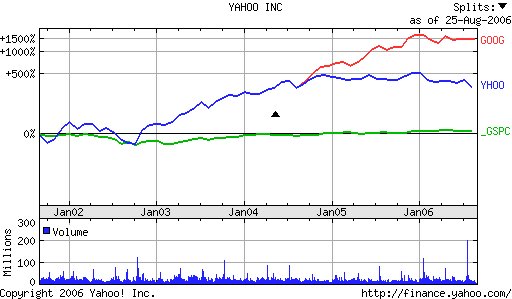
As an example of this, look at the five-year price chart on the left (click on the chart to enlarge it). It displays the prices of Google, Yahoo and the S&P500 for the period.

Well, God knows the company needs something. To me, Yahoo, has always been a sort of "used car" entrant among online information/data site companies. My partner continually asks me why I use that term. I suppose because, somehow, Yahoo always seems to be that "other" online provider that is seen as stumbling forward, without purpose. A type of bland, basic online information "transportation" vehicle.

AOL was a first generation vehicle. Yahoo blasted onto the scene with a dizzying variety of services, but no clear focus. It seems to offer a bit of everything, and the best of nothing.

Then came eBay, Google, and even MSN.

eBay rules auctions, for better or worse. Certainly better than Yahoo.

Google rules search and online advertising. After minting money with these, they have begun to "cover" all of Yahoo's more noteworthy features, such as free email and chat, at the same "free" price point. Game to Google.

MSN has now charged into video ads and ads for MySpace. At least it seems to have an awareness of how badly it stumbled and missed online advertising after it destroyed Netscape and foolishly felt safe in the online world.

While the rest of the online world focused on racing to dominate some identifiable, profitable online product/market, Yahoo seemed to be the used stock car of the internet, tuned-up a little on Saturday to run at the track.

The Friday piece actually cited Yahoo CEO Terry Semel, for whom I actually have a great deal of respect, as,

"confiding a concern to his top lieutenants that the company risked missing long-term developments. Who in the company is considering what might happen in three to five years, he asked, according to one executive at the meeting."

The incredulous, laughable result, was to name Usama Fayyad, Yahoo's "head of data," to head up what passes for the answer to Semel's question.

By the way, Terry, those of us adults who have worked in corporate America for a while refer to that function as "strategic planning," "strategy," "planning and development," or even "corporate strategic planning and development."

It's a little concept GE developed somewhere back in the mid-1950s. Yes, that's right- 50 years ago.

Art Laffer's Perspective on Inflation and The Dollar

Art Laffer is one very smart economic cookie. Witness his erudite editorial in last Thursday's Wall Street Journal.

In a polite slap at other economists, he wrote,

"But to confuse an increase in commodity prices with general inflation is a serious mistake, one which often seduces otherwise clear-thinking economists."

Laffer's point is that a combination of worldwide commodity price increases, and US dollar weakness, have resulted in a temporary rise in some prices in the US. This does not, he emphasizes, equate to general inflation in the US economy. That is a function of money supply versus economic growth. By comparing inflation-adjusted Treasury yields with nominal Treasury yields, Laffer demonstrates that inflation expectations have remained surprisingly stable and low since 1999.

In effect, Laffer cautions us to avoid confusing the temporary rise in dollar-denominated commodity prices with general US inflation involving the too-rapid expansion of the monetary base.

What a clear, simple and elegant reminder of what measures on which to focus, and how to understand them. What a very intelligent economist Art Laffer is.

Friday, August 25, 2006

The New Investment Banking vs. The Old

Yesterday, The Wall Street Journal had a review of "The Accidental Investment Banker," by Jonathan Knee. I have not read the book, nor do I plan to. This post is based upon the Journal's review, written by Dennis Berman, a reporter for the paper.

I have to say, in my opinion, the joke is on the author. He may suddenly have grasped the crass avarice of investment banking, but I think most of the rest of us in business, over the age of, say, 45, have always known this about investment bankers.

There are two themes to the review. One is about the author's route into the business. The other is the author's apparent embrace of the "old style" of investment banking. This, one suspects, is suppose to have been sometime in the pre-history of time, or at least the youngish author's experience- perhaps the 1970s?

On the first point, let me just say that it confirms something I've long suspected. There's very little actual unique value or talent resident in investment bankers, in general. Much of their eventual value is, like many bond traders, the result of proximity to deal flow and information, rather than their own latent talent, per se. Knee apparently joined Goldman because a friend "recruited" him after he finished some work for UAL. Some recommendation, that, eh? You finish helping gum up a major, failing airline, so you are now Goldman material.

This brings me to the second theme. The trend toward "short term greedy" investment banking started because Knee's employers got greedy themselves, and took their firms public. If they hadn't, the old ways of "long-term greedy" would have continued. But the sector had to provide for the growth it wanted, and partnerships become unwieldy and cumbersome to manage. Basically, investment banks and large consultancies used to function similarly. A few partners got rich billing out Ivy-graduated kids at inflated prices, paying them much less, and pocketing the difference. Witness Lehman's dissolution decades ago over the fight between Glucksman's traders and Petersen's bankers.

As capital and capital markets activity began to mushroom unexpectedly in the early 1980s, investment banks scaled up massively to take advantage of the deal/money flow, and not be left behind as market share midgets. Not only did old wire houses end up as public entities, but so did firms like Salomon Brothers. As this type of growth accelerated, senior partners took their one-time windfall and went public, culminating with Goldman some years ago. In the consulting world, the same thing happened with the old "Big 8." Andersen Consulting eventually became the publicly-held Accenture.

Since public companies can't really have private partners, that model went out the window. And with it, the ability of the firms to internally manage through soft periods with their own plentiful capital. So, welcome to the world of management by objectives, or, as the author phrases it, "short-term greedy."

So it seems that the sector chose to change the way it did business all on its own. Mostly, as is typical with human nature, due to profit motives of the guys at the top who stood to reap fortunes for the one-time conversions from private partnerships to public entities.

But is this necessarily a bad thing? What if, instead of accepting Knee's contention that the old ways were better, we reverse his hypothesis? What if today's mores are, in fact, better? Why could this be so?

Perhaps it is actually better now because everybody has greater liquidity at lower prices. If you, as a private business owner, wish to be "long term greedy," so be it. Hold on for longer, don't sell out. If you are the manager of a privately-held business, don't you still have to earn comparative returns on equity, at comparative growth rates, to merit continuing to run the firm, rather than your owner selling it with the help of a "short-term greedy" investment banker?

If you are the CEO of a public company, it's the same, only simpler. If your total returns aren't up to par, why should anyone give you years to 'turn things around?' Why not allow someone else to pay for the right to do what you can't? If shareholders want to give you more time, fine. If, however, sufficient numbers wish to cash out, why not, again, allow a "short-term greedy" banker to facilitate the transaction?

So, maybe this is all to the good. Everybody is aware of how mercenary, merciless, and amoral, investment bankers are. If they can convince sufficient numbers of shareholders to sell, or buy, a company, or a private owner to succumb to outside offers, who's to say that is wrong?

Maybe "long-term greedy" is, in reality, now a succession of intelligent "short-term greedy" bets? In today's Schumpeterian world of fast-paced technological change, can anyone expect a single sector of company to remain steady and unaffected in its ability to add value anymore? It's doubtful.

Perhaps investment banking's changes, along with those of the parallel universe of private equity, have evolved in such a way as to facilitate faster, more accurate value recognition in our modern financial and technological world.

Market forces are now more easily able to influence decisions such as type of ownership. Chances are, it's a good thing, not a bad thing.

Thursday, August 24, 2006

The New Bell Labs at Lucent: Is Basic Research Really Dead?

Monday's Wall Street Journal featured an article about some major changes underway at Bell Labs, a unit of the soon-to-be-acquired Lucent. The headline is that applied research is in, and fundamental research of the type that made the Labs famous, and won so many Nobel prizes for its staff, is out. Or, at least, greatly diminished.

As I read the article, it occurred to me that, although pure research was a good idea in the era of large industrial utilities, perhaps it no longer is. With such widespread use of many current technologies enabling smaller firms to innovate, perhaps "pure" research is an appropriate relic of a bygone era.

With ample venture capital, seasoned managers and smaller-scale tools, perhaps "pure" research can sprint off the test bench and into application and production so fast that perhaps it no longer makes sense to treat it separately commercially.

There will still be scientists at universities, researching and publishing for tenure, etc. It's not like all pure research is ending.


Rather, a smart scientist with a basic invention can now have a start-up formed around him, including funding, management, and, if necessary, regulatory acumen. Somehow, I sense handwringing for a bygone era that, in fact, was less productive than might have been.

Think about this. Has your life changed at a faster pace, been delivered more valuable innovation, in the last 20 years, or the period from, say, 1950-1970. The vaunted Labs did produce the transistor, and other basic discoveries. But, realistically, who would question that the pace of innovation has increased, not slowed, since the breakup of the old Bell System over 20 years ago that led to this crossroads for Bell Labs.

In fact, I often suggest to colleagues that, if the Bell breakup had never occurred, we probably would be far behind where we are today, in terms of technological innovations such as: cell phones, Blackberrys, the internet, and the now-burgeoning world of video content on demand.

Perhaps what's gone missing is basic research of the kind that shareholders pay for, but for which they fail to see results. I think basic research is alive and well, but its half-life is considerably shorter now, before it's applied to commercial enterprises.

Wednesday, August 23, 2006

Objective Equity Commentary Goes Biased: WisdomTree's New Hires

Last June, I posted a piece on Jeremy Siegel's Wall Street Journal editorial concerning "new" index funds. At the time, he simply noted that he developed them 'with' private concern WisdomTree Asset Management. According to the ad I saw on CNBC this afternoon, Siegel and former hedge-fund manager Michael Steinhardt have joined the firm.

For what it's worth, I recall Steinhardt liquidating his fund because he was having trouble generating performance for his investors, and preferred to spend more time on his coin (?) collection.


In any case, back to WisdomTree. From the WSJ piece back in June, it seemed that what Siegel has decided is that you can decide for yourself what features you want in a fund, tweak some existing benchmark to be more like that, and then call that group a fundamentally-based index. Siegel's apparent objective is to reduce index volatility.

That's nice, but it still misses the point. Indices have as their objective the descriptive measurement of a specific group of equities, usually representing the economy, or a sector thereof.

In fact, what Siegel and his colleagues have done is simply created some new, quasi-passively managed mutual funds. They are trying to position them as "indices" in order, I suppose, to compare their return/risk with an index such as the S&P500, and look better. There's nothing wrong with forming a new mutual fund company and launching a new, cleverly-designed fund approach. But let's not call it indexing, when it's apparently just passively managed.

I guess this means it's the end of Jeremy Siegel as an objective observer of equity markets. Everyone has his price, and WisdomTree finally must have met Jeremy's.

Tuesday, August 22, 2006

Amazon's Marketing Missteps in China

Today's Wall Street Journal's Marketplace section carried a wonderful little piece about a Chinese couple whose online retailing business is beating US giants in China.

The company, Dangdang.com, was founded by Peggy Yu and her husband, Li Guoqing. You can read the details on the WSJ website, or in print.

What drew my attention was this gem, about a third of the way through the piece,

"...But equally critical to the success, analysts and executives say, is the ability of domestic companies to understand and adapt to some of the other peculiarities of China's market. Ms. Yu says Dangdang had to make adjustments to the model pioneered by Amazon.com and others. For example, the vast majority of Dangdang's Chinese buyers of books pay cash on delivery- a result of the fact that credit cards are still relatively uncommon in China.....Edward Yu, president of Analysys International, a Beijing-based technology research company, says foreign Internet companies sometimes don't give local managers enough leeway to adapt their businesses to local customs."

Further on, Ms. Yu is quoted as restating a time-honored marketing principle,

"Don't try to change consumer behavior. If consumers don't want to pay with credit cards, then ask them how they want to pay. If they want to pay cash, then figure out a way to get their cash."

Of course, sometimes marketing success comes from changing consumer behaviors. But typically, that is with some technological 'must have,' like a Walkman, iPod, or VCR. And that may involve changing usage habits, not purchase habits.


In this case, it's clear that the local firm employed classically simple marketing concepts. Provide something familiar, books, in a new way, online, with a better value proposition. Taking care of details like payment methods, which Dangdang did not do immediately, made the difference between success and failure.

The article goes on to report that Dangdang's major competitor, Joyo, purchased recently by Amazon, grew sales at 50% last year. Dangdang's grew at a reported 175%.

Some things don't change. Size, as I have discussed in earlier posts (e.g., Starbucks, Intel, GM), can chill innovation and suck in mediocre managers who simply warm seats and "do their jobs."

It's refreshing to see a smaller company apply intelligent marketing principles, work hard, and outperform a larger, duller giant in the same product/market space.

More on Private Buyouts

I've written two posts in the past few months concerning private equity-financed buyouts, found here and here.

According to a piece in Friday's edition of the Wall Street Journal, something I mused about in the second linked post, from June, seems to be occurring already. It seems that VNU, NV, of the Netherlands, which owns the Nielsen ratings service, was taken private only after shareholders organized and demanded a higher premium for the deal. Mind you, these shareholders, some of them large mutual funds, overrode the board of directors' recommendation to accept the initial private equity offer, and extracted an additional 2.5% of the initial offer for their trouble.

According to the article, the premiums on some private equity deals is rising sufficiently to make them unattractive.

On a related note, I saw a fascinating little interview on CNBC yesterday. An analyst with a major commercial bank discussed Microsoft from a leveraged-buyout, private equity perspective.

Allowing that the firm is far too large to effectively be taken private like that, he went on to describe it as an ideal, typical buyout target. It has too much cash on its balance sheet to use productively. Its R&D spending is wasteful, producing little in the way of products or services which are driving total returns higher. And its staffing seems bloated, for the lack of value being created by the firm nowadays.

The only silly comment I heard was, as usual, the CNBC air-head interviewer. She asked how one "would fix Microsoft?"

There is no "fixing" Microsoft. My prior posts, here and here, discuss Microsoft's stagnant stock price and total returns for the past 5 years or so, as well as various mismanagement issues. It's a once-great, now-dormant tech giant, now being run more like a private bank account for Gates, Ballmer and perhaps a few other senior executives, than like a public company.

It's really a shame that this company is too large to be subject to the dynamics of our capital markets. How I'd love to see a one-time union of buyout firms like Texas Pacific Group, Blackstone, Carlyle, etc, to take Microsoft private, like a wolf pack cornering, bringing down and dismembering an aged bulk elk.

Now that would be something to see in the markets. Maybe not now, but perhaps in a few more years, such 'creative destruction' could come to pass.

Monday, August 21, 2006

Ford's Downsizing News: The "Final" Way Forward?

Last October, I wrote this post predicting one less major car company in Detroit by 2010. Yesterday's WSJ piece announcing Ford's "sweeping production cuts" seems to indicate the pace may have accelerated.

With all the hoopla surrounding GM's possible alliance with Nissan/Renault last month, the spotlight seemed to have left Ford. Now, with the former situation apparently in limbo, or dead, Ford's announcement of severe production curtailment puts it back in the limelight.

When I made my prediction last October, a full 10 months ago, I wasn't expecting the recent rise in oil and gasoline prices to cripple GM and Ford so quickly. I was anticipating something slower, more gradual. Perhaps an alliance or merger of Ford and GM a few years out, to consolidate the last US-based major auto producers.

With last week's announcement, though, I think Ford may soon no longer qualify as a "major" auto producer. Not quite the way I expected my prediction to come true, but close enough.

As Ford shrinks, it's reasonable to expect it to be picked up, either whole, or for the better brand names, by another, larger producer.

Between the "Way Forward" plan of some months ago, then the hiring of the outside consultant/investment banker recently, and now the sizable production cutbacks, one wonders how long Bill Ford is for the company which bears his name.

The article in the Wall Street Journal discusses how Ford should deal with the marketing of brands which it honestly doesn't expect to sell very well anymore, such as SUVs and pickup trucks. So, now we have sales of the most profitable autos slowing, no significant new models to take up the slack, a shrinking production base, and continued high gasoline prices probably modifying consumer behavior for longer than Ford has cash to ride out the unexpected changes.

Energy supply doesn't look to grow overnight, and demand isn't looking to slow markedly. Unless it's through a recession, which, again, is bad for the car companies.

It's now looking like, 10 months after my initial prediction of one less major auto company in Detroit by 2010, it may be more like 2008. A little less than 18 months is now probably time enough for either GM or Ford to merge, enter Chapter 11, or be acquired.

Saturday, August 19, 2006

"Closet Indexing" Misconstrued

Friday's Wall Street Journal featured an article about two Yale professors who have developed a measure for determining how much "active" management is present in mutual funds. The term they use for those funds which do not exhibit sufficient active management is a "closet index."

I won't go into their methodology. From what I read, it sounds feasible. They essentially compare the weight of a security in a portfolio with its weight in an index like the S&P500. The greater the summed (and normalized?) differences in the weights, the more "actively" they judge the fund to be managed.

My issue with this is their characterization of a mutual fund, or any managed fund or account, as a "closet index" simply because it does not meet, according to their criteria, a test of how securities are weighted in the portfolio.

To me, as an equity portfolio manager, I have a performance measure to attain, at some acceptable or pre-determined risk level. How I do it is up to me, within the bounds of my stated investment policies and strategies.

Therefore, although this is not what I do, if I were able to outperform the S&P by selecting the right 3 stocks to weight differentially, at the right times, why should that matter to a client?

What a client pays for, or should pay for, ultimately, is performance. Not style. If he could do better than me, he'd be doing it. If the S&P could consistently outperform my strategy over the long term, I'd be doing something else.

Why should the simple weighting of a portfolio incur the connotation that it is not "actively" managed? Granted, the authors further investigated the relationship between their measure of active management, and fund returns. Those with higher active management scores, as defined by the authors, had higher returns. Sort of.


The WSJ article states,

"According to the study, active-share percentages are a good predictor of performance. Funds registering the highest active share beat their benchmark index by an average of 1.30 percentage points per year, while those in the lowest active-share group produced returns that, on average, fell short of their benchmark by 1.41 percentage points."

While directionally comforting, I don't know if this result is actually statistically significant. The article is silent on that point. However, I doubt many clients would be impressed by a performance spread of less than 3 percentage points per year around a benchmark as descriptive of good and bad portfolio strategies. We don't know what the average annual standard deviation is, but it's a good bet that it would be higher than this difference of mean performances relative to a benchmark.

Which is to say, isn't performance, at a variance or volatility level, really the measure of a fund or account? How much real-time information does anyone have about mutual fund portfolios? Not much, actually.

So while the Yale authors' approach may segment management styles into active and less-active, it isn't clear that the resulting performance differences are sufficiently great to do much with this. If they had found a statistically significant difference from the benchmarks, and that average difference was more in the 6+ average annual percentage point range, I think I'd be much more impressed.

Thursday, August 17, 2006

Internet Usage & Cable System Upgrades

Today's Wall Street Journal featured a very interesting piece on a report by Cable Televsion Laboratories, the industry's research & development unit. In the report, the lab offered a scenario in which heavy future consumer usage of video on the internet could require substantial new upgrade investments by cable companies.

By contrast, Verizon's $20B fiber network was portrayed as capable of servicing this potential future demand.

After reading the entire article, I have to say that I would bet on something in the direction of the scenario requiring the upgrade investments. This is because so many major cable system executives went on record as being supremely confident that either consumer habits aren't going to change very much, or that they have sufficient current capacity to handle future online behavior.

Such overconfidence in technological businesses has an unfortunate habit of becoming, in retrospect, hubris. The music and film businesses have underappreciated the ability of the internet to change their business model. Broadcast networks have also been taken by surprise by the rapid growth of online video viewing. Booksellers have been affected by the likes of Amazon, even though the latter has not really made all that much profit with its own endeavor.

According to the WSJ piece, Cable Labs last affected the cable industry in the late 1990s with its reserach leading to digital on-demand services, leading to a $60B upgrade.

I don't personally care about this issue for purposes of investing in individual cable equities, or even, for that matter, Verizon. Rather, I just think that anytime an entire technology sector's senior ranks believe they have a firm grasp of consumer behavior, it's time to expect something different.

My recent posts concerning YouTube, Time Warner and broadcast networks suggests that technology in these areas can, simply by its existence, radically alter consumer behavior in unanticipated ways. In fact, the last linked post discusses Comcast's efforts to lock up substantial video licenses going forward. Thus, on one hand, they are investing in the future of online video content, but, on the other, they believe their capacity investments will handle the future as is.


I think a change in consumer habits will happen again with high-speed online usage of video content in the next few years. Anytime so many tech execs get comfortable believing in their ability to forecast consumer behaviors, it's a good bet that those behaviors are heading in another direction.

Wednesday, August 16, 2006

Inflation Concerns, Growth & Market Overreactions

I've watched with incredulity at investors' recent knee-jerk reactions to the Fed, oil supplies, and, yesterday, the PPI and core inflation numbers.

Each day is just a day, after all. A market full of mostly inept, mediocre investors behave as a herd, simply meandering without much coherent long term thinking.

Was it not just last week that, after a six week buildup, half of the pundits warned us that Bernanke & Co. have gone to sleep on their anti-inflation watch? Now, the inflation numbers do appear headed in the 'right' direction, after all.

Ooops!

But, wait. Growth is slowing. Yes, that's right- the business media has been harping on this for weeks. So, wasn't it surprising that recent retail sales numbers are actually pretty good? That wasn't supposed to happen, according to, once again, many pundits.

So.....growth actually does look good, with slowing inflation. Instead of the other way 'round. Maybe Larry Kudlow is right after all. This has been the 'greatest (economic expansion) story never told.'

Thus, we maintain our investment horizon as something more in keeping with the cycle of trends in performance, not investor reactions. Investor reactions are so easily, frequently and violently affected by misinterpreted news, that it seems futile to us to try to adjust to each new piece of daily news.


Instead, we focus on long-term performance and market trends. It has served us well in the past, and continues to aid us in being in the market for big moves, taking advantage of trends which support our positions.

Tuesday, August 15, 2006

AMD, Intel, Sirius & XM

In keeping with the slowness of corporate news on which to comment this month, I have several observations I will combine in today's post.

The Wall Street Journal ran an article today providing yet more evidence on how AMD continues to hustle to press its recently hard-won advantage over Intel. The latter is moving to market servers which will allow its 4-processor technology, an improvement over 'dual-core,' to be inserted into them upon the new processor technology's appearance in the coming months. Intel is lagging on this development.

Once again, AMD looks hungry, motivated and successful in a key market for their growth plans.

The Journal had a good article discussing the joint woes of Sirius and XM, the two satellite radio companies. This is looking like a business in which you may want to own the product, but you probably don't want to own the stock.

It turns out, similar to Detroit's unending financing giveaways, the two radio companies have engaged in massive teaser rates for buying and turning on their satellite units/services. Many of these plans end soon, and there is a lot of speculation that many of these subscribers won't stick. Analysts who follow the industry are now wondering if it will ever really grow out of a niche which encompasses people who follow the star talent which underpins the two radio services. They have both spent small fortunes on their on-air talent and various sports offerings, leaving them both bleeding rivers of red ink on the income statement.

Mel Karzanin is a brilliant guy, but he has to play the hand he's been dealt. It's beginning to look like this industry isn't going to be as ubiquitous as the two entrants were hoping.

As I discussed his XM service with a friend I visited over the weekend, I was very impressed with its capacity for mobile solutions. I'm not so sure, absent a need for a specific on-air personality, that I could not replicate some of the styles/stations in a fixed environment with just a PC, high-speed access, and speakers.

It continues to be an interesting product space to watch, but it's beginning to look more risky and less consistently successful in its performance, even if the latter is just about subscriber growth.

One more thought. Karzanin is a very shrewd guy. I caught him briefly on Cramer's show when I used to watch more than 30 seconds of it. Mel was pleading that it's about subscriber base growth now, and profits later, just like cable. Well, I have such respect for Karzanin that I'm frankly a little wary of him right now. His motives are suspect.

It's sort of like being on the 'other,' read 'wrong,' side of an equity deal from Goldman Sachs. Karzanin badly needs funding and time- and he's likely to say anything legal to get it. Now would not be the time I listened to his pitch for attracting equity capital.

If these companies become long-term, consistently superior total return plays, then there's plenty of time to wait and see either, or both develop into such. It looks like they have a ways to go yet before they arrive.

Monday, August 14, 2006

The Slim Pickings of August

It's August. The news is slow, for the most part. Even the Wall Street Journal is grasping for filler.

Witness the op-ed page today, featuring the former Salomon Brothers erstwhile "Dr. Doom," Henry Kaufman. Kaufman opines on "How the Fed Lost Its Groove."

Indeed!

Several things struck me about Kaufman's piece. Recall, if you will, that he was Salomon's lead guy on economics. Salomon was, primarily, a fixed income house. Thus, for Kaufman, economics is all about fixed income. And only fixed income.

Thus, the main thrust of Kaufman's editorial is the amount of debt being created due to the Fed's actions. Nowhere in his piece did I notice him mentioning their first responsibility- fighting inflation. Instead, he focuses on Wall Street trading business profit planning, risk taking, and private debt creation.

If memory serves, Kaufman left Salomon before it's rapid decline due to various scandals and poor strategic choices. He had difficulty creating and running a hedge fund. He spent most of the 1990's being wrong about the economy. Given sufficient time, he was finally "right" after making, gloomy forecasts for most of the decade.

Now, apparently, he's in the economic consulting business. Looks like he hasn't changed much at all, and how many of us do at his age?

Finally, more than anything, I sense in Kaufman's WSJ piece more of the "I should have Ben Bernanke's job" attitude. And I don't believe he was on George Bush's short list for the position, either. No, Henry Kaufman is just another has-been Wall Street economist who can't forgive the country, and Wall Street, for not giving him a better, more prominent position than the one he last held over a decade ago.


Why does anyone take him seriously, most of all the WSJ?

Friday, August 11, 2006

Terror, Energy and Growth

To judge from investor reactions yesterday and, so far, today, you'd think that the future of travel and lodging in America is now over. Kaput. Finis.

That's the implication of yesterday's knee-jerk reactions by investors as they drove the major indices higher, but savaged energy and hospitality stocks.

My question is, if this is investor sentiment after a successful foiling of a massive terror attempt, what would it be like after a successful act of terror? My portfolio fell more than 1% yesterday, as investors apparently believe that energy, particularly oil, is now going to be plentiful for the forseeable future.

In truth, the longer-term realities of the world are still the same. These are now common risks in the larger world. As one piece in yesterday's Wall Street Journal put it, people are beginning to view terrorism like natural disasters- they don't know when an attack may occur, but they realize the chances of one are non-zero.


If investors are waiting for "the end" of the war on terrorism, then we may have 20 years of a sideways or bear market. The reality is that global commerce will continue, there will be demand for commodities as China and India grow, and terrorism will become part of the political-economic landscape for a while.

As David Dreman, a well-known institutional investor was reported to have said yesterday, 25 cancelled flights won't have much effect on world demand for jet fuel.

While possible, I doubt that the world will retreat into a a modern "Dark Age" because of Muslim fanatics and their terrorism.

Thus, if anything, this week is probably a buying opportunity for energy and hospitality equities.

Thursday, August 10, 2006

The Fed Has Spoken: But What Will CNBC Do In the Interim?

Thank God it's over! Bernanke & Co. have spoken. Rates have remained flat for this Fed cycle.

But what will CNBC do for the next month or so? Lately, they've had so many wannabe-pundits on camera professing about rates that I thought they'd interview my dog, if I had one.

In discussing this with my partner the other day, he reminded me that Bernanke also happens to run a little thing called the Federal Reserve System. Between Washington and the regional Fed Banks, there is quite a staff in the outfit.

So, as I wrote a short time ago, there are some 70-80 people in the US who seem to believe that they are qualified to be Ben Bernanke. They pop up on CNBC with distressing regularity, solemnly intoning that Ben is missing 'this,' or if Ben would only look at 'that,' then he'd see the light, and all would be saved.

Now, I am reminded that there are at least 100+ seasoned professionals working for Bernanke already. The 80 private economists and pundits don't even rate first tier behind the Fed Governors. They are, at best, in third place, behind the Fed staffs.

More reason to laugh at CNBC's scouring of the economic world every few months, in order to bring us every possible inflation outlook or piece of advice under the sun.

At least we have a few weeks of respite, before the network cranks up the volume on this broken record again.

Wednesday, August 09, 2006

Internet Video Content: Further Developments

About a week ago, I wrote a piece concerning Comcast's efforts to secure internet video content via a major licensing program. At that time, I thought, mostly because Comcast's licenses don't seem to be exclusive, that it is a somewhat iffy strategic proposition.

In the intervening days, there have been a few more developments reported in the Wall Street Journal.


First, a piece in the Journal reported that 'big media' is launching dozens and dozens of web channels with narrowly-focused content. Rather than wait for the web to get to the TV, these networks are moving their new content directly onto the web, paying for them with embedded advertising.

On one hand, that seems pretty savvy. Why wait to be eaten by other websites, when you can develop them yourself. The bad news, of course, is that this essentially moots their broadcast assets.

Like the AT&T of old, where I once worked, it is a classic good news/bad news situation when technology is cannibalizing your product line faster than you can react to it. In the end, better you should lose to yourself than to your competition.

As a side point, I think this will blunt the Comcast initiative about which I wrote earlier. With so much content spewing forth, Comcast may well find itself offering for money what its competition is giving away for just the price of watching ads.

Then, this past Monday, Google and Viacom agreed to have the former distribute the latter's video content, with paid advertising, to third-party websites. The bet here is that the many smallish websites will draw viewers to the content, and sell the ads along the way.

Call me narrowminded, but I don't get this one. If you think the content is valuable, why squander it across a thousand unnamed websites? How exactly do I find Spongebob, or some other content I specifically wish to view?

Instead, this strategy seems to lock into existing websites, and pour content at them. It's "push" marketing, all the way.

I guess Google can't lose, since ads pay for this. Viacom could lose, if it has sold its content to the web too cheaply. Users might lose because content sort of vanishes onto the web in hard-to-find places.

The more players jump into the web video content game, the more curious it gets.

Should be fun to watch in the coming months and years.

Tuesday, August 08, 2006

Ford Motor Company: The "Other" Chairman Bill's Continuing Woes

The WSJ has run several pieces recently on Ford's new problems.

First, the recent vehicle recalls. Then, the doubling of recent quarterly losses. While not good news, it's probably fair to say these problems involve past events which can only be ameliorated now, rather than prevented.


Finally, we have the hiring of ex-Goldman Sachs investment banker Ken Leet to do what Bill Ford and his staff already get paid to do- evaluate strategic options in the current dire situation.

What's going on here?

Didn't Chairman Bill (Ford) just tell us earlier this year that he and his aides had developed the company's "Way Forward?" What happened to that plan? Is it out the window already?

My mentor at Chase Manhattan Bank, its SVP of Corporate Planning & Development, Gerry Weiss, also a GE veteran from the '50s through '70s, taught that competent management only hires consultants for two reasons: for information to which the consultant is privy, and the company is not, and the consultant can legally and ethically convey to the company, and/or; for special skills, such as negotiation, purchase or sale of unusual assets, etc, that would be of little value to retain on staff, but are required for some current purpose. Beyond that, he said, either the managers under employment are inept, or the consultants are redundant, or, possibly, the reverse. But you can't logically claim to need garden-variety 'evaluation' skills from consultants for your own sector's businesses, when you have deep staffs of employees to do that very task.

Thus, I am very sceptical of Leet's retainer by Ford. If Leet is really necessary, then it suggests that Bill Ford's "Way Forward," and the people who developed it for him, are wrong, and will ruin the company in short order. And it's doubtful that one outside consultant can magically fix the management problems of Ford's entire senior executive group. If Leet is unnecessary, why hire him? Either way, it doesn't say anything good about what shape the company is in.

More than anything, I think it suggests that Bill Ford, and maybe his board, doesn't have any confidence in Ford's own staff. Everything I've read that Leets is supposed to do- undertake strategic evaluations of options for Jaguar, Volvo, Aston Martin and Land Rover, plus Ford Credit- would seem to be well within the purview of the firm's own strategy and planning staffs. Certainly investment banks will be happy to call on the firm with ideas, gratis, on what to do with these units.

Why retain an expensive outsider? Perhaps it's just the latest inept maneuver of a genuinely motivated descendant of a proud family, desperately trying to save the company whose name he shares.

There Will Be (More) Headlines...... BP's Alaskan Pipeline

As I wrote in this post in March of this year, specifically-unknown, but generally-anticipated headlines are once again favoring our portfolio strategy.

In this case, it's the headlines about British Petroleum's surprise announcement of corrosion on the Alaskan pipeline, which will necessitate its closure for an as-yet undisclosed period of time.

There goes 8% of American's crude oil supply, in one fell swoop.

While not knowing precisely "which" headlines would affect investors and, thus, the equity markets, we knew there 'would be headlines.'

And in the energy sector, the odds seem to be for more headlines which send prices of energy, and, thus, energy stocks, up, rather than down. Fewer announcements of massive new, easy-to-exploit energy sources. More announcements of refinery closures for maintenance, pipeline closures for repair, and/or oil fields at risk due to war.

So, while others are busily trading today, and will be again for several days, on the basis of BP's announcement, we are simply reaping the benefits of the headlines from our steady portfolio positions.

Surely, there will be more headlines to come........