Monday's Wall Street Journal's "Theory & Practice" column featured a concept known as "net promoter." According to columnist Scott Thurm, the concept is "advocated by consulting firm Bain & Co., market researcher Satmetrix Systems, and author Fred Reichheld." Reichheld is a director emeritus at Bain & Co.
Apparently, the essence of the concept is to assess, on a 0-10 scale, customer responses to the question,
"How likely is it that you would recommend us to a friend or colleague?"
The high values (9-10) are "promoters," middle values (7-8) are deemed "passives," while the lower values (0-6) are considered "detractors." A "net-promoter score" is determined by "subtracting detractors from promoters." Whether that is in aggegrate, then taking an average, or by some other method, is not specified in the article.
In his column, Thurm discusses an emerging debate regarding whether or not the net promoter concept is effective for predicting revenue growth and "other customer satisfaction measures."
A Neil Morgan, assistant professor of Marketing at Indiana University, is quoted as saying,
"Does this thing predict business performance (my bold) or not?....There is no evidence that it does."
Without an explicit and defensible definition of "business performance," I'd say Mr. Morgan's comment is rather obvious, wouldn't you? The article goes on to state that Reichheld claimed, in a book, that, "on average, a 12-point increase in a company's net-promoter score doubles its growth rate." Apparently, Bain has now backed away from the claim. Not a good sign, eh?
Among the measure's supporters is, we are told, no less than Jeff Immelt, the continually-underperforming CEO of GE. This alone would make me suspect of the concept. Foundering large companies are not the best place to look for testimonials on a new management concept. When combined with the Bain backpedaling, I'd take this concept's value as a quantitative, or explanatory variable, with a grain of salt.
What I find curious is why nobody has thought to study the relationship between promoter scores, net-promoter scores, and total returns. I'd have to know more about the time dimension over which one can apply the promoter scores before associating it with a company's consistency of superior total return over time, but the question interests me greatly.
As a marketer by training and initial business experience, I find the basic idea interesting, and potentially useful. However, even after Googling the term "net promoter concept," and reading through this Bain webpage, I am at a loss as to know precisely how one "subtracts" the promoter scores from the detractor scores. Are they averaged? Normalized? Over what sample size? Time period?
The Phelon Group, mentioned in the Journal column, describes its own proprietary approach to operationalizing the concept here.
To simply measure a sort of 'recommended buy/rebuy' rate, at the extremes, where really passionate advocates or detractors will operate, makes intuitive sense. But, to quantify the effect, I would think you'd need to relate it, once you understand how to actually work with the measure, to a company's overall success in creating shareholder value over time, i.e., consistently superior total returns. It seems, though, at this point in time, that the mechanics and interpretations of the basic measure still constitute what might be termed an "art form."
Regardless of which method one uses to operationalize this concept, I would reserve judgment on its being anything more than another passing fad, until I see some solid research relating it to a company's ability to consistently earn superior total returns for its shareholders.
Friday, December 08, 2006


Thursday, December 07, 2006
Yahoo's Reorganization: Rearranging the Deck(er?) Chairs
Today's Wall Street Journal contains an article reporting on the Yahoo reorganization announced yesterday. For what it's worth, the story didn't make any of the three major columns on page one. Nor the top half of the stories listed in the center columns "What's News." Nor any editorial regarding the major shake-up.
Late last month, I wrote a piece commenting on the recently-publicized internal strife regarding Yahoo's lackluster performance. Back in August, I wrote this one, which highlighted the firm's strategic malaise. In that light, I would have to say that this reorganization looks bad. Gender notwithstanding, I think it's rare that having a CFO become a major operating executive is a good thing for a growth business. Yet, this is what Semel is doing, by adding line responsibilities to CFO Susan Decker's plate. Most CFOs, if they are good at what they do, don't really have a growth or creative mindset. If they do, then what the heck are they doing in a sombre suit (or dress/skirt) as CFO?
Further, the mass exodus of top managers notwithstanding, Terry Semel, who brought you these past years of wayward performance, is still running the show. This looks very, very bad.
The best that the Journal could come up with about Decker is a Yahoo spokeswoman's remark,
"If anyone can do it, I'm sure it's Sue Decker."
Well, what else would you expect a company spokeswoman to say- "We're not expecting much, but she's already here, so, what the heck?"
Rather, the WSJ piece is decidedly guarded on its review of Decker's career. As I contended last year, regarding GM and Ford, and, on an ongoing basis, GE, I smell the whiff of 'careful what you write about this person, she may soon be CEO of a large, if mediocre, online corporation from whom we'll want advertising, and to whom we'll want access.' The report is full of pulled punches about Decker's lack of any past operating success, much less experience. And that she is, basically, a one-time equity analyst cum corporate finance functionary.
In her new position, Ms. Decker will be responsible for Yahoo's "main revenue-generating activities, including its sales of online advertising for Yahoo and partner sites." The move is reported to be, in some observers' opinions, "a test of her fitness to succeed Chief Executive Terry Semel, 63 years old, upon his retirement."
Blogger is not cooperating with my attempt to paste a Yahoo-sourced (ironic, yes?) chart of stock price performance for Yahoo, Google and the S&P500 for an extended time period. It shows that, for the five years since Semel took over the firm, it has not actually outperformed the index, thanks to a precipitous fall in the stock price back in 2001. Since Google went public, it has easily outperformed Yahoo.
Thus, one might question whether any parts of the Semel-led team are capable of fixing what is wrong with Yahoo. As the 'peanut-butter manifesto' alleged, supporting my earlier observations, the firm has a mediocre presence in many online areas, but a commanding one nowhere.
Will Susan Decker and Jeff Weiner be fixing this shortcoming?
With problems of the scope and duration that Yahoo has, it's telling that the board did not intervene to replace Semel and his team with a new, more creative crew which is not wedded to the firm's past errors.
As it stands now, this reorganization, with Semel still in place, looks like rearranging the deck chairs on the Titanic.
As always, time will tell. Glad I'm not a passenger on this voyage.....
Late last month, I wrote a piece commenting on the recently-publicized internal strife regarding Yahoo's lackluster performance. Back in August, I wrote this one, which highlighted the firm's strategic malaise. In that light, I would have to say that this reorganization looks bad. Gender notwithstanding, I think it's rare that having a CFO become a major operating executive is a good thing for a growth business. Yet, this is what Semel is doing, by adding line responsibilities to CFO Susan Decker's plate. Most CFOs, if they are good at what they do, don't really have a growth or creative mindset. If they do, then what the heck are they doing in a sombre suit (or dress/skirt) as CFO?
Further, the mass exodus of top managers notwithstanding, Terry Semel, who brought you these past years of wayward performance, is still running the show. This looks very, very bad.
The best that the Journal could come up with about Decker is a Yahoo spokeswoman's remark,
"If anyone can do it, I'm sure it's Sue Decker."
Well, what else would you expect a company spokeswoman to say- "We're not expecting much, but she's already here, so, what the heck?"
Rather, the WSJ piece is decidedly guarded on its review of Decker's career. As I contended last year, regarding GM and Ford, and, on an ongoing basis, GE, I smell the whiff of 'careful what you write about this person, she may soon be CEO of a large, if mediocre, online corporation from whom we'll want advertising, and to whom we'll want access.' The report is full of pulled punches about Decker's lack of any past operating success, much less experience. And that she is, basically, a one-time equity analyst cum corporate finance functionary.
In her new position, Ms. Decker will be responsible for Yahoo's "main revenue-generating activities, including its sales of online advertising for Yahoo and partner sites." The move is reported to be, in some observers' opinions, "a test of her fitness to succeed Chief Executive Terry Semel, 63 years old, upon his retirement."
Blogger is not cooperating with my attempt to paste a Yahoo-sourced (ironic, yes?) chart of stock price performance for Yahoo, Google and the S&P500 for an extended time period. It shows that, for the five years since Semel took over the firm, it has not actually outperformed the index, thanks to a precipitous fall in the stock price back in 2001. Since Google went public, it has easily outperformed Yahoo.
Thus, one might question whether any parts of the Semel-led team are capable of fixing what is wrong with Yahoo. As the 'peanut-butter manifesto' alleged, supporting my earlier observations, the firm has a mediocre presence in many online areas, but a commanding one nowhere.
Will Susan Decker and Jeff Weiner be fixing this shortcoming?
With problems of the scope and duration that Yahoo has, it's telling that the board did not intervene to replace Semel and his team with a new, more creative crew which is not wedded to the firm's past errors.
As it stands now, this reorganization, with Semel still in place, looks like rearranging the deck chairs on the Titanic.
As always, time will tell. Glad I'm not a passenger on this voyage.....
Wednesday, December 06, 2006
On The Utility of Publicly Available Information
Last week, the Wall Street Journal ran a feature article concerning the private research coordination business founded and managed by Mark Gerson.
It reminded me of a one-time analyst and money manager I knew years ago who broke into the business in a similar way. Though his network of contacts among retail packaged goods salesmen, he had access to what was, at that time, essentially instantaneous field sales reports. By offering his analytical services free for a few months, he secured a prized research post at a mid-sized broker.
Gerson's business does this on a larger scale, by brokering purveyors of such private intelligence, with those who would like to have it, but don't know the right people. Among his clientele on the buying side are, apparently, legions of hedge funds, who want up to date information on grass roots sales results and field performance of various products and services.
Some way into the piece, the author quotes a private investment firm's partner as saying,
"What's in the public domain is worthless in terms of making money."
Strong words, indeed. And, as it turns out, wrong.
My own experience, using only Compustat data, is that an effectively constructed equity strategy can consistently outperform the S&P500 without using 'private' data. The equity strategy that I have built, refined and managed over many years has consistently outperformed the index, using only Compustat-sourced data. A look at some of the information on the companion website to this blog will give you some idea of what I mean.
My guess is, the investment firm partner who was quoted in the article focuses on very short time periods, and is primarily involved in trading, as opposed to investing. It never fails to amaze me that so many institutional 'investors' feel they must have 'non-public' information, in order to outperform the market.
Rarely, it seems, do investment managers consider building more potent selection processes, which incorporate understandings of the investors' behaviors, as filtered through market outcomes. Perhaps because, as author and fund manager James O'Shaughnessy points out, so few people are disciplined, the concept of consistently using an approach which is carefully developed to take investors' behaviors into account is simply unworkable. Their animal passions and emotions take over, negating whatever value there is in allowing a well-developed selection and management strategy to operate as intended.
It has continally surprised me that one can outperform a major market index simply by carefully, consistently observing and processing regularly-recurring public data. You'd think that anything so widely available would necessarily have no value, as the quote's author seems to think.
However, the reality seems to be that, with so much data about companies and markets available, knowing just 'which' data may provide key insights is less obvious than you may think. And knowing how to evaluate, or analyze it, appears to be more arcane than you might think, as well.
It reminded me of a one-time analyst and money manager I knew years ago who broke into the business in a similar way. Though his network of contacts among retail packaged goods salesmen, he had access to what was, at that time, essentially instantaneous field sales reports. By offering his analytical services free for a few months, he secured a prized research post at a mid-sized broker.
Gerson's business does this on a larger scale, by brokering purveyors of such private intelligence, with those who would like to have it, but don't know the right people. Among his clientele on the buying side are, apparently, legions of hedge funds, who want up to date information on grass roots sales results and field performance of various products and services.
Some way into the piece, the author quotes a private investment firm's partner as saying,
"What's in the public domain is worthless in terms of making money."
Strong words, indeed. And, as it turns out, wrong.
My own experience, using only Compustat data, is that an effectively constructed equity strategy can consistently outperform the S&P500 without using 'private' data. The equity strategy that I have built, refined and managed over many years has consistently outperformed the index, using only Compustat-sourced data. A look at some of the information on the companion website to this blog will give you some idea of what I mean.
My guess is, the investment firm partner who was quoted in the article focuses on very short time periods, and is primarily involved in trading, as opposed to investing. It never fails to amaze me that so many institutional 'investors' feel they must have 'non-public' information, in order to outperform the market.
Rarely, it seems, do investment managers consider building more potent selection processes, which incorporate understandings of the investors' behaviors, as filtered through market outcomes. Perhaps because, as author and fund manager James O'Shaughnessy points out, so few people are disciplined, the concept of consistently using an approach which is carefully developed to take investors' behaviors into account is simply unworkable. Their animal passions and emotions take over, negating whatever value there is in allowing a well-developed selection and management strategy to operate as intended.
It has continally surprised me that one can outperform a major market index simply by carefully, consistently observing and processing regularly-recurring public data. You'd think that anything so widely available would necessarily have no value, as the quote's author seems to think.
However, the reality seems to be that, with so much data about companies and markets available, knowing just 'which' data may provide key insights is less obvious than you may think. And knowing how to evaluate, or analyze it, appears to be more arcane than you might think, as well.
Tuesday, December 05, 2006
Kerkorian On Diversification
In this weekend's article on Kirk Kerkorian, the Wall Street Journal quoted him on the topic of diversification as saying,
"Diversification is for people who aren't sure about what they are doing."
This caught my attention, because my portfolio periodically becomes concentrated in companies in certain sectors, causing consternation among potential investors.
For example, several years ago, as the housing market was in a healthy growth mode, I held a significant percentage of the portfolio in several home builders and financing institutions. While discussing the strategy with several representatives of investing institutions, I was criticized for this concentration. My explanation that was unlikely to earn above-market returns simply through diversification fell on deaf ears. As Kerkorian observes, these people, not being investors themselves, but merely analysts, were more interested in risk avoidance than actually earning returns.
A similar situation exists when hedge funds engage in long/short allocations. That is, they may only be 70% long, and 30% short, in order to, they believe, mitigate risks of extreme losses. I have had discussions with people at such funds, who have told me that any all-long or all-short positions add no value over that of a mutual fund. To them, apparently, the value of a 'hedge' fund is in the hedging.
In reality, though, the proof is in the performance. If one is confident that a market environment is supportive of an all-long position for one's strategy, then one should be long. In that respect, I feel that Kerkorian's view is correct. Managers often hedge because they are simply unsure whether to be long, or short.
I think that sometimes, people can make a situation far more complicated than it need be. Kerkorian's remark reminds us that it's not always necessary to diversify. There are times when you have a specific objective, knowledge of a situation, and are able to reap profits because of your concentrated efforts, rather than diluting them via diversification.
"Diversification is for people who aren't sure about what they are doing."
This caught my attention, because my portfolio periodically becomes concentrated in companies in certain sectors, causing consternation among potential investors.
For example, several years ago, as the housing market was in a healthy growth mode, I held a significant percentage of the portfolio in several home builders and financing institutions. While discussing the strategy with several representatives of investing institutions, I was criticized for this concentration. My explanation that was unlikely to earn above-market returns simply through diversification fell on deaf ears. As Kerkorian observes, these people, not being investors themselves, but merely analysts, were more interested in risk avoidance than actually earning returns.
A similar situation exists when hedge funds engage in long/short allocations. That is, they may only be 70% long, and 30% short, in order to, they believe, mitigate risks of extreme losses. I have had discussions with people at such funds, who have told me that any all-long or all-short positions add no value over that of a mutual fund. To them, apparently, the value of a 'hedge' fund is in the hedging.
In reality, though, the proof is in the performance. If one is confident that a market environment is supportive of an all-long position for one's strategy, then one should be long. In that respect, I feel that Kerkorian's view is correct. Managers often hedge because they are simply unsure whether to be long, or short.
I think that sometimes, people can make a situation far more complicated than it need be. Kerkorian's remark reminds us that it's not always necessary to diversify. There are times when you have a specific objective, knowledge of a situation, and are able to reap profits because of your concentrated efforts, rather than diluting them via diversification.
Sunday, December 03, 2006
Kirk Kerkorian Dumps GM: Wagoner Wins, Shareholders Lose
Friday's exit by Kirk Kerkorian from GM stock should really worry and frustrate shareholders. It isn't often that an investor of such pedigree becomes so disenchanted with management that he simply walks away from his investment.
I was particularly struck by a quote in one of the Wall Street Journal's articles. It had GM director Armando Codina asking,
"Who does this guy from Las Vegas think he is, telling us what to do?"
 This is simply incredible. Perhaps a more important question is,
"Who does Armando Codina think he is, and what does he think he's accomplished as a GM director to create value for the shareholders he represents?"
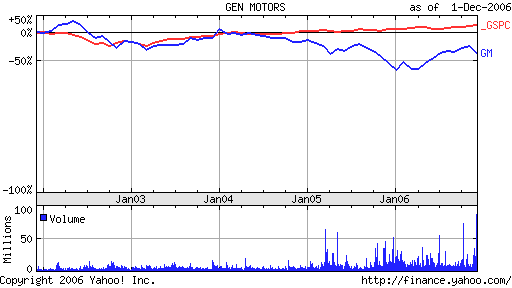
As the nearby Yahoo-sourced five-year price chart for GM and the S&P500 shows (click on the chart to view a larger version), GM was going nowhere for years before Kerkorian showed an interest in the firm. The only significant uptick the company's stock has shown was after the billionaire showed signs of sustained interest in contributing to GM's long-term "turnaround."
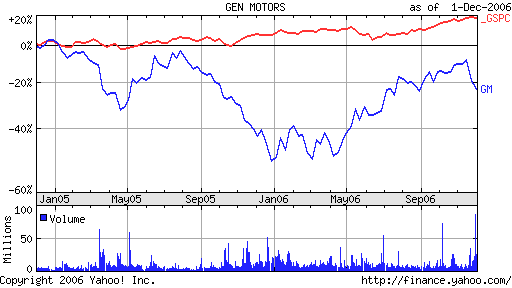
 If I were a GM shareholder, I'd be bolting too, now. The stock was down significantly as Kerkorian pulled the last of his money out of the troubled auto maker. This six-month price chart shows how the stock lost twenty percentage points of gain in November, ending the month even with the index for its six-month performance.
To answer Codina's question, though, Kerkorian, and his sometime-lieutenant, Jerry York, significantly contributed to the rescue of Chrysler by restructuring it and selling it to Daimler-Benz, profiting roughly $3B in the process. So, just on past performance, one would tend to bet on Kerkorian over Wagoner and his board.
 Over the last two years, the company's stock price has behaved like a roller coaster. Rather than listen to York, who was given a seat on the GM board, and Kerkorian, Wagoner played a game of "chicken" with the savvy investor. Now, the shareholders have lost. An investor with a legendary touch for making money, and a genuine interest in the company, and its sector, is gone.
To me, Kerkorian has behaved as a sort of modern-day J.P. Morgan. I mean that in the best sense, as a compliment. He has seen industry restructuring potential where the current CEOs have seen only discomforting change. By considering broad-scale integration of GM and Nissan/Renault, Kerkorian offered shareholders a chance to have a stake in an auto maker which would have had the management talent and market share size to survive, and maybe prosper, in a long-term slugging match with Toyota.
Now, all shareholders have is Wagoner's tired, conventional attempts to stave off disaster. Last week, ironically, the company completed the sale of its controlling interest in its financing arm, GMAC, thus selling the last of the family jewels. With this cash, and the loss of the continuing profit stream from the finance unit, GM has more than mortgaged its future- it simply sold it to for continued short-term survival.
According to various media pundits, Kerkorian may return when GM has suffered sufficient losses for the directors to come to their collective senses. But, given their rebuff of York's suggestions this past fall, one wonders if there will be enough time and money left, whenever that moment comes, for even Kerkorian & Co. to wring value out of what will be a then much-weakened GM.
For now, though, Rick Wagoner is in possession of the field, having seen off both Carlos Ghosn's and Kirk Kerkorian's attempts to help GM shareholders survive the next few years of difficulty.
I was particularly struck by a quote in one of the Wall Street Journal's articles. It had GM director Armando Codina asking,
"Who does this guy from Las Vegas think he is, telling us what to do?"
 This is simply incredible. Perhaps a more important question is,
"Who does Armando Codina think he is, and what does he think he's accomplished as a GM director to create value for the shareholders he represents?"
As the nearby Yahoo-sourced five-year price chart for GM and the S&P500 shows (click on the chart to view a larger version), GM was going nowhere for years before Kerkorian showed an interest in the firm. The only significant uptick the company's stock has shown was after the billionaire showed signs of sustained interest in contributing to GM's long-term "turnaround."
 If I were a GM shareholder, I'd be bolting too, now. The stock was down significantly as Kerkorian pulled the last of his money out of the troubled auto maker. This six-month price chart shows how the stock lost twenty percentage points of gain in November, ending the month even with the index for its six-month performance.
To answer Codina's question, though, Kerkorian, and his sometime-lieutenant, Jerry York, significantly contributed to the rescue of Chrysler by restructuring it and selling it to Daimler-Benz, profiting roughly $3B in the process. So, just on past performance, one would tend to bet on Kerkorian over Wagoner and his board.
 Over the last two years, the company's stock price has behaved like a roller coaster. Rather than listen to York, who was given a seat on the GM board, and Kerkorian, Wagoner played a game of "chicken" with the savvy investor. Now, the shareholders have lost. An investor with a legendary touch for making money, and a genuine interest in the company, and its sector, is gone.
To me, Kerkorian has behaved as a sort of modern-day J.P. Morgan. I mean that in the best sense, as a compliment. He has seen industry restructuring potential where the current CEOs have seen only discomforting change. By considering broad-scale integration of GM and Nissan/Renault, Kerkorian offered shareholders a chance to have a stake in an auto maker which would have had the management talent and market share size to survive, and maybe prosper, in a long-term slugging match with Toyota.
Now, all shareholders have is Wagoner's tired, conventional attempts to stave off disaster. Last week, ironically, the company completed the sale of its controlling interest in its financing arm, GMAC, thus selling the last of the family jewels. With this cash, and the loss of the continuing profit stream from the finance unit, GM has more than mortgaged its future- it simply sold it to for continued short-term survival.
According to various media pundits, Kerkorian may return when GM has suffered sufficient losses for the directors to come to their collective senses. But, given their rebuff of York's suggestions this past fall, one wonders if there will be enough time and money left, whenever that moment comes, for even Kerkorian & Co. to wring value out of what will be a then much-weakened GM.
For now, though, Rick Wagoner is in possession of the field, having seen off both Carlos Ghosn's and Kirk Kerkorian's attempts to help GM shareholders survive the next few years of difficulty.
Friday, December 01, 2006
More On Brand Strategies: Hormel
Wednesday's Wall Street Journal carried an article on Hormel's attempt to "Add Upscale Foods Without Alienating Lovers of Its Spam." In short, to broaden its product line and stoke growth without screwing up its brand identity.
What struck me about this was a quote by Hormel's lawyer-turned-CEO, Jeffrey Ettinger,
"Hormel stands for canned ham, bacon and more traditional products. We don't want to harm these items with the target consumers."
Well, score one for Mr. Ettinger getting half of the concept of branding right. Unfortunately, the article begins by describing the company's failed attempt to market ethnic foods of restaurant quality.
The piece also lists the components of Spam, and how it is actually made. I won't go into the details here- if you're interested in them, wait a couple hours after eating, then go read the Journal article. Suffice to say, it is hard to see how a company which has staked its brand on a product like that can actually believe anyone would also buy haute cuisine from the same kitchens.
As I wrote here in September of last year, about Les Wexner's Limited Brands strategy, Hormel could simply create a new brand identity for these upscale offerings. For example, Frito-Lay acquired Stacy's Pita Chips last year, as described here. The announcement states,
"Stacy's, which will continue to be based in Randolph, MA, with more than 100 employees, is planned to operate as a separate unit and report to Frito-Lay North America chairman and chief executive officer Irene Rosenfeld."
I Googled Stacy's Pita Chips and had to search through two screens to learn who the acquirer was. I was aware some large food company had acquired it, but could recall which one. It is nowhere to be seen on the Stacy's packages.
Why can't Hormel do likewise?
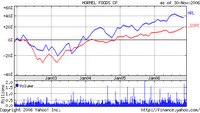 As the nearby Yahoo-sourced, five-year price chart of Hormel and the S&P500 shows (click on the chart to view a larger version), the company has actually done rather well over the period. Most of its outperformance seems to have come from its sagging far less than the index when the technology bubble burst at the beginning of this decade. However, it has at least kept pace with the S&P, which is no mean feat.
I think the WSJ piece illustrates the pitfalls of listening to CEOs on media venues such as CNBC, and presuming each of them knows what he is doing. Ettinger has had the job only one year, with no external candidates being considered. Taking Hormel into more 'natural' processed food niches would not seem to be a brand-enhancing strategy. Witness Wal-Mart's floundering with its new upscale fashion merchandising strategy this year.
Instead, Hormel should probably stick to more brand extensions for Spam, as it has been doing. The company seems to know this consumer segment of older males well, so mining it further is more likely to bring profitable sales than going after young ethnic mothers.
Why is the fundamental concept of branding seemingly so difficult for companies tounderstandd? Why do CEOs and group managers attempt to make a successful brand straddle multiple segments which have differing buyer values? How do managers who do this wind up as CEOs?
Now there's a question for those interested in shareholder democracy and corporate governance.
What struck me about this was a quote by Hormel's lawyer-turned-CEO, Jeffrey Ettinger,
"Hormel stands for canned ham, bacon and more traditional products. We don't want to harm these items with the target consumers."
Well, score one for Mr. Ettinger getting half of the concept of branding right. Unfortunately, the article begins by describing the company's failed attempt to market ethnic foods of restaurant quality.
The piece also lists the components of Spam, and how it is actually made. I won't go into the details here- if you're interested in them, wait a couple hours after eating, then go read the Journal article. Suffice to say, it is hard to see how a company which has staked its brand on a product like that can actually believe anyone would also buy haute cuisine from the same kitchens.
As I wrote here in September of last year, about Les Wexner's Limited Brands strategy, Hormel could simply create a new brand identity for these upscale offerings. For example, Frito-Lay acquired Stacy's Pita Chips last year, as described here. The announcement states,
"Stacy's, which will continue to be based in Randolph, MA, with more than 100 employees, is planned to operate as a separate unit and report to Frito-Lay North America chairman and chief executive officer Irene Rosenfeld."
I Googled Stacy's Pita Chips and had to search through two screens to learn who the acquirer was. I was aware some large food company had acquired it, but could recall which one. It is nowhere to be seen on the Stacy's packages.
Why can't Hormel do likewise?
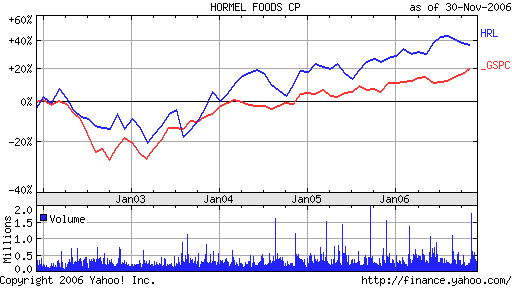 As the nearby Yahoo-sourced, five-year price chart of Hormel and the S&P500 shows (click on the chart to view a larger version), the company has actually done rather well over the period. Most of its outperformance seems to have come from its sagging far less than the index when the technology bubble burst at the beginning of this decade. However, it has at least kept pace with the S&P, which is no mean feat.
I think the WSJ piece illustrates the pitfalls of listening to CEOs on media venues such as CNBC, and presuming each of them knows what he is doing. Ettinger has had the job only one year, with no external candidates being considered. Taking Hormel into more 'natural' processed food niches would not seem to be a brand-enhancing strategy. Witness Wal-Mart's floundering with its new upscale fashion merchandising strategy this year.
Instead, Hormel should probably stick to more brand extensions for Spam, as it has been doing. The company seems to know this consumer segment of older males well, so mining it further is more likely to bring profitable sales than going after young ethnic mothers.
Why is the fundamental concept of branding seemingly so difficult for companies tounderstandd? Why do CEOs and group managers attempt to make a successful brand straddle multiple segments which have differing buyer values? How do managers who do this wind up as CEOs?
Now there's a question for those interested in shareholder democracy and corporate governance.
Thursday, November 30, 2006
Citi v. BofA : Which Is Larger? Who Cares?
There seems to be a lot of media-generated hoopla this week over the increase in Bank of American's market capitalization to exceed that of CitiGroup.
The Money and Investing section of the Wall Street Journal even carried an article yesterday with a chart box headline reading, "There's a new No. 1." CNBC had a special segment featuring Jim Cramer opining on which bank to buy. The network covered the mock "choice" with great fanfare.
To me, this is a silly contest of size between two financial utilities with more similarities than differences. Size of this sort can, and was, purchased. Especially by BofA, which is, in truth, NCNB (which became NationsBank) of Charlotte, which bought the right to rebrand itself with the storied name and logo of the San Francisco takeover victim.
 First, let me go on record as stating that the only measure that matters is a longish-term total return for shareholders. As a quick approximation of this, here's a Yahoo-sourced price chart (please click on the chart to see a larger version) of BofA, Citi and the S&P500 for nearly 20 years.
I thought it would be interesting to look at how similar the change in stock prices have been throughout the long period. Since 2000, there hasn't been all that much difference in the slopes of the curves for the two banks. It's clear that whatever outperformance Citi has enjoyed came in the 1998-2000 timeframe.
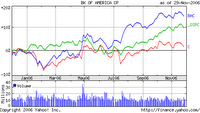 For clarity, though, here's the same chart, for just the last five years. BofA is clearly superior at having generated superior total returns. It confirms, in greater detail, that Citi's best performance period was more than five years ago.
All this is somewhat interesting, but perhaps misses the point. In five years, the better performing bank of the two only returned roughly 15%, total. Plus dividends. CitiGroup is a little better than flat, and worse than the S&P.
With a performance like this, maybe something should change at Citi.
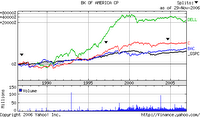 To put this in perspective, let's look at how a fallen growth stock stacks up against these two "large" banks.
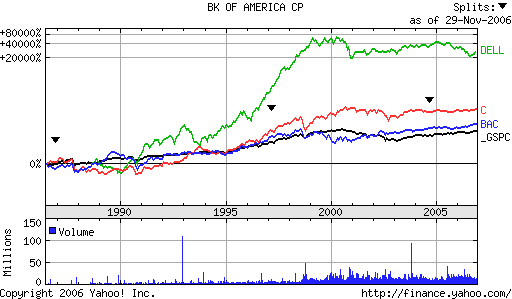
In this chart, I've added Dell to the earlier long-term comparison of Citi, BofA, and the S&P500.
It sort of puts things in perspective for me. All this hue and cry over which bank is larger seems, for me, to rapidly fade into the background, as I see the much larger gain in stock price in Dell over the period. The two banks are literally not even in the same league. Not even after Dell plateaued six years ago.
As an investor, I can't say I even care which bank has which market cap. Both have such anemic returns over the last half decade that I doubt my strategy's selection process would include either company in my equity portfolio.
Yet another case of entertainment trumping news. The 'news' being, no matter which firm is larger, or how large they get, they still can't deliver consistently superior total returns for their shareholders. If one of them could? Now that would be news to me.
The Money and Investing section of the Wall Street Journal even carried an article yesterday with a chart box headline reading, "There's a new No. 1." CNBC had a special segment featuring Jim Cramer opining on which bank to buy. The network covered the mock "choice" with great fanfare.
To me, this is a silly contest of size between two financial utilities with more similarities than differences. Size of this sort can, and was, purchased. Especially by BofA, which is, in truth, NCNB (which became NationsBank) of Charlotte, which bought the right to rebrand itself with the storied name and logo of the San Francisco takeover victim.
 First, let me go on record as stating that the only measure that matters is a longish-term total return for shareholders. As a quick approximation of this, here's a Yahoo-sourced price chart (please click on the chart to see a larger version) of BofA, Citi and the S&P500 for nearly 20 years.
I thought it would be interesting to look at how similar the change in stock prices have been throughout the long period. Since 2000, there hasn't been all that much difference in the slopes of the curves for the two banks. It's clear that whatever outperformance Citi has enjoyed came in the 1998-2000 timeframe.
 For clarity, though, here's the same chart, for just the last five years. BofA is clearly superior at having generated superior total returns. It confirms, in greater detail, that Citi's best performance period was more than five years ago.
All this is somewhat interesting, but perhaps misses the point. In five years, the better performing bank of the two only returned roughly 15%, total. Plus dividends. CitiGroup is a little better than flat, and worse than the S&P.
With a performance like this, maybe something should change at Citi.
 To put this in perspective, let's look at how a fallen growth stock stacks up against these two "large" banks.
In this chart, I've added Dell to the earlier long-term comparison of Citi, BofA, and the S&P500.
It sort of puts things in perspective for me. All this hue and cry over which bank is larger seems, for me, to rapidly fade into the background, as I see the much larger gain in stock price in Dell over the period. The two banks are literally not even in the same league. Not even after Dell plateaued six years ago.
As an investor, I can't say I even care which bank has which market cap. Both have such anemic returns over the last half decade that I doubt my strategy's selection process would include either company in my equity portfolio.
Yet another case of entertainment trumping news. The 'news' being, no matter which firm is larger, or how large they get, they still can't deliver consistently superior total returns for their shareholders. If one of them could? Now that would be news to me.
Wednesday, November 29, 2006
In Pursuit of The New York Times
There seems to be a run on the New York Times group, or parts thereof, by retired or 'removed' CEOs.
First Jack Welch & Co. want to pry the Boston Globe away from the company.
Now we learn that AIG former-CEO Hank Greenberg is building a position in the parent company.
What gives with these ex-CEOs going after the NYTimes?
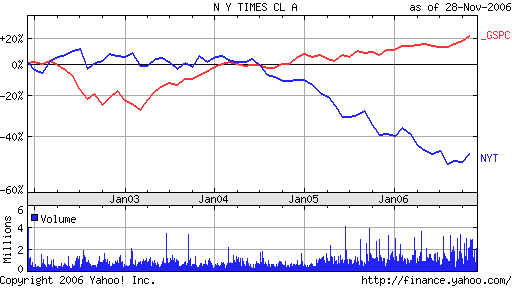
I've pasted a Yahoo-sourced price chart of the NYT vs. the S&P500 Index for the past five years (click on the chart to view the enlarged version). It isn't pretty. The newpaper group is down more than 40% over the period, while the index has risen roughly 20%, for a 60 percentage point difference.
Revenues are shrinking, as are profits. Over the five year period, revenues have oscillated, but finished essentially flat, while profits did about the same. Except for a recent, severe dip.
So, why the sudden interest by Greenberg and Welch in these basket case newspapers? Has nobody told them what Google, eBay and Yahoo are doing to the classified ad business of newspapers, as well as general print advertising? Are they unaware that many people receive their news online now, rather than reading a daily paper?
What would have to happen to turn these papers around? What is it Welch and Greenberg bring to the table that is missing from current management, or anyone else?
I am genuinely curious about why the sudden rush to either buy or dismember the NY Times group. Is it all charity and philanthrophy, to save the jobs of pressmen and beat reporters? Or do Greenberg and Welch see profits where nobody else does?
Tuesday, November 28, 2006
Apple's Competitors Take Aim At iPod & iTunes
Yesterday's Wall Street Journal featured a special section on home entertainment. The lead piece focused on Apple's dominance of digital music distribution.
According to the article, iPod/iTunes holds a 71% share of the market, while EMusic is second, with only 10%.
I can't recall that last time I bought a full-priced CD in a retail store. The last time I bought large numbers of CDs was over six years ago, from the now defunct website, CDNow. That's how much Apple has changed the experience of buying, and playing music.
The main point of the Journal's piece on digital music was that none of the also-rans to Apple are trying to take it on directly. Through various approaches involving monthly fees, limited play of free copies of songs, most competitors hope to attract users willing to adopt a different music purchase and/or listening system.
Only Microsoft's Zune is configured to be just like the Apple iPods. That is, the pricing and general content acquisition models are similar. However, the Zune is much bulkier than the iPods, looking as if it had been rushed out prematurely for this Christmas season. The article quotes an analyst as believing that Microsoft is the only company capable of taking on Apple directly with a nearly-identical system for music distribution and playing.
Looking at the 'music leasing' model of several iPod competitors, I wonder how many of those users feel like I do, and want to own their content? I've never personally been interested in paying to lease music I like for a few months. So, realistically, with such high market penetration by Apple already, I doubt any of them have much long-term potential to earn consistently superior returns with their strategies.
As for Microsoft, I see their Zune offering as similar, in a corporate sense, to their XBox division. Microsoft is slowly creating standalone product groups to create new hardware which will pull software along with it. As such, these new groups could just as easily have had different logos and corporate names, even if funded by Microsoft.
This is very close to my earlier recommendations for just such a split among the company's disparate units.
However, since they remain as Microsoft groups, I can't help but wonder if their potential to earn total returns is lost among the still-huge revenue streams from conventional PC software sales. For all the hype about new directions at Microsoft, and new blood, their corporate form pretty much guarantees that most new initiatives won't be sufficiently large to move the share price, and, thus, total return, needle.
Apple by contrast, has a 70% total return just from July. Their nimbleness and focus on growth-oriented product markets is resulting in a much better experience for their shareholders.
From what I read in the WSJ yesterday concerning digital music, I don't see any competitors dethroning Apple any time soon. So many consumers have already bought and stored music in the firm's proprietary format, that I just don't expect they will have compelling reasons to switch brands in the near future.
According to the article, iPod/iTunes holds a 71% share of the market, while EMusic is second, with only 10%.
I can't recall that last time I bought a full-priced CD in a retail store. The last time I bought large numbers of CDs was over six years ago, from the now defunct website, CDNow. That's how much Apple has changed the experience of buying, and playing music.
The main point of the Journal's piece on digital music was that none of the also-rans to Apple are trying to take it on directly. Through various approaches involving monthly fees, limited play of free copies of songs, most competitors hope to attract users willing to adopt a different music purchase and/or listening system.
Only Microsoft's Zune is configured to be just like the Apple iPods. That is, the pricing and general content acquisition models are similar. However, the Zune is much bulkier than the iPods, looking as if it had been rushed out prematurely for this Christmas season. The article quotes an analyst as believing that Microsoft is the only company capable of taking on Apple directly with a nearly-identical system for music distribution and playing.
Looking at the 'music leasing' model of several iPod competitors, I wonder how many of those users feel like I do, and want to own their content? I've never personally been interested in paying to lease music I like for a few months. So, realistically, with such high market penetration by Apple already, I doubt any of them have much long-term potential to earn consistently superior returns with their strategies.
As for Microsoft, I see their Zune offering as similar, in a corporate sense, to their XBox division. Microsoft is slowly creating standalone product groups to create new hardware which will pull software along with it. As such, these new groups could just as easily have had different logos and corporate names, even if funded by Microsoft.
This is very close to my earlier recommendations for just such a split among the company's disparate units.
However, since they remain as Microsoft groups, I can't help but wonder if their potential to earn total returns is lost among the still-huge revenue streams from conventional PC software sales. For all the hype about new directions at Microsoft, and new blood, their corporate form pretty much guarantees that most new initiatives won't be sufficiently large to move the share price, and, thus, total return, needle.
Apple by contrast, has a 70% total return just from July. Their nimbleness and focus on growth-oriented product markets is resulting in a much better experience for their shareholders.
From what I read in the WSJ yesterday concerning digital music, I don't see any competitors dethroning Apple any time soon. So many consumers have already bought and stored music in the firm's proprietary format, that I just don't expect they will have compelling reasons to switch brands in the near future.
Monday, November 27, 2006
A Private Equity Bubble?
The Saturday/Sunday edition of the Wall Street Journal is typically rather lightweight in content. My partner is of the opinion that much of the edition is filler that wouldn't make the weekday paper.
However, this weekend's "Breaking Views/Insights on Investing" discussed the recent Blackstone private takeover of Equity Office Properties from the perspective of bubble investing.
I admit to having forgotten how the Federated/Campeau fiasco drove then-independent First Boston into the arms of Credit Suisse. The American investment bank had funded Campeau's takeover of Federated stores with a bridge loan which it held, anticipating syndicating the loan among other institutions. First Boston proved unable to do this, and, thus, took the loss as Federated went bankrupt in 1990.
Sixteen years is a long time. Now, Blackstone Group is paying $36B in the largest private equity takeover of all time. According to the WSJ piece, Goldman Sachs and Bank of America are risking some $3.5B of their shareholder's capital by holding a block of the deals equity.
I'm not familiar with the economics of the underlying transaction. Perhaps Blackstone feels that commercial property has bottomed, and now is the time to buy. Or perhaps it just feels that the outlook for commercial property rents and appreciation are more attractive than the market does. Either way, it's a very large move.
Leaving two publicly-held banks, Goldman and BofA, with 10% of the deal's financing of which to dispose, seems peculiarly risky. This is the sort of thing, as the Journal article reminds us, that goes bad in an instant, with no way to recoup the losses. The reason the authors give for this funding move is simply that the fee income from funding this deal is enormous.
That this is an attractive alternative for the two firms suggests the extent to which they now feel they must take capital risks in order to generate income.
And, of course, it probably won't take much of a shadow of uncertainty to cloud the deal's fortunes such that the 'equity block' that these two companies hold declines by far more than the amount of the fees they're booking.
As always, time will tell.......
However, this weekend's "Breaking Views/Insights on Investing" discussed the recent Blackstone private takeover of Equity Office Properties from the perspective of bubble investing.
I admit to having forgotten how the Federated/Campeau fiasco drove then-independent First Boston into the arms of Credit Suisse. The American investment bank had funded Campeau's takeover of Federated stores with a bridge loan which it held, anticipating syndicating the loan among other institutions. First Boston proved unable to do this, and, thus, took the loss as Federated went bankrupt in 1990.
Sixteen years is a long time. Now, Blackstone Group is paying $36B in the largest private equity takeover of all time. According to the WSJ piece, Goldman Sachs and Bank of America are risking some $3.5B of their shareholder's capital by holding a block of the deals equity.
I'm not familiar with the economics of the underlying transaction. Perhaps Blackstone feels that commercial property has bottomed, and now is the time to buy. Or perhaps it just feels that the outlook for commercial property rents and appreciation are more attractive than the market does. Either way, it's a very large move.
Leaving two publicly-held banks, Goldman and BofA, with 10% of the deal's financing of which to dispose, seems peculiarly risky. This is the sort of thing, as the Journal article reminds us, that goes bad in an instant, with no way to recoup the losses. The reason the authors give for this funding move is simply that the fee income from funding this deal is enormous.
That this is an attractive alternative for the two firms suggests the extent to which they now feel they must take capital risks in order to generate income.
And, of course, it probably won't take much of a shadow of uncertainty to cloud the deal's fortunes such that the 'equity block' that these two companies hold declines by far more than the amount of the fees they're booking.
As always, time will tell.......
Sunday, November 26, 2006
US Airways Bid for Delta

The recent USAirways bid for Delta has sparked quite a bit of business media comment. Holman Jenkins wrote a good piece on Wednesday in the Wall Street Journal.
Essentially, he notes that US Airways CEO Doug Parker's proposed acquisition "might have been inspired by the old joke about two hunters trying to outrun a bear."
Just so. As the Yahoo-sourced chart of US Airways', Delta's, and the S&P500's prices for the past two years (click on chart to see an enlarged version) illustrates, It is not a merger of two strong competitors.
Delta is in bankruptcy. US Airways is somewhat difficult to track prior to a year or so ago, when, thru a merger, the price trail was more or less obliterated, as America West took US Airways' name.
However, in the past year, US Airways has clearly outperformed the S&P, while Delta languishes. Contrary to the pundits who declare that most desirable airline mergers combine non-overlapping airlines, this one promises to help remove excess capacity in similar markets. Which, of course, should firm up pricing for US Airways. Additionally, as Jenkins noted in his piece, it leaves the merged airline with slots at Kennedy and O'Hare, where new entrants have difficulty obtaining gates.
So much for the value of the merger.
However, the larger issue, to me, is competition in an industry in which so much of the business model is either shared and in common with competitors, or easily obtainable, thus lowering barriers to entry.
Specifically, all airlines must, of necessity, use the same airports. Thus, they rely on shared airport management, the FAA, baggage systems, and, in some cases, reservation systems. Anyone with money can start and airline and lease planes from the usual suspects, including GE Capital.
Thus, little is left in the control of an airline's management to actually make a sustained difference to customers, for which the latter will pay revenues that drive a consistently superior total return in the market.
I've pondered this sector for some time, as Southwest Air is, to my knowledge, the only airline ever to be selected, using my quantitative, disciplined process, for my equity portfolio.
This proposed merger does not alter my view. I think in the current market structure, a focus on building a regional strength, with low costs due to common equipment, for maximum use of crews and low training and maintenance costs, are key. The hub and spoke system probably means there are regional physical barriers to airline growth, if the company wishes to enjoy any significant period of consistently superior total returns.
Moving beyond that typically sees an airline struggle with expensive logistical issues and traffic feeder/load factor issues.
It could well be, thanks to the structure of this sector, that its players are simply unlikely to earn many years of consistently superior total returns.
Wednesday, November 22, 2006
Comcast To Distribute Disney Video Content
Yesterday's Wall Street Journal announced the pending deal between Comcast and Disney, in which the former would distribute the latter's video content.
In this prior post, I've opined that Comcast is aiming for a very narrow window with this online content distribution strategy. Overall, I think it's a mistake.
Now, with my recent posts about Yahoo, management buyouts and pension plans recently echoed and supported by major media pundits, and my year-old warnings about GM and Ford now routinely substantiated, perhaps Comcast is my one forecasting mistake. It's too early to tell yet.
In discussing this with my partner, I asked, what would have to happen for Comcast's move to be correct, profitable, and lead to consistently superior total returns over the next few years.
Blogger is not cooperating with my attempt to paste a stock price chart for the past 5 years for Comcast and the S&P500. It would show that Comcast has been up and down, with a net performance that is essentially flat, and below the S&P.
My guess is that viewers would not look directly to content producers on the web, and content producers, or the various existing 'channels' on cable, would not open up shop with URLS on the web to sell programming directly to viewers.
Comcast does seem to have scored a coup in getting Disney content for its on demand services. But isn't some of that already available, 'on demand,' on Disney's own site, or iTunes? Note that no part of this deal with Disney is "exclusive." And it is purported to be worth $1B to Disney.
For just a moment, let's stop and give Bob Iger yet more credit for being a very astute CEO. I think I am hoping Disney enters my portfolio selections soon. Iger just got a cable company to pay him for content that, when it appears on a cable channel, he has to pay them to take. And he didn't even have to agree to anything exclusive.
OK, back to Comcast. With iTV scheduled to arrive in the late Spring, it should be technically feasible for viewers and content producers to use the internet as it is best used- a direct, totally-disintermediating approach that allows the viewer and content producer to do business with each other. There will probably also be software vendors offering easy-to-use, web-based products which coordinate the viewer's preference, online availability of content, and the programming of iTV and whatever competitor products meet it in the marketplace.
The question is, how many people will be very late adopters, even with such tools available, and look to Comcast for their total viewing needs? And, moreover, switch to Comcast digital on-demand to get these programs?
Would it not seem reasonable to assume that most people for whom this would be attractive either already have digital on-demand, or buy premium channels from Comcast? Doesn't this new supply of Disney content in some sense constitute free new offerings for existing digital customers? How many people will actually buy Comcast digital just for these new Disney offerings?
If this were an exclusive distribution deal, I'd be a whole lot more inclined to believe it will make a huge difference for Comcast. As it is, I believe there are enough other distribution outlets from which to view much of this content, as to make this Comcast deal far less than one which will materially contribute to its ability to earn consistently superior returns for its shareholders.
In this prior post, I've opined that Comcast is aiming for a very narrow window with this online content distribution strategy. Overall, I think it's a mistake.
Now, with my recent posts about Yahoo, management buyouts and pension plans recently echoed and supported by major media pundits, and my year-old warnings about GM and Ford now routinely substantiated, perhaps Comcast is my one forecasting mistake. It's too early to tell yet.
In discussing this with my partner, I asked, what would have to happen for Comcast's move to be correct, profitable, and lead to consistently superior total returns over the next few years.
Blogger is not cooperating with my attempt to paste a stock price chart for the past 5 years for Comcast and the S&P500. It would show that Comcast has been up and down, with a net performance that is essentially flat, and below the S&P.
My guess is that viewers would not look directly to content producers on the web, and content producers, or the various existing 'channels' on cable, would not open up shop with URLS on the web to sell programming directly to viewers.
Comcast does seem to have scored a coup in getting Disney content for its on demand services. But isn't some of that already available, 'on demand,' on Disney's own site, or iTunes? Note that no part of this deal with Disney is "exclusive." And it is purported to be worth $1B to Disney.
For just a moment, let's stop and give Bob Iger yet more credit for being a very astute CEO. I think I am hoping Disney enters my portfolio selections soon. Iger just got a cable company to pay him for content that, when it appears on a cable channel, he has to pay them to take. And he didn't even have to agree to anything exclusive.
OK, back to Comcast. With iTV scheduled to arrive in the late Spring, it should be technically feasible for viewers and content producers to use the internet as it is best used- a direct, totally-disintermediating approach that allows the viewer and content producer to do business with each other. There will probably also be software vendors offering easy-to-use, web-based products which coordinate the viewer's preference, online availability of content, and the programming of iTV and whatever competitor products meet it in the marketplace.
The question is, how many people will be very late adopters, even with such tools available, and look to Comcast for their total viewing needs? And, moreover, switch to Comcast digital on-demand to get these programs?
Would it not seem reasonable to assume that most people for whom this would be attractive either already have digital on-demand, or buy premium channels from Comcast? Doesn't this new supply of Disney content in some sense constitute free new offerings for existing digital customers? How many people will actually buy Comcast digital just for these new Disney offerings?
If this were an exclusive distribution deal, I'd be a whole lot more inclined to believe it will make a huge difference for Comcast. As it is, I believe there are enough other distribution outlets from which to view much of this content, as to make this Comcast deal far less than one which will materially contribute to its ability to earn consistently superior returns for its shareholders.
Tuesday, November 21, 2006
Yahoo Insiders Confirm My Suspicions
It seems to be the week for the business media reporting stories that I wrote about far in advance.
This time, it's a leaked memo from a Yahoo SVP regarding the company's inability to dominate any of the many areas in which it has invested over time. I wrote about that in several posts, most notably here. I wrote, "Yahoo blasted onto the scene with a dizzying variety of services, but no clear focus. It seems to offer a bit of everything, and the best of nothing."
This is essentially the thrust of the now-famous "Peanut Butter Manifesto," written by Brad Garlinghouse, and reported in Saturday's edition of the Wall Street Journal. It echoes almost exactly my sentiments in the linked post.
There's not a lot new to say about the issue, except that Google's stock price broke above $500/share today, which marks a significant P/e multiple for that company.
Suffice to say, reading the WSJ story gave me renewed confidence in my strategic diagnostic skills and instincts.
A third story ran today, though, in the Journal, that is a bit different, and the subject of the next post.
This time, it's a leaked memo from a Yahoo SVP regarding the company's inability to dominate any of the many areas in which it has invested over time. I wrote about that in several posts, most notably here. I wrote, "Yahoo blasted onto the scene with a dizzying variety of services, but no clear focus. It seems to offer a bit of everything, and the best of nothing."
This is essentially the thrust of the now-famous "Peanut Butter Manifesto," written by Brad Garlinghouse, and reported in Saturday's edition of the Wall Street Journal. It echoes almost exactly my sentiments in the linked post.
There's not a lot new to say about the issue, except that Google's stock price broke above $500/share today, which marks a significant P/e multiple for that company.
Suffice to say, reading the WSJ story gave me renewed confidence in my strategic diagnostic skills and instincts.
A third story ran today, though, in the Journal, that is a bit different, and the subject of the next post.
The NYTimes Confirms My Views on Pensions and Private Equity Management Buyouts
In prior posts, here and here, I have written about the mistakes unions made years ago with pensions, and the conflicts of interest of managements as they lead buyouts of public companies. Recently, the New York Times has published pieces echoing my thoughts from months ago- September of 2005 for healthcare, which is similar to the pension debacle, and August of this year for buyouts.
It gives me a very good feeling to know I called these issues far in advance of one of the nation's leading newspapers. It's even better to know I have an even simpler solution than the one proposed by the NYTimes writer concerning buyouts.
Joe Nocera wrote "Resolving to Reimagine Health Costs," which focuses on the third-party payer health care mess. My contention is that pensions are essentially the same thing, in terms of accepting promises to pay from a company which is, typically, an adversary of the worker's union. Similar to accepting non-cash value from a company for health care, accepting promises in lieu of cash for pensions also makes for distorted decision-making.
Two days ago, Andrew Ross Sorkin wrote "Rewriting the Rules for Buyouts," recommending a complicated process by which a majority of minority shareholders should have final say in the approval of a management-led buyout. I believe my idea, expressed in the second linked piece above, is both simpler and allows for greater shareholder choice. Simply allow any shareholders to be part of the buyout, if they so choose, on the terms of the offer. This would insulated them from any supposed bad effects of being forced to sell out to the going-private group.
Given this past week's flurry of ever-increasingly large buyouts, such as Clear Channel and a large REIT, the issue is still relevant.
Since I hope to identify trends and challenges which are developing in business, and affect companies' abilities to earn consistently superior total returns, it's very gratifying to know I identified these issues long before a major news and opinion organization like the Times got around to them.
It gives me a very good feeling to know I called these issues far in advance of one of the nation's leading newspapers. It's even better to know I have an even simpler solution than the one proposed by the NYTimes writer concerning buyouts.
Joe Nocera wrote "Resolving to Reimagine Health Costs," which focuses on the third-party payer health care mess. My contention is that pensions are essentially the same thing, in terms of accepting promises to pay from a company which is, typically, an adversary of the worker's union. Similar to accepting non-cash value from a company for health care, accepting promises in lieu of cash for pensions also makes for distorted decision-making.
Two days ago, Andrew Ross Sorkin wrote "Rewriting the Rules for Buyouts," recommending a complicated process by which a majority of minority shareholders should have final say in the approval of a management-led buyout. I believe my idea, expressed in the second linked piece above, is both simpler and allows for greater shareholder choice. Simply allow any shareholders to be part of the buyout, if they so choose, on the terms of the offer. This would insulated them from any supposed bad effects of being forced to sell out to the going-private group.
Given this past week's flurry of ever-increasingly large buyouts, such as Clear Channel and a large REIT, the issue is still relevant.
Since I hope to identify trends and challenges which are developing in business, and affect companies' abilities to earn consistently superior total returns, it's very gratifying to know I identified these issues long before a major news and opinion organization like the Times got around to them.
Monday, November 20, 2006
Online Banking
Saturday's Wall Street Journal featured an article on the current generation of online banking. It brought back memories from my days at Chase Manhattan Bank in the 1980s.
To be sure, twenty years is a virtual eternity in a technology area like this. When I arrived at Chase, Citibank had recently discontinued its own home banking project, which included script that one would print out as "money" on a home printer. Back then, the biggest obstacle to "home banking," as it was then known, was the inability to simply use a personal computer as an ATM.
Chase had two separate electronic banking groups operating in the mid-1980s. Believe it or not, we lost money on every customer in the "online bill paying" product. That was because the customer entered the electronic bill payment, but Chase had a roomful of low-level employees writing checks on a Chase account to physically send, for the customer, to the payee.
Oh, how times have changed!
The WSJ piece rightly points out that online, home or electronic banking- choose your preferred name for the service- tends to wrap you up in the bank's clutches in a rather irreversible manner. As such, by making you captive, their economic propositions, in terms of loan rates, terms, deposit rates, etc., will tend to get a little worse, since you can't easily leave the relationship.
This is one reason I don't personally participate in online banking. Although, I admit, the potential to manage cash disbursements to the day is vaguely appealing. Then again, I have worked at a bank, and am aware of the culture of finger-pointing and unaccountability when an error is made. Heaven help the poor customer who tries to manage cash flow by timing payments closely, and ends up late on the mortgage or utility accounts, thanks to uncontrollable network problems.
I was also struck by the popularity of third-party, omnibus account aggregator services, which allow all ones disparate financial institutional relationships to be presented, online, in one place. On the plus side, this keeps each institution at arms length. On the minus side, you risk a lot of security with an essentially unregulated, reporting and processing vendor.
According to the article, electronic customers are 27% more profitable, and online bill paying has now risen to a 15% market share, from just 4.8% in 2001. As many as 40% of US households now do some online banking.
Which brings me to the point of this post. As the piece suggested, online banking is now moving into the phase of differentiation. Banks need to provide distinctive assortments of offerings online, in order to gain some advantage from it.
Does this not begin to resemble the earlier eras? More technology expenditures to gain new users and share, moving the user base from early adopters to late adopters? Will these later users, perhaps including me, open more accounts and provide more profits due to online usage?
It's an interesting intellectual and business question. Investments are made on the profitability and usage data of current online banking customers, but the eventual drivers of such numbers will be the masses of customers which banks hope will migrate out of branches and onto cyber connections.
Granted, there is a likely cost saving in servicing accounts online. With ATMs probably accounting for most cash transactions, online banking offers the promise of dispensing with an avalanche of paper check processing for large banks. But will these profits be offset by communications and technology expenditures? Will the online services be free? My guess is, eventually, "yes."
All of which confirms my continuing view of these mega-banks as the financial super-utilities that my friend, B, foresaw in 1996. I would not bet that any one bank will see its total returns rise over time on the back of online banking. They might not fall too far, due to the cost savings, but I'm guessing that significant revenue gains won't come from this area. And, in the end, the easiest way to earn consistently superior total returns is to engineer consistently superior revenue growth.
To be sure, twenty years is a virtual eternity in a technology area like this. When I arrived at Chase, Citibank had recently discontinued its own home banking project, which included script that one would print out as "money" on a home printer. Back then, the biggest obstacle to "home banking," as it was then known, was the inability to simply use a personal computer as an ATM.
Chase had two separate electronic banking groups operating in the mid-1980s. Believe it or not, we lost money on every customer in the "online bill paying" product. That was because the customer entered the electronic bill payment, but Chase had a roomful of low-level employees writing checks on a Chase account to physically send, for the customer, to the payee.
Oh, how times have changed!
The WSJ piece rightly points out that online, home or electronic banking- choose your preferred name for the service- tends to wrap you up in the bank's clutches in a rather irreversible manner. As such, by making you captive, their economic propositions, in terms of loan rates, terms, deposit rates, etc., will tend to get a little worse, since you can't easily leave the relationship.
This is one reason I don't personally participate in online banking. Although, I admit, the potential to manage cash disbursements to the day is vaguely appealing. Then again, I have worked at a bank, and am aware of the culture of finger-pointing and unaccountability when an error is made. Heaven help the poor customer who tries to manage cash flow by timing payments closely, and ends up late on the mortgage or utility accounts, thanks to uncontrollable network problems.
I was also struck by the popularity of third-party, omnibus account aggregator services, which allow all ones disparate financial institutional relationships to be presented, online, in one place. On the plus side, this keeps each institution at arms length. On the minus side, you risk a lot of security with an essentially unregulated, reporting and processing vendor.
According to the article, electronic customers are 27% more profitable, and online bill paying has now risen to a 15% market share, from just 4.8% in 2001. As many as 40% of US households now do some online banking.
Which brings me to the point of this post. As the piece suggested, online banking is now moving into the phase of differentiation. Banks need to provide distinctive assortments of offerings online, in order to gain some advantage from it.
Does this not begin to resemble the earlier eras? More technology expenditures to gain new users and share, moving the user base from early adopters to late adopters? Will these later users, perhaps including me, open more accounts and provide more profits due to online usage?
It's an interesting intellectual and business question. Investments are made on the profitability and usage data of current online banking customers, but the eventual drivers of such numbers will be the masses of customers which banks hope will migrate out of branches and onto cyber connections.
Granted, there is a likely cost saving in servicing accounts online. With ATMs probably accounting for most cash transactions, online banking offers the promise of dispensing with an avalanche of paper check processing for large banks. But will these profits be offset by communications and technology expenditures? Will the online services be free? My guess is, eventually, "yes."
All of which confirms my continuing view of these mega-banks as the financial super-utilities that my friend, B, foresaw in 1996. I would not bet that any one bank will see its total returns rise over time on the back of online banking. They might not fall too far, due to the cost savings, but I'm guessing that significant revenue gains won't come from this area. And, in the end, the easiest way to earn consistently superior total returns is to engineer consistently superior revenue growth.
Friday, November 17, 2006
Microsoft's Experience With Online Advertising
Today's Wall Street Journal featured a story on Microsoft's long road to embracing online advertising. It followed the gradually rising fortunes of Joanne Bradford, whom the company hired in 2001, from McGraw-Hill, to head that effort. She is soon to be named to head the MSN online group, at just 43 years of age.
That's the basic news contained in the story. The sad part is why it took the company five years to accept Ms. Bradford's strategy and efforts to do the job for which Microsoft hired her. Particularly embarrassing for the company are the reported antics of a David Cole, now on leave from Microsoft, and her one-time manager.
The article reminds me of my years at ATT, where outsiders had to attempt to break through resident narrowmindedness as the telecommunications giant struggled to ready itself for deregulation. Countless middle- and senior-level executives were hired to do jobs which some even more senior ATT executives and officers did not even agree were necessary.
Such seems to have been the case for Joanne Bradford at Microsoft. Meanwhile, as the WSJ piece details, Google roared past the software giant and revolutionized the online advertising business.
In taking five years to finally come to a realization that online ads are important to its future, it makes me wonder if Microsoft has enough time to recover from its mistakes in this area.
And, now, rather than recruit an online business executive, they are simply promoting Ms. Bradford, their online advertising executive. Granted, she seems to have finally persevered and won acceptance of her function at the firm. Does this make her the best overall online business leader?
Personally, I'd think more of Microsoft if it expanded Ms. Bradford's advertising duties and objectives, while recruiting a senior online business executive for the MSN online group.
Blogger is misbehaving today, so I am unable to paste a chart comparing Microsoft's five year stock price with the S&P500. Suffice to say, the latter is up about 20%, and the former is still negative.
Reading stories like this one, about the company's inability to coordinate its hiring and funding of key areas such as online advertising, suggest to me that Microsoft will continue to stumble in its efforts to compete in non-software-based business areas for some time to come.
That's the basic news contained in the story. The sad part is why it took the company five years to accept Ms. Bradford's strategy and efforts to do the job for which Microsoft hired her. Particularly embarrassing for the company are the reported antics of a David Cole, now on leave from Microsoft, and her one-time manager.
The article reminds me of my years at ATT, where outsiders had to attempt to break through resident narrowmindedness as the telecommunications giant struggled to ready itself for deregulation. Countless middle- and senior-level executives were hired to do jobs which some even more senior ATT executives and officers did not even agree were necessary.
Such seems to have been the case for Joanne Bradford at Microsoft. Meanwhile, as the WSJ piece details, Google roared past the software giant and revolutionized the online advertising business.
In taking five years to finally come to a realization that online ads are important to its future, it makes me wonder if Microsoft has enough time to recover from its mistakes in this area.
And, now, rather than recruit an online business executive, they are simply promoting Ms. Bradford, their online advertising executive. Granted, she seems to have finally persevered and won acceptance of her function at the firm. Does this make her the best overall online business leader?
Personally, I'd think more of Microsoft if it expanded Ms. Bradford's advertising duties and objectives, while recruiting a senior online business executive for the MSN online group.
Blogger is misbehaving today, so I am unable to paste a chart comparing Microsoft's five year stock price with the S&P500. Suffice to say, the latter is up about 20%, and the former is still negative.
Reading stories like this one, about the company's inability to coordinate its hiring and funding of key areas such as online advertising, suggest to me that Microsoft will continue to stumble in its efforts to compete in non-software-based business areas for some time to come.
Thursday, November 16, 2006
Wal-Mart In The Democrat Party's Crosshairs
This morning, on CNBC, the co-anchors discussed yesterday's attacks by Democratic Senator Obama (Ill), and former Democratic Senator Edwards (NC), upon Wal-Mart.
It has taken less than two weeks for the Democrats to begin to feel their oats over the prospect of the slimmest of majorities possible in the US Senate, come January.
Both Democrats, heard via recorded statements, excoriated the retailer for its wage levels and structures, and its health care policies. Edwards nebulously referred to "billionaire" senior executives of Wal-Mart, offering no evidence of his assertions, contrasting the alleged wealth to further assertions that low-level employees of the firm must apply for food stamps, school lunch programs, and other governmental transfer payments.
To his lasting credit, co-anchor Joe Kernan, apparently the only sensible, moderate voice on the panel, noted that Edwards offered no proof of his sweeping assertions, and that many individuals and institutions are the actual owners of Wal-Mart, via shareholding positions. Senior executives of the firm, whatever their compensations, are unlikely to hold any significant voting interest in their employer.
As readers of this blog may know, I am no fan of Wal-Mart. In many prior posts, which you may find by searching on the company's name at the top of the page, I have opined that Wal-Mart's executives have made some fairly spectacular blunders in the past year. Additionally, I simply believe that their current business model has run out of room for growth.
However, that does not merit these attacks from liberal Democrats who are prospective candidates for President in 2008. It would seem that, despite their single-seat Senate majority, the Democrats are beginning to behave as if they have veto-proof clout. By Obama's, and Edward's, demagogery, they are already revealing their true intentions, which were carefully hidden during the recent election campaign.
If memory serves me, Wal-Mart's lowest-level employees are now more likely to be part-time. Thus, they would probably not qualify for benefits such as health care. Whether this is a wise strategy or not, time will tell. If it proves to be a lightning rod for this type of publicity and, in time, legislation aimed at Wal-Mart, then it probably will not have been wise. But, this is the nature of free market enterprise. Companies experiment with their business models, within the context of the society and legal environments in which they exist.
My personal opinion is that Wal-Mart is suffering an unusual amount of self-inflicted damage from its various personnel, compensation and marketing strategies. However, the consequence for that should, and may be, a loss of business. It shouldn't be to become the corporate whipping boy of national office-seeking politicians.
Sometimes, the law of unintended consequences acts in exceptionally circuitous ways. It would be ironic indeed if, as a result of their recent victories in both Houses of Congress, the Democrats engaged in such virulent attacks upon the engines of economic wealth creation in America, such as Wal-Mart, so quickly, that they assured their own loss of control in the next cycle of elections.
For more on that theme, see this post.
It has taken less than two weeks for the Democrats to begin to feel their oats over the prospect of the slimmest of majorities possible in the US Senate, come January.
Both Democrats, heard via recorded statements, excoriated the retailer for its wage levels and structures, and its health care policies. Edwards nebulously referred to "billionaire" senior executives of Wal-Mart, offering no evidence of his assertions, contrasting the alleged wealth to further assertions that low-level employees of the firm must apply for food stamps, school lunch programs, and other governmental transfer payments.
To his lasting credit, co-anchor Joe Kernan, apparently the only sensible, moderate voice on the panel, noted that Edwards offered no proof of his sweeping assertions, and that many individuals and institutions are the actual owners of Wal-Mart, via shareholding positions. Senior executives of the firm, whatever their compensations, are unlikely to hold any significant voting interest in their employer.
As readers of this blog may know, I am no fan of Wal-Mart. In many prior posts, which you may find by searching on the company's name at the top of the page, I have opined that Wal-Mart's executives have made some fairly spectacular blunders in the past year. Additionally, I simply believe that their current business model has run out of room for growth.
However, that does not merit these attacks from liberal Democrats who are prospective candidates for President in 2008. It would seem that, despite their single-seat Senate majority, the Democrats are beginning to behave as if they have veto-proof clout. By Obama's, and Edward's, demagogery, they are already revealing their true intentions, which were carefully hidden during the recent election campaign.
If memory serves me, Wal-Mart's lowest-level employees are now more likely to be part-time. Thus, they would probably not qualify for benefits such as health care. Whether this is a wise strategy or not, time will tell. If it proves to be a lightning rod for this type of publicity and, in time, legislation aimed at Wal-Mart, then it probably will not have been wise. But, this is the nature of free market enterprise. Companies experiment with their business models, within the context of the society and legal environments in which they exist.
My personal opinion is that Wal-Mart is suffering an unusual amount of self-inflicted damage from its various personnel, compensation and marketing strategies. However, the consequence for that should, and may be, a loss of business. It shouldn't be to become the corporate whipping boy of national office-seeking politicians.
Sometimes, the law of unintended consequences acts in exceptionally circuitous ways. It would be ironic indeed if, as a result of their recent victories in both Houses of Congress, the Democrats engaged in such virulent attacks upon the engines of economic wealth creation in America, such as Wal-Mart, so quickly, that they assured their own loss of control in the next cycle of elections.
For more on that theme, see this post.
Wednesday, November 15, 2006
Three Blind Mice: The Auto CEOs Visit White House
Yesterday's news featured clips of the White House meeting between President Bush and his staff, and GM Chairman and Chief Executive Rick Wagoner, Ford Chief Executive Alan Mulally and Tom LaSorda, president and chief executive officer of Chrysler Group.
Among the topics said to be on the agenda were: CAFE regulations; health care cost reductions for American auto manufacturers, and; ethanol fuel distribution infrastructural support.
There seems to be an irony that these publicly-held firms want help when others in their industry appear to be making money in this country. One does not see executives from Toyota, Honda, or Mercedes going, hats in hands, to the White House for protectionist favors.
However, with Bill Ford's recent remarks about China in mind, as alluded to in this recent post, yesterday's effort seems to be a case of "spitting into the wind."
To wit, if one really believes that China is the next destination for a large number of global automotive production jobs, why bother asking for help from the US federal government? Trends as large as that of China sucking up the relatively lower-paying auto assembly jobs are hardly going to be stopped by the actions of the American government. A few protectionist laws here or there will just start a trade war, and at a time when the Doha round is already in trouble.
Plus, even if the Detroit-based auto manufacturers were given concessions by the White House and Congress, in exchange for jobs preservation, how will those companies explain the need for even more help, subsequently, when continued cost and pricing pressure from China overwhelm this round of bailouts?
Isn't Ford's investment in China, per the prior linked blog post, evidence that the company sees more future there than in the US for automotive production? Doesn't that make a mockery of petitioning the White House for help, even as Ford relatively disinvests in the US?
Among the topics said to be on the agenda were: CAFE regulations; health care cost reductions for American auto manufacturers, and; ethanol fuel distribution infrastructural support.
There seems to be an irony that these publicly-held firms want help when others in their industry appear to be making money in this country. One does not see executives from Toyota, Honda, or Mercedes going, hats in hands, to the White House for protectionist favors.
However, with Bill Ford's recent remarks about China in mind, as alluded to in this recent post, yesterday's effort seems to be a case of "spitting into the wind."
To wit, if one really believes that China is the next destination for a large number of global automotive production jobs, why bother asking for help from the US federal government? Trends as large as that of China sucking up the relatively lower-paying auto assembly jobs are hardly going to be stopped by the actions of the American government. A few protectionist laws here or there will just start a trade war, and at a time when the Doha round is already in trouble.
Plus, even if the Detroit-based auto manufacturers were given concessions by the White House and Congress, in exchange for jobs preservation, how will those companies explain the need for even more help, subsequently, when continued cost and pricing pressure from China overwhelm this round of bailouts?
Isn't Ford's investment in China, per the prior linked blog post, evidence that the company sees more future there than in the US for automotive production? Doesn't that make a mockery of petitioning the White House for help, even as Ford relatively disinvests in the US?
Tuesday, November 14, 2006
TimeWarner To Buy Kool-Aid: Parsons' Thirst Seems Unquenchable
I caught some of Dick Parsons' interview from Jim Cramer's nightly TV program on CNBC, as it was replayed (mid-last-week) on CNBC's "SquawkBox."
To say that Parsons is self-delusional is to be kind. Let's hope he's simply being "diplomatic," as others have described him with increasing frequency recently.
He opined that TW is all about publishing, and the premier company in print publishing. He went on to blithely proclaim that online publishing is publishing, too, so TW will simply enter that market and triumph there, as well.
Personally, when someone is so disconnected from reality as Parsons seems to be, I find it distinctly unsettling.
For instance, read my posts here and here, regarding TW's travails. A few weeks of mild stock price recovery has not fundamentally altered the five-year picture portrayed in the chart in the second post/link.
Separately, I had a chance discussion recently with a manager from one of TW's units, and the manager confirmed what I have been reading in the press lately. It doesn't sound good.
With Dick Parsons drinking so much Kool-Aid, perhaps TimeWarner should just acquire the brand, and save money on wholesale purchases.
To say that Parsons is self-delusional is to be kind. Let's hope he's simply being "diplomatic," as others have described him with increasing frequency recently.
He opined that TW is all about publishing, and the premier company in print publishing. He went on to blithely proclaim that online publishing is publishing, too, so TW will simply enter that market and triumph there, as well.
Personally, when someone is so disconnected from reality as Parsons seems to be, I find it distinctly unsettling.
For instance, read my posts here and here, regarding TW's travails. A few weeks of mild stock price recovery has not fundamentally altered the five-year picture portrayed in the chart in the second post/link.
Separately, I had a chance discussion recently with a manager from one of TW's units, and the manager confirmed what I have been reading in the press lately. It doesn't sound good.
With Dick Parsons drinking so much Kool-Aid, perhaps TimeWarner should just acquire the brand, and save money on wholesale purchases.
Monday, November 13, 2006
CEO Performance: Terry McGraw vs. Jeff Immelt
Last week's recent appearance of Terry McGraw on CNBC's morning program, SquawkBox, left me with an initial reaction of, "why is that guy hosting this program?"
In the many years that I have run monthly selections for my equity portfolio strategy, I don't believe McGraw's company, McGraw-Hill, has ever been among those chosen. McGraw is apparently the current chairman of the Business Roundtable.
On the same program, a reporter from the Financial Times was interviewed regarding her interview with Jeff Immelt, CEO of GE. This caused someone on the set to refer to Immelt as the "dean of American business."
Now, about this time, I got to wondering, which of the two CEOs has performed better over the past five years? I know Immelt's record- he's essentially wasted his shareholder's money by underperforming the S&P during his "deanship" at the helm of GE.
But, being the data-driven guy that I am, I took a fresh look at the current five-year numbers on sales and NIAT growth, as well as total return, for GE and McGraw-Hill.
 The chart on the left (click on it to view the enlarged version) contains the annual growth rates for the three measures.
It's not even close- Terry McGraw has clearly outmanaged Jeff Immelt, in terms of performance on these three key variables- for the past five years.
First, it's clear that both companies are among the low-growth type of large-caps. They have nearly identical average sales growth rates of 5% (GE) and 6% (MHP). However, McGraw-Hill, at 14%, has nearly double the average growth rate of GE's 8% for Net Income After Tax. As a result, McGraw-Hill's average annual total return for the last five years is 22%, to GE's 4%, and the S&P's 8%.
As my proprietary research has discovered, for slow-growth companies, profit growth and ROE are important determinants of total return performance. Investors clearly view the companies similarly as low-growth enterprises, and, thus, value McGraw-Hill's superior ability to consistently wring profits out of sluggishly-growing businesses. GE has simply not kept pace.
I think FT missed the boat by focusing on Immelt. For such a diversified and tough collection of businesses, Terry McGraw would have had something more to convey to FT's readership. All Immelt can really discuss is how to get overpaid and underperform while running a mediocre closed-end mutual fund. For more detail on this, simply search this blog for "immelt" and you'll find a collection of my prior pieces on Immelt's dismal performance as CEO of GE.
I'm glad I happened to be watching CNBC that morning, because I have a new respect for McGraw-Hill and its CEO. I'm still doubtful that the company will be selected for even my low-growth portfolio component, because its sales growth, while far slower than that of the average high-growth large-cap company, is still sufficiently high to be exceeding the S&P's average rate periodically.
Despite that, Terry McGraw appears to be producing a low-probability event, in that he has outperformed the S&P consistently over the past five years. There's no denying the data- he's clearly done a better job for his shareholders than Jeff Immelt has for his.
In the many years that I have run monthly selections for my equity portfolio strategy, I don't believe McGraw's company, McGraw-Hill, has ever been among those chosen. McGraw is apparently the current chairman of the Business Roundtable.
On the same program, a reporter from the Financial Times was interviewed regarding her interview with Jeff Immelt, CEO of GE. This caused someone on the set to refer to Immelt as the "dean of American business."
Now, about this time, I got to wondering, which of the two CEOs has performed better over the past five years? I know Immelt's record- he's essentially wasted his shareholder's money by underperforming the S&P during his "deanship" at the helm of GE.
But, being the data-driven guy that I am, I took a fresh look at the current five-year numbers on sales and NIAT growth, as well as total return, for GE and McGraw-Hill.
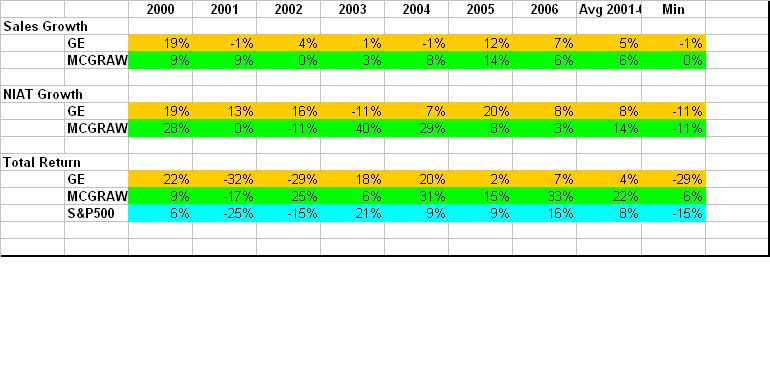 The chart on the left (click on it to view the enlarged version) contains the annual growth rates for the three measures.
It's not even close- Terry McGraw has clearly outmanaged Jeff Immelt, in terms of performance on these three key variables- for the past five years.
First, it's clear that both companies are among the low-growth type of large-caps. They have nearly identical average sales growth rates of 5% (GE) and 6% (MHP). However, McGraw-Hill, at 14%, has nearly double the average growth rate of GE's 8% for Net Income After Tax. As a result, McGraw-Hill's average annual total return for the last five years is 22%, to GE's 4%, and the S&P's 8%.
As my proprietary research has discovered, for slow-growth companies, profit growth and ROE are important determinants of total return performance. Investors clearly view the companies similarly as low-growth enterprises, and, thus, value McGraw-Hill's superior ability to consistently wring profits out of sluggishly-growing businesses. GE has simply not kept pace.
I think FT missed the boat by focusing on Immelt. For such a diversified and tough collection of businesses, Terry McGraw would have had something more to convey to FT's readership. All Immelt can really discuss is how to get overpaid and underperform while running a mediocre closed-end mutual fund. For more detail on this, simply search this blog for "immelt" and you'll find a collection of my prior pieces on Immelt's dismal performance as CEO of GE.
I'm glad I happened to be watching CNBC that morning, because I have a new respect for McGraw-Hill and its CEO. I'm still doubtful that the company will be selected for even my low-growth portfolio component, because its sales growth, while far slower than that of the average high-growth large-cap company, is still sufficiently high to be exceeding the S&P's average rate periodically.
Despite that, Terry McGraw appears to be producing a low-probability event, in that he has outperformed the S&P consistently over the past five years. There's no denying the data- he's clearly done a better job for his shareholders than Jeff Immelt has for his.
Subscribe to:
Posts (Atom)


