Yesterday's Wall Street Journal announced the pending deal between Comcast and Disney, in which the former would distribute the latter's video content.
In this prior post, I've opined that Comcast is aiming for a very narrow window with this online content distribution strategy. Overall, I think it's a mistake.
Now, with my recent posts about Yahoo, management buyouts and pension plans recently echoed and supported by major media pundits, and my year-old warnings about GM and Ford now routinely substantiated, perhaps Comcast is my one forecasting mistake. It's too early to tell yet.
In discussing this with my partner, I asked, what would have to happen for Comcast's move to be correct, profitable, and lead to consistently superior total returns over the next few years.
Blogger is not cooperating with my attempt to paste a stock price chart for the past 5 years for Comcast and the S&P500. It would show that Comcast has been up and down, with a net performance that is essentially flat, and below the S&P.
My guess is that viewers would not look directly to content producers on the web, and content producers, or the various existing 'channels' on cable, would not open up shop with URLS on the web to sell programming directly to viewers.
Comcast does seem to have scored a coup in getting Disney content for its on demand services. But isn't some of that already available, 'on demand,' on Disney's own site, or iTunes? Note that no part of this deal with Disney is "exclusive." And it is purported to be worth $1B to Disney.
For just a moment, let's stop and give Bob Iger yet more credit for being a very astute CEO. I think I am hoping Disney enters my portfolio selections soon. Iger just got a cable company to pay him for content that, when it appears on a cable channel, he has to pay them to take. And he didn't even have to agree to anything exclusive.
OK, back to Comcast. With iTV scheduled to arrive in the late Spring, it should be technically feasible for viewers and content producers to use the internet as it is best used- a direct, totally-disintermediating approach that allows the viewer and content producer to do business with each other. There will probably also be software vendors offering easy-to-use, web-based products which coordinate the viewer's preference, online availability of content, and the programming of iTV and whatever competitor products meet it in the marketplace.
The question is, how many people will be very late adopters, even with such tools available, and look to Comcast for their total viewing needs? And, moreover, switch to Comcast digital on-demand to get these programs?
Would it not seem reasonable to assume that most people for whom this would be attractive either already have digital on-demand, or buy premium channels from Comcast? Doesn't this new supply of Disney content in some sense constitute free new offerings for existing digital customers? How many people will actually buy Comcast digital just for these new Disney offerings?
If this were an exclusive distribution deal, I'd be a whole lot more inclined to believe it will make a huge difference for Comcast. As it is, I believe there are enough other distribution outlets from which to view much of this content, as to make this Comcast deal far less than one which will materially contribute to its ability to earn consistently superior returns for its shareholders.
Wednesday, November 22, 2006


Tuesday, November 21, 2006
Yahoo Insiders Confirm My Suspicions
It seems to be the week for the business media reporting stories that I wrote about far in advance.
This time, it's a leaked memo from a Yahoo SVP regarding the company's inability to dominate any of the many areas in which it has invested over time. I wrote about that in several posts, most notably here. I wrote, "Yahoo blasted onto the scene with a dizzying variety of services, but no clear focus. It seems to offer a bit of everything, and the best of nothing."
This is essentially the thrust of the now-famous "Peanut Butter Manifesto," written by Brad Garlinghouse, and reported in Saturday's edition of the Wall Street Journal. It echoes almost exactly my sentiments in the linked post.
There's not a lot new to say about the issue, except that Google's stock price broke above $500/share today, which marks a significant P/e multiple for that company.
Suffice to say, reading the WSJ story gave me renewed confidence in my strategic diagnostic skills and instincts.
A third story ran today, though, in the Journal, that is a bit different, and the subject of the next post.
This time, it's a leaked memo from a Yahoo SVP regarding the company's inability to dominate any of the many areas in which it has invested over time. I wrote about that in several posts, most notably here. I wrote, "Yahoo blasted onto the scene with a dizzying variety of services, but no clear focus. It seems to offer a bit of everything, and the best of nothing."
This is essentially the thrust of the now-famous "Peanut Butter Manifesto," written by Brad Garlinghouse, and reported in Saturday's edition of the Wall Street Journal. It echoes almost exactly my sentiments in the linked post.
There's not a lot new to say about the issue, except that Google's stock price broke above $500/share today, which marks a significant P/e multiple for that company.
Suffice to say, reading the WSJ story gave me renewed confidence in my strategic diagnostic skills and instincts.
A third story ran today, though, in the Journal, that is a bit different, and the subject of the next post.
The NYTimes Confirms My Views on Pensions and Private Equity Management Buyouts
In prior posts, here and here, I have written about the mistakes unions made years ago with pensions, and the conflicts of interest of managements as they lead buyouts of public companies. Recently, the New York Times has published pieces echoing my thoughts from months ago- September of 2005 for healthcare, which is similar to the pension debacle, and August of this year for buyouts.
It gives me a very good feeling to know I called these issues far in advance of one of the nation's leading newspapers. It's even better to know I have an even simpler solution than the one proposed by the NYTimes writer concerning buyouts.
Joe Nocera wrote "Resolving to Reimagine Health Costs," which focuses on the third-party payer health care mess. My contention is that pensions are essentially the same thing, in terms of accepting promises to pay from a company which is, typically, an adversary of the worker's union. Similar to accepting non-cash value from a company for health care, accepting promises in lieu of cash for pensions also makes for distorted decision-making.
Two days ago, Andrew Ross Sorkin wrote "Rewriting the Rules for Buyouts," recommending a complicated process by which a majority of minority shareholders should have final say in the approval of a management-led buyout. I believe my idea, expressed in the second linked piece above, is both simpler and allows for greater shareholder choice. Simply allow any shareholders to be part of the buyout, if they so choose, on the terms of the offer. This would insulated them from any supposed bad effects of being forced to sell out to the going-private group.
Given this past week's flurry of ever-increasingly large buyouts, such as Clear Channel and a large REIT, the issue is still relevant.
Since I hope to identify trends and challenges which are developing in business, and affect companies' abilities to earn consistently superior total returns, it's very gratifying to know I identified these issues long before a major news and opinion organization like the Times got around to them.
It gives me a very good feeling to know I called these issues far in advance of one of the nation's leading newspapers. It's even better to know I have an even simpler solution than the one proposed by the NYTimes writer concerning buyouts.
Joe Nocera wrote "Resolving to Reimagine Health Costs," which focuses on the third-party payer health care mess. My contention is that pensions are essentially the same thing, in terms of accepting promises to pay from a company which is, typically, an adversary of the worker's union. Similar to accepting non-cash value from a company for health care, accepting promises in lieu of cash for pensions also makes for distorted decision-making.
Two days ago, Andrew Ross Sorkin wrote "Rewriting the Rules for Buyouts," recommending a complicated process by which a majority of minority shareholders should have final say in the approval of a management-led buyout. I believe my idea, expressed in the second linked piece above, is both simpler and allows for greater shareholder choice. Simply allow any shareholders to be part of the buyout, if they so choose, on the terms of the offer. This would insulated them from any supposed bad effects of being forced to sell out to the going-private group.
Given this past week's flurry of ever-increasingly large buyouts, such as Clear Channel and a large REIT, the issue is still relevant.
Since I hope to identify trends and challenges which are developing in business, and affect companies' abilities to earn consistently superior total returns, it's very gratifying to know I identified these issues long before a major news and opinion organization like the Times got around to them.
Monday, November 20, 2006
Online Banking
Saturday's Wall Street Journal featured an article on the current generation of online banking. It brought back memories from my days at Chase Manhattan Bank in the 1980s.
To be sure, twenty years is a virtual eternity in a technology area like this. When I arrived at Chase, Citibank had recently discontinued its own home banking project, which included script that one would print out as "money" on a home printer. Back then, the biggest obstacle to "home banking," as it was then known, was the inability to simply use a personal computer as an ATM.
Chase had two separate electronic banking groups operating in the mid-1980s. Believe it or not, we lost money on every customer in the "online bill paying" product. That was because the customer entered the electronic bill payment, but Chase had a roomful of low-level employees writing checks on a Chase account to physically send, for the customer, to the payee.
Oh, how times have changed!
The WSJ piece rightly points out that online, home or electronic banking- choose your preferred name for the service- tends to wrap you up in the bank's clutches in a rather irreversible manner. As such, by making you captive, their economic propositions, in terms of loan rates, terms, deposit rates, etc., will tend to get a little worse, since you can't easily leave the relationship.
This is one reason I don't personally participate in online banking. Although, I admit, the potential to manage cash disbursements to the day is vaguely appealing. Then again, I have worked at a bank, and am aware of the culture of finger-pointing and unaccountability when an error is made. Heaven help the poor customer who tries to manage cash flow by timing payments closely, and ends up late on the mortgage or utility accounts, thanks to uncontrollable network problems.
I was also struck by the popularity of third-party, omnibus account aggregator services, which allow all ones disparate financial institutional relationships to be presented, online, in one place. On the plus side, this keeps each institution at arms length. On the minus side, you risk a lot of security with an essentially unregulated, reporting and processing vendor.
According to the article, electronic customers are 27% more profitable, and online bill paying has now risen to a 15% market share, from just 4.8% in 2001. As many as 40% of US households now do some online banking.
Which brings me to the point of this post. As the piece suggested, online banking is now moving into the phase of differentiation. Banks need to provide distinctive assortments of offerings online, in order to gain some advantage from it.
Does this not begin to resemble the earlier eras? More technology expenditures to gain new users and share, moving the user base from early adopters to late adopters? Will these later users, perhaps including me, open more accounts and provide more profits due to online usage?
It's an interesting intellectual and business question. Investments are made on the profitability and usage data of current online banking customers, but the eventual drivers of such numbers will be the masses of customers which banks hope will migrate out of branches and onto cyber connections.
Granted, there is a likely cost saving in servicing accounts online. With ATMs probably accounting for most cash transactions, online banking offers the promise of dispensing with an avalanche of paper check processing for large banks. But will these profits be offset by communications and technology expenditures? Will the online services be free? My guess is, eventually, "yes."
All of which confirms my continuing view of these mega-banks as the financial super-utilities that my friend, B, foresaw in 1996. I would not bet that any one bank will see its total returns rise over time on the back of online banking. They might not fall too far, due to the cost savings, but I'm guessing that significant revenue gains won't come from this area. And, in the end, the easiest way to earn consistently superior total returns is to engineer consistently superior revenue growth.
To be sure, twenty years is a virtual eternity in a technology area like this. When I arrived at Chase, Citibank had recently discontinued its own home banking project, which included script that one would print out as "money" on a home printer. Back then, the biggest obstacle to "home banking," as it was then known, was the inability to simply use a personal computer as an ATM.
Chase had two separate electronic banking groups operating in the mid-1980s. Believe it or not, we lost money on every customer in the "online bill paying" product. That was because the customer entered the electronic bill payment, but Chase had a roomful of low-level employees writing checks on a Chase account to physically send, for the customer, to the payee.
Oh, how times have changed!
The WSJ piece rightly points out that online, home or electronic banking- choose your preferred name for the service- tends to wrap you up in the bank's clutches in a rather irreversible manner. As such, by making you captive, their economic propositions, in terms of loan rates, terms, deposit rates, etc., will tend to get a little worse, since you can't easily leave the relationship.
This is one reason I don't personally participate in online banking. Although, I admit, the potential to manage cash disbursements to the day is vaguely appealing. Then again, I have worked at a bank, and am aware of the culture of finger-pointing and unaccountability when an error is made. Heaven help the poor customer who tries to manage cash flow by timing payments closely, and ends up late on the mortgage or utility accounts, thanks to uncontrollable network problems.
I was also struck by the popularity of third-party, omnibus account aggregator services, which allow all ones disparate financial institutional relationships to be presented, online, in one place. On the plus side, this keeps each institution at arms length. On the minus side, you risk a lot of security with an essentially unregulated, reporting and processing vendor.
According to the article, electronic customers are 27% more profitable, and online bill paying has now risen to a 15% market share, from just 4.8% in 2001. As many as 40% of US households now do some online banking.
Which brings me to the point of this post. As the piece suggested, online banking is now moving into the phase of differentiation. Banks need to provide distinctive assortments of offerings online, in order to gain some advantage from it.
Does this not begin to resemble the earlier eras? More technology expenditures to gain new users and share, moving the user base from early adopters to late adopters? Will these later users, perhaps including me, open more accounts and provide more profits due to online usage?
It's an interesting intellectual and business question. Investments are made on the profitability and usage data of current online banking customers, but the eventual drivers of such numbers will be the masses of customers which banks hope will migrate out of branches and onto cyber connections.
Granted, there is a likely cost saving in servicing accounts online. With ATMs probably accounting for most cash transactions, online banking offers the promise of dispensing with an avalanche of paper check processing for large banks. But will these profits be offset by communications and technology expenditures? Will the online services be free? My guess is, eventually, "yes."
All of which confirms my continuing view of these mega-banks as the financial super-utilities that my friend, B, foresaw in 1996. I would not bet that any one bank will see its total returns rise over time on the back of online banking. They might not fall too far, due to the cost savings, but I'm guessing that significant revenue gains won't come from this area. And, in the end, the easiest way to earn consistently superior total returns is to engineer consistently superior revenue growth.
Friday, November 17, 2006
Microsoft's Experience With Online Advertising
Today's Wall Street Journal featured a story on Microsoft's long road to embracing online advertising. It followed the gradually rising fortunes of Joanne Bradford, whom the company hired in 2001, from McGraw-Hill, to head that effort. She is soon to be named to head the MSN online group, at just 43 years of age.
That's the basic news contained in the story. The sad part is why it took the company five years to accept Ms. Bradford's strategy and efforts to do the job for which Microsoft hired her. Particularly embarrassing for the company are the reported antics of a David Cole, now on leave from Microsoft, and her one-time manager.
The article reminds me of my years at ATT, where outsiders had to attempt to break through resident narrowmindedness as the telecommunications giant struggled to ready itself for deregulation. Countless middle- and senior-level executives were hired to do jobs which some even more senior ATT executives and officers did not even agree were necessary.
Such seems to have been the case for Joanne Bradford at Microsoft. Meanwhile, as the WSJ piece details, Google roared past the software giant and revolutionized the online advertising business.
In taking five years to finally come to a realization that online ads are important to its future, it makes me wonder if Microsoft has enough time to recover from its mistakes in this area.
And, now, rather than recruit an online business executive, they are simply promoting Ms. Bradford, their online advertising executive. Granted, she seems to have finally persevered and won acceptance of her function at the firm. Does this make her the best overall online business leader?
Personally, I'd think more of Microsoft if it expanded Ms. Bradford's advertising duties and objectives, while recruiting a senior online business executive for the MSN online group.
Blogger is misbehaving today, so I am unable to paste a chart comparing Microsoft's five year stock price with the S&P500. Suffice to say, the latter is up about 20%, and the former is still negative.
Reading stories like this one, about the company's inability to coordinate its hiring and funding of key areas such as online advertising, suggest to me that Microsoft will continue to stumble in its efforts to compete in non-software-based business areas for some time to come.
That's the basic news contained in the story. The sad part is why it took the company five years to accept Ms. Bradford's strategy and efforts to do the job for which Microsoft hired her. Particularly embarrassing for the company are the reported antics of a David Cole, now on leave from Microsoft, and her one-time manager.
The article reminds me of my years at ATT, where outsiders had to attempt to break through resident narrowmindedness as the telecommunications giant struggled to ready itself for deregulation. Countless middle- and senior-level executives were hired to do jobs which some even more senior ATT executives and officers did not even agree were necessary.
Such seems to have been the case for Joanne Bradford at Microsoft. Meanwhile, as the WSJ piece details, Google roared past the software giant and revolutionized the online advertising business.
In taking five years to finally come to a realization that online ads are important to its future, it makes me wonder if Microsoft has enough time to recover from its mistakes in this area.
And, now, rather than recruit an online business executive, they are simply promoting Ms. Bradford, their online advertising executive. Granted, she seems to have finally persevered and won acceptance of her function at the firm. Does this make her the best overall online business leader?
Personally, I'd think more of Microsoft if it expanded Ms. Bradford's advertising duties and objectives, while recruiting a senior online business executive for the MSN online group.
Blogger is misbehaving today, so I am unable to paste a chart comparing Microsoft's five year stock price with the S&P500. Suffice to say, the latter is up about 20%, and the former is still negative.
Reading stories like this one, about the company's inability to coordinate its hiring and funding of key areas such as online advertising, suggest to me that Microsoft will continue to stumble in its efforts to compete in non-software-based business areas for some time to come.
Thursday, November 16, 2006
Wal-Mart In The Democrat Party's Crosshairs
This morning, on CNBC, the co-anchors discussed yesterday's attacks by Democratic Senator Obama (Ill), and former Democratic Senator Edwards (NC), upon Wal-Mart.
It has taken less than two weeks for the Democrats to begin to feel their oats over the prospect of the slimmest of majorities possible in the US Senate, come January.
Both Democrats, heard via recorded statements, excoriated the retailer for its wage levels and structures, and its health care policies. Edwards nebulously referred to "billionaire" senior executives of Wal-Mart, offering no evidence of his assertions, contrasting the alleged wealth to further assertions that low-level employees of the firm must apply for food stamps, school lunch programs, and other governmental transfer payments.
To his lasting credit, co-anchor Joe Kernan, apparently the only sensible, moderate voice on the panel, noted that Edwards offered no proof of his sweeping assertions, and that many individuals and institutions are the actual owners of Wal-Mart, via shareholding positions. Senior executives of the firm, whatever their compensations, are unlikely to hold any significant voting interest in their employer.
As readers of this blog may know, I am no fan of Wal-Mart. In many prior posts, which you may find by searching on the company's name at the top of the page, I have opined that Wal-Mart's executives have made some fairly spectacular blunders in the past year. Additionally, I simply believe that their current business model has run out of room for growth.
However, that does not merit these attacks from liberal Democrats who are prospective candidates for President in 2008. It would seem that, despite their single-seat Senate majority, the Democrats are beginning to behave as if they have veto-proof clout. By Obama's, and Edward's, demagogery, they are already revealing their true intentions, which were carefully hidden during the recent election campaign.
If memory serves me, Wal-Mart's lowest-level employees are now more likely to be part-time. Thus, they would probably not qualify for benefits such as health care. Whether this is a wise strategy or not, time will tell. If it proves to be a lightning rod for this type of publicity and, in time, legislation aimed at Wal-Mart, then it probably will not have been wise. But, this is the nature of free market enterprise. Companies experiment with their business models, within the context of the society and legal environments in which they exist.
My personal opinion is that Wal-Mart is suffering an unusual amount of self-inflicted damage from its various personnel, compensation and marketing strategies. However, the consequence for that should, and may be, a loss of business. It shouldn't be to become the corporate whipping boy of national office-seeking politicians.
Sometimes, the law of unintended consequences acts in exceptionally circuitous ways. It would be ironic indeed if, as a result of their recent victories in both Houses of Congress, the Democrats engaged in such virulent attacks upon the engines of economic wealth creation in America, such as Wal-Mart, so quickly, that they assured their own loss of control in the next cycle of elections.
For more on that theme, see this post.
It has taken less than two weeks for the Democrats to begin to feel their oats over the prospect of the slimmest of majorities possible in the US Senate, come January.
Both Democrats, heard via recorded statements, excoriated the retailer for its wage levels and structures, and its health care policies. Edwards nebulously referred to "billionaire" senior executives of Wal-Mart, offering no evidence of his assertions, contrasting the alleged wealth to further assertions that low-level employees of the firm must apply for food stamps, school lunch programs, and other governmental transfer payments.
To his lasting credit, co-anchor Joe Kernan, apparently the only sensible, moderate voice on the panel, noted that Edwards offered no proof of his sweeping assertions, and that many individuals and institutions are the actual owners of Wal-Mart, via shareholding positions. Senior executives of the firm, whatever their compensations, are unlikely to hold any significant voting interest in their employer.
As readers of this blog may know, I am no fan of Wal-Mart. In many prior posts, which you may find by searching on the company's name at the top of the page, I have opined that Wal-Mart's executives have made some fairly spectacular blunders in the past year. Additionally, I simply believe that their current business model has run out of room for growth.
However, that does not merit these attacks from liberal Democrats who are prospective candidates for President in 2008. It would seem that, despite their single-seat Senate majority, the Democrats are beginning to behave as if they have veto-proof clout. By Obama's, and Edward's, demagogery, they are already revealing their true intentions, which were carefully hidden during the recent election campaign.
If memory serves me, Wal-Mart's lowest-level employees are now more likely to be part-time. Thus, they would probably not qualify for benefits such as health care. Whether this is a wise strategy or not, time will tell. If it proves to be a lightning rod for this type of publicity and, in time, legislation aimed at Wal-Mart, then it probably will not have been wise. But, this is the nature of free market enterprise. Companies experiment with their business models, within the context of the society and legal environments in which they exist.
My personal opinion is that Wal-Mart is suffering an unusual amount of self-inflicted damage from its various personnel, compensation and marketing strategies. However, the consequence for that should, and may be, a loss of business. It shouldn't be to become the corporate whipping boy of national office-seeking politicians.
Sometimes, the law of unintended consequences acts in exceptionally circuitous ways. It would be ironic indeed if, as a result of their recent victories in both Houses of Congress, the Democrats engaged in such virulent attacks upon the engines of economic wealth creation in America, such as Wal-Mart, so quickly, that they assured their own loss of control in the next cycle of elections.
For more on that theme, see this post.
Wednesday, November 15, 2006
Three Blind Mice: The Auto CEOs Visit White House
Yesterday's news featured clips of the White House meeting between President Bush and his staff, and GM Chairman and Chief Executive Rick Wagoner, Ford Chief Executive Alan Mulally and Tom LaSorda, president and chief executive officer of Chrysler Group.
Among the topics said to be on the agenda were: CAFE regulations; health care cost reductions for American auto manufacturers, and; ethanol fuel distribution infrastructural support.
There seems to be an irony that these publicly-held firms want help when others in their industry appear to be making money in this country. One does not see executives from Toyota, Honda, or Mercedes going, hats in hands, to the White House for protectionist favors.
However, with Bill Ford's recent remarks about China in mind, as alluded to in this recent post, yesterday's effort seems to be a case of "spitting into the wind."
To wit, if one really believes that China is the next destination for a large number of global automotive production jobs, why bother asking for help from the US federal government? Trends as large as that of China sucking up the relatively lower-paying auto assembly jobs are hardly going to be stopped by the actions of the American government. A few protectionist laws here or there will just start a trade war, and at a time when the Doha round is already in trouble.
Plus, even if the Detroit-based auto manufacturers were given concessions by the White House and Congress, in exchange for jobs preservation, how will those companies explain the need for even more help, subsequently, when continued cost and pricing pressure from China overwhelm this round of bailouts?
Isn't Ford's investment in China, per the prior linked blog post, evidence that the company sees more future there than in the US for automotive production? Doesn't that make a mockery of petitioning the White House for help, even as Ford relatively disinvests in the US?
Among the topics said to be on the agenda were: CAFE regulations; health care cost reductions for American auto manufacturers, and; ethanol fuel distribution infrastructural support.
There seems to be an irony that these publicly-held firms want help when others in their industry appear to be making money in this country. One does not see executives from Toyota, Honda, or Mercedes going, hats in hands, to the White House for protectionist favors.
However, with Bill Ford's recent remarks about China in mind, as alluded to in this recent post, yesterday's effort seems to be a case of "spitting into the wind."
To wit, if one really believes that China is the next destination for a large number of global automotive production jobs, why bother asking for help from the US federal government? Trends as large as that of China sucking up the relatively lower-paying auto assembly jobs are hardly going to be stopped by the actions of the American government. A few protectionist laws here or there will just start a trade war, and at a time when the Doha round is already in trouble.
Plus, even if the Detroit-based auto manufacturers were given concessions by the White House and Congress, in exchange for jobs preservation, how will those companies explain the need for even more help, subsequently, when continued cost and pricing pressure from China overwhelm this round of bailouts?
Isn't Ford's investment in China, per the prior linked blog post, evidence that the company sees more future there than in the US for automotive production? Doesn't that make a mockery of petitioning the White House for help, even as Ford relatively disinvests in the US?
Tuesday, November 14, 2006
TimeWarner To Buy Kool-Aid: Parsons' Thirst Seems Unquenchable
I caught some of Dick Parsons' interview from Jim Cramer's nightly TV program on CNBC, as it was replayed (mid-last-week) on CNBC's "SquawkBox."
To say that Parsons is self-delusional is to be kind. Let's hope he's simply being "diplomatic," as others have described him with increasing frequency recently.
He opined that TW is all about publishing, and the premier company in print publishing. He went on to blithely proclaim that online publishing is publishing, too, so TW will simply enter that market and triumph there, as well.
Personally, when someone is so disconnected from reality as Parsons seems to be, I find it distinctly unsettling.
For instance, read my posts here and here, regarding TW's travails. A few weeks of mild stock price recovery has not fundamentally altered the five-year picture portrayed in the chart in the second post/link.
Separately, I had a chance discussion recently with a manager from one of TW's units, and the manager confirmed what I have been reading in the press lately. It doesn't sound good.
With Dick Parsons drinking so much Kool-Aid, perhaps TimeWarner should just acquire the brand, and save money on wholesale purchases.
To say that Parsons is self-delusional is to be kind. Let's hope he's simply being "diplomatic," as others have described him with increasing frequency recently.
He opined that TW is all about publishing, and the premier company in print publishing. He went on to blithely proclaim that online publishing is publishing, too, so TW will simply enter that market and triumph there, as well.
Personally, when someone is so disconnected from reality as Parsons seems to be, I find it distinctly unsettling.
For instance, read my posts here and here, regarding TW's travails. A few weeks of mild stock price recovery has not fundamentally altered the five-year picture portrayed in the chart in the second post/link.
Separately, I had a chance discussion recently with a manager from one of TW's units, and the manager confirmed what I have been reading in the press lately. It doesn't sound good.
With Dick Parsons drinking so much Kool-Aid, perhaps TimeWarner should just acquire the brand, and save money on wholesale purchases.
Monday, November 13, 2006
CEO Performance: Terry McGraw vs. Jeff Immelt
Last week's recent appearance of Terry McGraw on CNBC's morning program, SquawkBox, left me with an initial reaction of, "why is that guy hosting this program?"
In the many years that I have run monthly selections for my equity portfolio strategy, I don't believe McGraw's company, McGraw-Hill, has ever been among those chosen. McGraw is apparently the current chairman of the Business Roundtable.
On the same program, a reporter from the Financial Times was interviewed regarding her interview with Jeff Immelt, CEO of GE. This caused someone on the set to refer to Immelt as the "dean of American business."
Now, about this time, I got to wondering, which of the two CEOs has performed better over the past five years? I know Immelt's record- he's essentially wasted his shareholder's money by underperforming the S&P during his "deanship" at the helm of GE.
But, being the data-driven guy that I am, I took a fresh look at the current five-year numbers on sales and NIAT growth, as well as total return, for GE and McGraw-Hill.
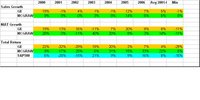 The chart on the left (click on it to view the enlarged version) contains the annual growth rates for the three measures.
It's not even close- Terry McGraw has clearly outmanaged Jeff Immelt, in terms of performance on these three key variables- for the past five years.
First, it's clear that both companies are among the low-growth type of large-caps. They have nearly identical average sales growth rates of 5% (GE) and 6% (MHP). However, McGraw-Hill, at 14%, has nearly double the average growth rate of GE's 8% for Net Income After Tax. As a result, McGraw-Hill's average annual total return for the last five years is 22%, to GE's 4%, and the S&P's 8%.
As my proprietary research has discovered, for slow-growth companies, profit growth and ROE are important determinants of total return performance. Investors clearly view the companies similarly as low-growth enterprises, and, thus, value McGraw-Hill's superior ability to consistently wring profits out of sluggishly-growing businesses. GE has simply not kept pace.
I think FT missed the boat by focusing on Immelt. For such a diversified and tough collection of businesses, Terry McGraw would have had something more to convey to FT's readership. All Immelt can really discuss is how to get overpaid and underperform while running a mediocre closed-end mutual fund. For more detail on this, simply search this blog for "immelt" and you'll find a collection of my prior pieces on Immelt's dismal performance as CEO of GE.
I'm glad I happened to be watching CNBC that morning, because I have a new respect for McGraw-Hill and its CEO. I'm still doubtful that the company will be selected for even my low-growth portfolio component, because its sales growth, while far slower than that of the average high-growth large-cap company, is still sufficiently high to be exceeding the S&P's average rate periodically.
Despite that, Terry McGraw appears to be producing a low-probability event, in that he has outperformed the S&P consistently over the past five years. There's no denying the data- he's clearly done a better job for his shareholders than Jeff Immelt has for his.
In the many years that I have run monthly selections for my equity portfolio strategy, I don't believe McGraw's company, McGraw-Hill, has ever been among those chosen. McGraw is apparently the current chairman of the Business Roundtable.
On the same program, a reporter from the Financial Times was interviewed regarding her interview with Jeff Immelt, CEO of GE. This caused someone on the set to refer to Immelt as the "dean of American business."
Now, about this time, I got to wondering, which of the two CEOs has performed better over the past five years? I know Immelt's record- he's essentially wasted his shareholder's money by underperforming the S&P during his "deanship" at the helm of GE.
But, being the data-driven guy that I am, I took a fresh look at the current five-year numbers on sales and NIAT growth, as well as total return, for GE and McGraw-Hill.
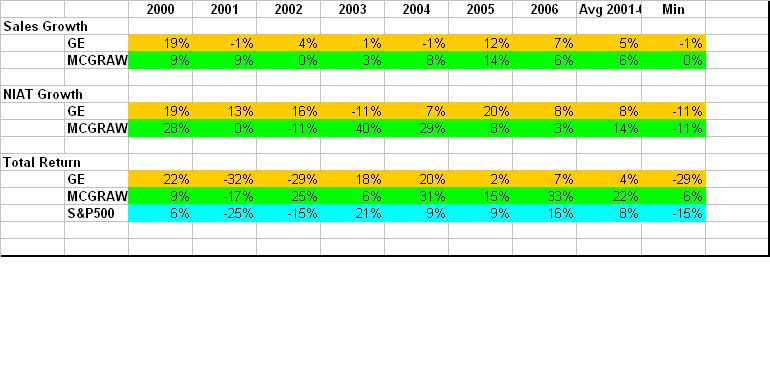 The chart on the left (click on it to view the enlarged version) contains the annual growth rates for the three measures.
It's not even close- Terry McGraw has clearly outmanaged Jeff Immelt, in terms of performance on these three key variables- for the past five years.
First, it's clear that both companies are among the low-growth type of large-caps. They have nearly identical average sales growth rates of 5% (GE) and 6% (MHP). However, McGraw-Hill, at 14%, has nearly double the average growth rate of GE's 8% for Net Income After Tax. As a result, McGraw-Hill's average annual total return for the last five years is 22%, to GE's 4%, and the S&P's 8%.
As my proprietary research has discovered, for slow-growth companies, profit growth and ROE are important determinants of total return performance. Investors clearly view the companies similarly as low-growth enterprises, and, thus, value McGraw-Hill's superior ability to consistently wring profits out of sluggishly-growing businesses. GE has simply not kept pace.
I think FT missed the boat by focusing on Immelt. For such a diversified and tough collection of businesses, Terry McGraw would have had something more to convey to FT's readership. All Immelt can really discuss is how to get overpaid and underperform while running a mediocre closed-end mutual fund. For more detail on this, simply search this blog for "immelt" and you'll find a collection of my prior pieces on Immelt's dismal performance as CEO of GE.
I'm glad I happened to be watching CNBC that morning, because I have a new respect for McGraw-Hill and its CEO. I'm still doubtful that the company will be selected for even my low-growth portfolio component, because its sales growth, while far slower than that of the average high-growth large-cap company, is still sufficiently high to be exceeding the S&P's average rate periodically.
Despite that, Terry McGraw appears to be producing a low-probability event, in that he has outperformed the S&P consistently over the past five years. There's no denying the data- he's clearly done a better job for his shareholders than Jeff Immelt has for his.
Friday, November 10, 2006
China's Automotive Ambitions
Tuesday's Wall Street Journal featured an article on the rapidly-evolving automotive production sector of the Chinese economy. The details are interesting, and not at all surprising.
Their automotive sector resembles, in many ways, that of the US economy prior to the 1950s. There are many brands, a scramble to gain share, and many component suppliers.
A key difference, however, is the presence of large European, Japanese and American automotive companies with minority stakes in some of the Chinese firms, as well as a coterie of component suppliers from Europe and America.
Thus, the Chinese producers are poised to gain rapidly on American and European manufacturers, in China, by piggy-backing on these existing infrastructures.
With the US elections on Tuesday as a backdrop, the development of the Chinese automotive sector presents the newly-elected Democratic Congress with a vexing predicament.
Do they support US expansion abroad, global trade, and economic health, by acknowledging and accepting this reality of Chinese automotive ascension? Or do they myopically frame the issue as one of US automotive manufacturing and assembly jobs migrating to China, and behave in a protectionist vein?
The article ends with a quote from Bill Ford, describing his firm's substantial investments in China,
"Americans don't get it. They don't understand what's going to happen."
The "it" to which Ford refers is that, soon, China will be the global destination for low-cost, highly productive auto manufacturing. Democratic policies notwithstanding, this is going to occur. The question is, does the US government, in the form of the newly-arriving Democratic Congressional leadership, maneuver to benefit Americans as a result of this reality, and construct positive relationships with the Chinese, or fail to do so, and risk substituting the risk of military confrontation with that of trade confrontation?
For GM and Ford, of course, all of this Chinese development creates even more risk for their turnarounds. With so much value being compressed in the process of producing and marketing cars, and so much of that remaining value moving to China, what's left for a US-based company to extract and on which to make a profit?
Their automotive sector resembles, in many ways, that of the US economy prior to the 1950s. There are many brands, a scramble to gain share, and many component suppliers.
A key difference, however, is the presence of large European, Japanese and American automotive companies with minority stakes in some of the Chinese firms, as well as a coterie of component suppliers from Europe and America.
Thus, the Chinese producers are poised to gain rapidly on American and European manufacturers, in China, by piggy-backing on these existing infrastructures.
With the US elections on Tuesday as a backdrop, the development of the Chinese automotive sector presents the newly-elected Democratic Congress with a vexing predicament.
Do they support US expansion abroad, global trade, and economic health, by acknowledging and accepting this reality of Chinese automotive ascension? Or do they myopically frame the issue as one of US automotive manufacturing and assembly jobs migrating to China, and behave in a protectionist vein?
The article ends with a quote from Bill Ford, describing his firm's substantial investments in China,
"Americans don't get it. They don't understand what's going to happen."
The "it" to which Ford refers is that, soon, China will be the global destination for low-cost, highly productive auto manufacturing. Democratic policies notwithstanding, this is going to occur. The question is, does the US government, in the form of the newly-arriving Democratic Congressional leadership, maneuver to benefit Americans as a result of this reality, and construct positive relationships with the Chinese, or fail to do so, and risk substituting the risk of military confrontation with that of trade confrontation?
For GM and Ford, of course, all of this Chinese development creates even more risk for their turnarounds. With so much value being compressed in the process of producing and marketing cars, and so much of that remaining value moving to China, what's left for a US-based company to extract and on which to make a profit?
Thursday, November 09, 2006
More about Cell Phone Video vs. Television Viewing
Yesterday's Wall Street Journal featured a Marketplace section article focusing on the spread of homegrown video content onto various competing sites. The reason I am returning to this theme again, as I have written about it before here, and here, is twofold. First, it is obviously now becoming significantly more important to the business planning of several large, would-be new media companies, such as Verizon and Comcast. Second, more of the discussion of these ventures and arrangements is beginning to articulate the ways in which users may actually consume these services. As a business person originally trained in marketing, the second always fascinates me. The first is obviously interesting as it relates to my portfolio management activities.
Specifically, the piece spotlighted Verizon's move to support, or feature, YouTube on its cellphones, while Comcast is trying to attract homemade videos to its ziddio.com website.
One line of the article stated,
"It's far from clear, for example, whether short homemade videos will appeal to TV viewers, who are accustomed to watching longer programs with a higher quality picture."
I watch YouTube videos on occasion. Some are video clips of network TV, or live concerts, and some are homemade clips. I also watch cable and, on occasion, network television. I'm one person- but I do both.
So, what sense does the above-cited passage make? Obviously, I adjust my expectations to the medium at hand.
So, back to cellphone videos. Yankee Group is cited as the source for the article stating that an estimated 5.7 million people "will watch video and TV on their cellphones," up from roughly 1.5 million in 2005. I can't, and won't, argue with empirical data. However, it's a big stretch to note that video viewing on cellphone is growing, and then assume that putting YouTube on cellphones is a good move.
My hypothesis would be that most of those cellphone views are of sports and breaking news, both global and business-related.
The overall image I have, reading recurring stories about how many distributors are rushing to license YouTube, or their own privately-originated video content, or pipe video onto every digital device imaginable, simply reinforces my belief that very few of the executives and development teams at these companies have any clear idea whatsowever of why and how consumers might actually pay for and use these services. It seems to be one very large, collective "Hail Mary" video content pass downfield for distributors, in hopes of avoiding the obviously increasing risk of disintermediation by content producers.
Which leaves me sceptical that Comcast or Verizon will enjoy much financial gain for their ill-conceived attempts to force consumer behavior into their distribution models.
For instance, the WSJ piece notes that YouTube has to be significantly altered to be viewable on a cellphone. This is allegedly the reason why device and content providers need to 'work together' to make sure the result is viewable.
I would be much more confident about these various business plans if I read that they were based upon actual research of cellphone users' video usage habits. Is it possible that most of this investment is being predicated on the viewing habits of a lot of 15-20 year olds whose parents won't continue to pay premium add-on monthly fees as these services become more expensive and technically complicated?
Specifically, the piece spotlighted Verizon's move to support, or feature, YouTube on its cellphones, while Comcast is trying to attract homemade videos to its ziddio.com website.
One line of the article stated,
"It's far from clear, for example, whether short homemade videos will appeal to TV viewers, who are accustomed to watching longer programs with a higher quality picture."
I watch YouTube videos on occasion. Some are video clips of network TV, or live concerts, and some are homemade clips. I also watch cable and, on occasion, network television. I'm one person- but I do both.
So, what sense does the above-cited passage make? Obviously, I adjust my expectations to the medium at hand.
So, back to cellphone videos. Yankee Group is cited as the source for the article stating that an estimated 5.7 million people "will watch video and TV on their cellphones," up from roughly 1.5 million in 2005. I can't, and won't, argue with empirical data. However, it's a big stretch to note that video viewing on cellphone is growing, and then assume that putting YouTube on cellphones is a good move.
My hypothesis would be that most of those cellphone views are of sports and breaking news, both global and business-related.
The overall image I have, reading recurring stories about how many distributors are rushing to license YouTube, or their own privately-originated video content, or pipe video onto every digital device imaginable, simply reinforces my belief that very few of the executives and development teams at these companies have any clear idea whatsowever of why and how consumers might actually pay for and use these services. It seems to be one very large, collective "Hail Mary" video content pass downfield for distributors, in hopes of avoiding the obviously increasing risk of disintermediation by content producers.
Which leaves me sceptical that Comcast or Verizon will enjoy much financial gain for their ill-conceived attempts to force consumer behavior into their distribution models.
For instance, the WSJ piece notes that YouTube has to be significantly altered to be viewable on a cellphone. This is allegedly the reason why device and content providers need to 'work together' to make sure the result is viewable.
I would be much more confident about these various business plans if I read that they were based upon actual research of cellphone users' video usage habits. Is it possible that most of this investment is being predicated on the viewing habits of a lot of 15-20 year olds whose parents won't continue to pay premium add-on monthly fees as these services become more expensive and technically complicated?
Wednesday, November 08, 2006
Non-Partisan Post-Election Day Musings
This is the second try at this post, as blogger ate my first one. I suppose that should make this better, tighter, and more focused, so perhaps there was a cosmic method to that.
In my previous post, I had some thoughts about why yesterday's election results were probably not going to be, and, as it turned out, are, not such a bad thing for the country, or the Republicans.
Today, I want to share some insights I had today while discussing the Congressional election results with a few friends. This is primarily a business blog, and yesterday's post was a rare exception to that. Today, I want to discuss my political insights because I believe they have significant implications for US business and economic activity in the near future.
My basic contention is that, after decades of experimenting with Federal Legislative environments featuring large majorities for one or the other party, the American electorate has now arrived at a point of allowing only narrow margins of control in either House, and that this condition will lead to more stable, effective, productive, and better conditions for Americans in general, and business and the economy in particular, in the decades to come.
Suffice to say, I believe that Nancy Pelosi was right in declaring that 'the people have spoken and want a change,' or some similarly expected blather, but not in the way she would like to believe. You see, I believe that the most important outcome of yesterday's election was not the change in House and (probably) Senate leadership, but the narrow margins by which the Democrats have been handed each House.
With two small exceptions- 1958 and a brief span during the Reagan years for the Senate, the House has had a large Democratic majority from the time I was born, until 1994. The Senate was similar, with its Democratic hegemony ending somewhat sooner, as I recall.
However, we now have a situation in which the electorate has left each party within easy striking distance in each election of gaining/regaining control of either or both Houses. This is something profoundly new on the American political landscape for certainly the 50 years that I have been alive.
To be sure, it makes you wonder just how something like this can occur. That is, we each vote for the Representative in our own district, and probably know little about the one next to us. And we can't vote for half of each candidate. Yet, somehow, as the past decade has resulted in such divisive partisanship, voters have slowly moved toward today's razor-thin House and Senate margins.
In fact, taken from a long perspective, it looks like this (I have Googled this topic, and found nothing helpful, so my details may be off, but I'm confident of my general trend information). From the 1940s, under Roosevelt's New Deal, the Democrats achieved large majorities that lasted for most of 50 years. From the late 1980s, the Republicans recaptured the Senate, and, of course, massively regained the majority in the House in 1994.
The results of these large majorities, especially since the Vietnam War era of the mid-1960s, and the departures of 'statesmen' like J. William Fulbright from the Senate, have been to see partisan rancor rise, and consensus legislation diminish. For some 40 years, Americans have have lived with intense animosity among the branches of government, and especially, between parties in each legislative chamber.
Having begun, in the late 1980s, and by 1994, to give the Republicans a chance to do better with large majorities, it seems that Americans have collectively, through a summation of individual House and Senate districts and seats, to have arrived at the conclusion that this is an unworkable approach.
If you view the last dozen years in terms of GOP power in the House and Senate, you see that it has been gently drifting to ever-slimmer majorities. A few years ago we saw a single liberal Republican, Jim Jeffords of Vermont, switch parties after his election, and hand the Senate back to the Democrats for a brief period. In the House, the GOP majority was only something like 30 seats by 2002, and some 15+ in 2004.
Now, we have what party leaders would call "ungovernable" majorities in both the US House and Senate. As I wrote in yesterday's post, this won't actually affect legislation very much in this next two years, as Bush can wield his veto pen.
I think this is what the voters want. Now, each party has the tantalizing prospect of returning to power in the next election cycle in both chambers. Legistlative obstinance, petulance, or uncooperativeness from either party's Congressional members can still lead to the prospect of further punishment. However, unlike the past, where the majority could easily dispense largesse to fend off change of control for decades, now, it will have to behave, or lose control at the very next election. For the minority, in this case, the Republicans, voters have given them the prospect of a reward for 'better' behavior that was missing in the past.
It now benefits neither party to stonewall the other, or become totally uncompromising. Both parties know that control can now change with each two-year election.
In some ways, I think this will make parties less important. With control of the House or Senate so ephemeral, members may need to serve their electors' interests better, and their party ideology less well, because the party won't be in such a position to easily 'reward' the member with committee chairs, etc.
What this may mean for business and the economy is a more centrist, effective, and sensible approach to problem solving in Congress. Because, ultimately, Congress is composed of members who want to be re-elected. Without a party structure to which to look to dispense so much largesse, because neither party can be sure of having control of either chamber, the members will probably need to show progress on key issues, and very little purely negative behavior.
(Added note: Consider this evidence of the preceding paragraph's contention. The Democrats deliberately recruited many centrist House candidates this year, in order to target midwestern and other districts. That is to say, the more liberal party willingly forsook its own extremist wing and deliberately selected, supported and elected House members who will look more like moderate Republicans on many key issues than they resemble the leaders of their own party in Congress. If that does not signal desperation on the part of the Democratic Party, and a resignation to the will of the electorate to find moderate solutions, what does?)
I may be wrong. This may be simply a fleeting moment of small margins of control of each chamber, on the way to another era of overwhelming Democratic majorities. I just don't think that's in the cards, though. The Democrats of the 1970s presided over horrible economic and social conditions for two decades, and managed to retain power. The Republicans barely got half that amount of time before losing control due to ineffectiveness, corruption, and arrogance. IF this is a trend, look for these thin majorities to remain for decades, as the electorate's own check on either party's power in Congress.
One on-air pundit repeated a famous phrase (the source of which I cannot find, even on Bartlett's) which goes something like, "no man's liberty, property or livelihood is safe while the legislature is in session." It seems as if the American electorate agrees, and has finally discovered an effective tool to limit the effects to which the quote refers.
Today's lunch between Pelosi and Bush would seem to indicate that the former realizes she must exhibit the appearance of spirit of compromise, rather than, say, celebrate a coming orgy of liberal legislation at a lunch with Charlie Rangel, David Obey, Henry Waxman, and John Dingell.
Maybe the near-term future for American businesses is brighter after this recent Congressional shakeup.
In my previous post, I had some thoughts about why yesterday's election results were probably not going to be, and, as it turned out, are, not such a bad thing for the country, or the Republicans.
Today, I want to share some insights I had today while discussing the Congressional election results with a few friends. This is primarily a business blog, and yesterday's post was a rare exception to that. Today, I want to discuss my political insights because I believe they have significant implications for US business and economic activity in the near future.
My basic contention is that, after decades of experimenting with Federal Legislative environments featuring large majorities for one or the other party, the American electorate has now arrived at a point of allowing only narrow margins of control in either House, and that this condition will lead to more stable, effective, productive, and better conditions for Americans in general, and business and the economy in particular, in the decades to come.
Suffice to say, I believe that Nancy Pelosi was right in declaring that 'the people have spoken and want a change,' or some similarly expected blather, but not in the way she would like to believe. You see, I believe that the most important outcome of yesterday's election was not the change in House and (probably) Senate leadership, but the narrow margins by which the Democrats have been handed each House.
With two small exceptions- 1958 and a brief span during the Reagan years for the Senate, the House has had a large Democratic majority from the time I was born, until 1994. The Senate was similar, with its Democratic hegemony ending somewhat sooner, as I recall.
However, we now have a situation in which the electorate has left each party within easy striking distance in each election of gaining/regaining control of either or both Houses. This is something profoundly new on the American political landscape for certainly the 50 years that I have been alive.
To be sure, it makes you wonder just how something like this can occur. That is, we each vote for the Representative in our own district, and probably know little about the one next to us. And we can't vote for half of each candidate. Yet, somehow, as the past decade has resulted in such divisive partisanship, voters have slowly moved toward today's razor-thin House and Senate margins.
In fact, taken from a long perspective, it looks like this (I have Googled this topic, and found nothing helpful, so my details may be off, but I'm confident of my general trend information). From the 1940s, under Roosevelt's New Deal, the Democrats achieved large majorities that lasted for most of 50 years. From the late 1980s, the Republicans recaptured the Senate, and, of course, massively regained the majority in the House in 1994.
The results of these large majorities, especially since the Vietnam War era of the mid-1960s, and the departures of 'statesmen' like J. William Fulbright from the Senate, have been to see partisan rancor rise, and consensus legislation diminish. For some 40 years, Americans have have lived with intense animosity among the branches of government, and especially, between parties in each legislative chamber.
Having begun, in the late 1980s, and by 1994, to give the Republicans a chance to do better with large majorities, it seems that Americans have collectively, through a summation of individual House and Senate districts and seats, to have arrived at the conclusion that this is an unworkable approach.
If you view the last dozen years in terms of GOP power in the House and Senate, you see that it has been gently drifting to ever-slimmer majorities. A few years ago we saw a single liberal Republican, Jim Jeffords of Vermont, switch parties after his election, and hand the Senate back to the Democrats for a brief period. In the House, the GOP majority was only something like 30 seats by 2002, and some 15+ in 2004.
Now, we have what party leaders would call "ungovernable" majorities in both the US House and Senate. As I wrote in yesterday's post, this won't actually affect legislation very much in this next two years, as Bush can wield his veto pen.
I think this is what the voters want. Now, each party has the tantalizing prospect of returning to power in the next election cycle in both chambers. Legistlative obstinance, petulance, or uncooperativeness from either party's Congressional members can still lead to the prospect of further punishment. However, unlike the past, where the majority could easily dispense largesse to fend off change of control for decades, now, it will have to behave, or lose control at the very next election. For the minority, in this case, the Republicans, voters have given them the prospect of a reward for 'better' behavior that was missing in the past.
It now benefits neither party to stonewall the other, or become totally uncompromising. Both parties know that control can now change with each two-year election.
In some ways, I think this will make parties less important. With control of the House or Senate so ephemeral, members may need to serve their electors' interests better, and their party ideology less well, because the party won't be in such a position to easily 'reward' the member with committee chairs, etc.
What this may mean for business and the economy is a more centrist, effective, and sensible approach to problem solving in Congress. Because, ultimately, Congress is composed of members who want to be re-elected. Without a party structure to which to look to dispense so much largesse, because neither party can be sure of having control of either chamber, the members will probably need to show progress on key issues, and very little purely negative behavior.
(Added note: Consider this evidence of the preceding paragraph's contention. The Democrats deliberately recruited many centrist House candidates this year, in order to target midwestern and other districts. That is to say, the more liberal party willingly forsook its own extremist wing and deliberately selected, supported and elected House members who will look more like moderate Republicans on many key issues than they resemble the leaders of their own party in Congress. If that does not signal desperation on the part of the Democratic Party, and a resignation to the will of the electorate to find moderate solutions, what does?)
I may be wrong. This may be simply a fleeting moment of small margins of control of each chamber, on the way to another era of overwhelming Democratic majorities. I just don't think that's in the cards, though. The Democrats of the 1970s presided over horrible economic and social conditions for two decades, and managed to retain power. The Republicans barely got half that amount of time before losing control due to ineffectiveness, corruption, and arrogance. IF this is a trend, look for these thin majorities to remain for decades, as the electorate's own check on either party's power in Congress.
One on-air pundit repeated a famous phrase (the source of which I cannot find, even on Bartlett's) which goes something like, "no man's liberty, property or livelihood is safe while the legislature is in session." It seems as if the American electorate agrees, and has finally discovered an effective tool to limit the effects to which the quote refers.
Today's lunch between Pelosi and Bush would seem to indicate that the former realizes she must exhibit the appearance of spirit of compromise, rather than, say, celebrate a coming orgy of liberal legislation at a lunch with Charlie Rangel, David Obey, Henry Waxman, and John Dingell.
Maybe the near-term future for American businesses is brighter after this recent Congressional shakeup.
Tuesday, November 07, 2006
Non-Partisan Election Day Musings
Over the past week, I've had conversations with several friends about today's Congressional and Senatorial elections. Those talks have caused me to reflect on some trends I've noticed, in retrospect, and what some ramifications of various outcomes of these elections may be.
I don't intend this to be a partisan post. If I'm successful, you won't actually even know for which party's candidates I voted this afternoon.
Several things strike me about the prospect of the US House having a majority of Democrats in the Congress which is seated in January, 2007. First, while it took some 40 years for the prior Democratic majority to be whittled down, and, finally, overthrown, in 1994, the Republican-led Congress will have run its course in only 12 years. Both basically became encrusted with too much corruption for even the local voters to tolerate, so that, when added up across 435 districts, the party majorities in Congress changed.
Is it possible that the Republicans needed only 12 years to become as corrupt, on a broad scale, as the Democrats did in 40, because of modern communications and information technology? I believe it is. As my business partner stated it, corruption and bribery have become "more efficient" in the digital age.
If the Democrats win the majority in the House tonight/tomorrow/next month (after unending challenges, recounts, lawsuits, etc.), it may have profoundly unintended consequences for both parties.
For the Democrats, I believe it may well shine a spotlight on them in their "not yet ready for prime time" condition. As several news stories have reported, as many as 40 of the prospective new Democratic Representatives will look a lot like moderate Republicans, based upon their positions on a handful of salient issues- Iraq, abortion, gay marriage, etc. These Representatives, who could almost be called "Reagan Democratic Representatives," to use the old term for the crossover voters who elected that President twice in the 1980s, could well be significantly out of step with their vastly more liberal leadership. And that might lead to some unexpected alliances between the newly-elected, moderate Democrats, and current moderate Republicans, to either block extremely liberal legislation originating in the House, and/or even force more moderate conference versions before bills leave the House.
At the same time, it may be surprising to most Americans to see the much-feared, prospective Democratic House Committee leadership in action- Rangel, Obey, Waxman, Pelosi, Dingell, et. al. The Republicans have railed about the possibilities of these people running House committees for over a decade. Their actual behaviors may result in Americans having two years to rethink leaving the House in Democratic hands, come the 2008 elections.
Meanwhile, being out of leadership may be good for the Republicans. Since Gingrich was forced from office in 1999, the party has lost the ideological high ground that Gingrich led them to with his "Contract with America" in 1994. Now, with the hack-like, rotund Dennis Hastert at the helm, the House Republicans, amidst various sex and bribery scandals, look disturbingly like Jim Wright's Democrats of 1993.
Consider this example. It now appears, from various publicly reported accounts, that Hastert's lieutenants were advised of Mark Foley's sexual activities vis a vis former House pages. Apparently, fellow Illinois Congressman John Shimkus, a Hastert handler, simply swept the issue under the rug, and never mentioned it to Hastert. If this, the kindest interpretation of what probably happened, is true, it shows just how far out of touch with American society the Republican House leadership has become.
Hastert should have been on a televised press conference within hours of the receipt of such information, explaining what he knew, his options, and how he proposed to act in order to investigate the accused, and modify procedures to minimize the prospects of a recurrence. Instead, the issue has come to overwhelm the House Republicans at a time when they are already in danger of losing their majority to the Democrats.
It could well be the right time for a Republican break from leadership, in order to reshuffle its leadership, rethink its positions, and regain ideological supremacy from what already seems to be a largely ideological bankrupt Democratic House leadership.
Thus, a Democratic takeover of the House might be a needed tonic that the Republicans don't want. A little medicine now might result in their return to power, on better foundations, in 2008.
The best news about all of this is that, regardless of who wins the House, or Senate, for that matter, there doesn't have to be that much change in Federal government direction. Since either, or both, Democratic majorities would be slim, President Bush would easily wield a veto pen that could not be overridden. In fact, as I mentioned above, it's possible that some of the new House Democrats could actually dampen their own leadership's legislation before it leaves that chamber for the Senate.
Finally, letting the Democrats run the Senate and House in the two years prior to a Presidential election in which there will be no incumbent, could turn out to be a blessing in disguise for the country. If the Democrats demonstrate that, once returned to power, they can govern positively, productively and effectively, then the change may indeed be beneficial. And the Democrats may indeed have learned to curb their ultra-liberal tendencies, perhaps by changing their leadership. If, however, all the Democrats can do in those two years is to block President Bush's judicial nominations, attempt to raise taxes, withdraw from Iraq via funding cuts, and otherwise roll back 12 years of Republican work, then Americans will see that the party is not yet ready to govern the Legislative houses. Such an outcome might well provide a tailwind for the Republican Presidential candidate in 2008, with fresh evidence of the Democratic party's Congressional ineptitude.
Ironically, the worst thing for the country may be for the Republicans to dodge a bullet in both Houses this election, and carry on as usual. I think that would be a tragedy for everyone, no matter what their political leaning.
I don't intend this to be a partisan post. If I'm successful, you won't actually even know for which party's candidates I voted this afternoon.
Several things strike me about the prospect of the US House having a majority of Democrats in the Congress which is seated in January, 2007. First, while it took some 40 years for the prior Democratic majority to be whittled down, and, finally, overthrown, in 1994, the Republican-led Congress will have run its course in only 12 years. Both basically became encrusted with too much corruption for even the local voters to tolerate, so that, when added up across 435 districts, the party majorities in Congress changed.
Is it possible that the Republicans needed only 12 years to become as corrupt, on a broad scale, as the Democrats did in 40, because of modern communications and information technology? I believe it is. As my business partner stated it, corruption and bribery have become "more efficient" in the digital age.
If the Democrats win the majority in the House tonight/tomorrow/next month (after unending challenges, recounts, lawsuits, etc.), it may have profoundly unintended consequences for both parties.
For the Democrats, I believe it may well shine a spotlight on them in their "not yet ready for prime time" condition. As several news stories have reported, as many as 40 of the prospective new Democratic Representatives will look a lot like moderate Republicans, based upon their positions on a handful of salient issues- Iraq, abortion, gay marriage, etc. These Representatives, who could almost be called "Reagan Democratic Representatives," to use the old term for the crossover voters who elected that President twice in the 1980s, could well be significantly out of step with their vastly more liberal leadership. And that might lead to some unexpected alliances between the newly-elected, moderate Democrats, and current moderate Republicans, to either block extremely liberal legislation originating in the House, and/or even force more moderate conference versions before bills leave the House.
At the same time, it may be surprising to most Americans to see the much-feared, prospective Democratic House Committee leadership in action- Rangel, Obey, Waxman, Pelosi, Dingell, et. al. The Republicans have railed about the possibilities of these people running House committees for over a decade. Their actual behaviors may result in Americans having two years to rethink leaving the House in Democratic hands, come the 2008 elections.
Meanwhile, being out of leadership may be good for the Republicans. Since Gingrich was forced from office in 1999, the party has lost the ideological high ground that Gingrich led them to with his "Contract with America" in 1994. Now, with the hack-like, rotund Dennis Hastert at the helm, the House Republicans, amidst various sex and bribery scandals, look disturbingly like Jim Wright's Democrats of 1993.
Consider this example. It now appears, from various publicly reported accounts, that Hastert's lieutenants were advised of Mark Foley's sexual activities vis a vis former House pages. Apparently, fellow Illinois Congressman John Shimkus, a Hastert handler, simply swept the issue under the rug, and never mentioned it to Hastert. If this, the kindest interpretation of what probably happened, is true, it shows just how far out of touch with American society the Republican House leadership has become.
Hastert should have been on a televised press conference within hours of the receipt of such information, explaining what he knew, his options, and how he proposed to act in order to investigate the accused, and modify procedures to minimize the prospects of a recurrence. Instead, the issue has come to overwhelm the House Republicans at a time when they are already in danger of losing their majority to the Democrats.
It could well be the right time for a Republican break from leadership, in order to reshuffle its leadership, rethink its positions, and regain ideological supremacy from what already seems to be a largely ideological bankrupt Democratic House leadership.
Thus, a Democratic takeover of the House might be a needed tonic that the Republicans don't want. A little medicine now might result in their return to power, on better foundations, in 2008.
The best news about all of this is that, regardless of who wins the House, or Senate, for that matter, there doesn't have to be that much change in Federal government direction. Since either, or both, Democratic majorities would be slim, President Bush would easily wield a veto pen that could not be overridden. In fact, as I mentioned above, it's possible that some of the new House Democrats could actually dampen their own leadership's legislation before it leaves that chamber for the Senate.
Finally, letting the Democrats run the Senate and House in the two years prior to a Presidential election in which there will be no incumbent, could turn out to be a blessing in disguise for the country. If the Democrats demonstrate that, once returned to power, they can govern positively, productively and effectively, then the change may indeed be beneficial. And the Democrats may indeed have learned to curb their ultra-liberal tendencies, perhaps by changing their leadership. If, however, all the Democrats can do in those two years is to block President Bush's judicial nominations, attempt to raise taxes, withdraw from Iraq via funding cuts, and otherwise roll back 12 years of Republican work, then Americans will see that the party is not yet ready to govern the Legislative houses. Such an outcome might well provide a tailwind for the Republican Presidential candidate in 2008, with fresh evidence of the Democratic party's Congressional ineptitude.
Ironically, the worst thing for the country may be for the Republicans to dodge a bullet in both Houses this election, and carry on as usual. I think that would be a tragedy for everyone, no matter what their political leaning.
More Video Distribution: Verizon and Microsoft XBox
Today's Wall Street Journal carried stories covering the entry of two more companies into online video distribution.
Verizon, in the midst of spending tens of billions of dollars to wire its major markets for high-speed video, is now entering into an agreement to redistribute YouTube content onto its cellphones and television service. Microsoft's Xbox was announced as being capable, imminently, of downloading and playing video content from members of an entertainment consortium, into with which Microsoft has entered agreements.
I hesitate to say that either development is particularly earth-shaking. For Verizon, it's simply securing another third party video content source. Unless I'm mistaken, I can now go to YouTube myself with my cell phone. Searching it, however, would be a challenge. As for TV, I guess, armed with a wireless full typewriter-style keyboard remote, surfing YouTube would be feasible, but I won't be dropping Comcast for that.
Regarding Microsoft, again, it seems like a splinter market- online gaming youth. As my consultant friend S explained, the mostly male youth playing online games with their Xbox 360s won't be 'watching TV,' so now, a crawler can offer them deals on instant movie and other programming downloads. How large a revenue opportunity this will prove to be is beyond me, but it does provide some offset to iTunes.
Either way, I simply don't see these 'also ran' video content deals having significant impact on the total returns of either of these firms. They seem designed more to simply ante up in the race to provide ubiquitous video content access to digital device consumers.
As I sit here writing this, I find it hard to see myself extensively browsing the web with my cell phone. A Blackberry, perhaps. But in the same way that iPods and Xboxes are dedicated-application digital devices, perhaps so, too, will another evolve for wireless multi-media content viewing and communications. Everytime I read Walt Mossberg's Wall Street Journal reviews of such omnibus devices, they seem to be too bulky, clumsy, short on battery life, and missing some key feature in one of the modes- either browsing or communications.
More likely than not, the continued spread of inexpensive, or free, video content among wireless devices will, in a sort of constant iteration of device and content, lead to various new types of devices which stress one application or another, and, thus, appeal to distinct segments.
Verizon, in the midst of spending tens of billions of dollars to wire its major markets for high-speed video, is now entering into an agreement to redistribute YouTube content onto its cellphones and television service. Microsoft's Xbox was announced as being capable, imminently, of downloading and playing video content from members of an entertainment consortium, into with which Microsoft has entered agreements.
I hesitate to say that either development is particularly earth-shaking. For Verizon, it's simply securing another third party video content source. Unless I'm mistaken, I can now go to YouTube myself with my cell phone. Searching it, however, would be a challenge. As for TV, I guess, armed with a wireless full typewriter-style keyboard remote, surfing YouTube would be feasible, but I won't be dropping Comcast for that.
Regarding Microsoft, again, it seems like a splinter market- online gaming youth. As my consultant friend S explained, the mostly male youth playing online games with their Xbox 360s won't be 'watching TV,' so now, a crawler can offer them deals on instant movie and other programming downloads. How large a revenue opportunity this will prove to be is beyond me, but it does provide some offset to iTunes.
Either way, I simply don't see these 'also ran' video content deals having significant impact on the total returns of either of these firms. They seem designed more to simply ante up in the race to provide ubiquitous video content access to digital device consumers.
As I sit here writing this, I find it hard to see myself extensively browsing the web with my cell phone. A Blackberry, perhaps. But in the same way that iPods and Xboxes are dedicated-application digital devices, perhaps so, too, will another evolve for wireless multi-media content viewing and communications. Everytime I read Walt Mossberg's Wall Street Journal reviews of such omnibus devices, they seem to be too bulky, clumsy, short on battery life, and missing some key feature in one of the modes- either browsing or communications.
More likely than not, the continued spread of inexpensive, or free, video content among wireless devices will, in a sort of constant iteration of device and content, lead to various new types of devices which stress one application or another, and, thus, appeal to distinct segments.
Monday, November 06, 2006
CBS Hires Quincy Smith To Find The Next YouTube
The "Who's News" section of Today's Wall Street Journal carried a prominent piece about CBS hiring one Quincy Smith, formerly of Allen & Co., the media investment banking firm.
Smith has admittedly great credentials for a 35 year old guy. He's apparently well-entrenched with the Google leadership troika, having been involved in Netscape some years earlier.
Now, a little background on this hire. Les Moonves, CEO of CBS, the spun off dreck of Sumner Redstone's mistakenly integrated Viacom, watched his boss fire Viacom's CEO, Tom Freston for, among other sins, not moving into internet businesses sufficiently quickly. Moonves is even quotes as saying,
"This shows how serious we are about new media.....We're looking to buy the YouTube that nobody has heard of yet. Quincy is the right person to help us place those bets."
Interesting. Here, Freston was being careful about selecting his entry point in a difficult situation, and Moonves, seeing that approach fail, simply ladles out cash to a new media business star, letting Smith take the ax, should things go awry.
And that's why I wanted to write this post. I think they probably will go awry. Not because Smith isn't good- he probably is.
It's that he is at CBS now. Being a highly-paid pawn, knight, or maybe even rook, on the CBS chessboard. And if I recall correctly from a fragment of a Michael Eisner interview with Redstone just last month, the latter decried anyone paying up for YouTube. Meanwhile, as I have written here, I think those who seek the "next" YouTube have the wrong concept of what's now happening in online media. Verizon's desire to be a "destination" on the internet is probably wishful thinking now.
So, we have Les Moonves charging Quincy Smith to find the next YouTube, while Sumner Redstone is already wary of paying up for new media outlets. Sounds like a recipe for frustration and disaster. And if all Smith does is broker some deal with Yahoo or AOL, how much did CBS really need to pay to do that? It would seem Smith's value is in finding precisely the kind of diamond in the rough away from which Redstone shies.
Why didn't Moonves just retain Allen & Co, with some equity sharing arrangement to incent the latter, to do the same thing for CBS, with less risk?
I don't see the Quincy Smith hire as leading to CBS demonstrating consistently superior returns for shareholders over the coming years. So the CBS/Quincy Smith saga should make for some entertaining business news over the next 12-18 months.
Smith has admittedly great credentials for a 35 year old guy. He's apparently well-entrenched with the Google leadership troika, having been involved in Netscape some years earlier.
Now, a little background on this hire. Les Moonves, CEO of CBS, the spun off dreck of Sumner Redstone's mistakenly integrated Viacom, watched his boss fire Viacom's CEO, Tom Freston for, among other sins, not moving into internet businesses sufficiently quickly. Moonves is even quotes as saying,
"This shows how serious we are about new media.....We're looking to buy the YouTube that nobody has heard of yet. Quincy is the right person to help us place those bets."
Interesting. Here, Freston was being careful about selecting his entry point in a difficult situation, and Moonves, seeing that approach fail, simply ladles out cash to a new media business star, letting Smith take the ax, should things go awry.
And that's why I wanted to write this post. I think they probably will go awry. Not because Smith isn't good- he probably is.
It's that he is at CBS now. Being a highly-paid pawn, knight, or maybe even rook, on the CBS chessboard. And if I recall correctly from a fragment of a Michael Eisner interview with Redstone just last month, the latter decried anyone paying up for YouTube. Meanwhile, as I have written here, I think those who seek the "next" YouTube have the wrong concept of what's now happening in online media. Verizon's desire to be a "destination" on the internet is probably wishful thinking now.
So, we have Les Moonves charging Quincy Smith to find the next YouTube, while Sumner Redstone is already wary of paying up for new media outlets. Sounds like a recipe for frustration and disaster. And if all Smith does is broker some deal with Yahoo or AOL, how much did CBS really need to pay to do that? It would seem Smith's value is in finding precisely the kind of diamond in the rough away from which Redstone shies.
Why didn't Moonves just retain Allen & Co, with some equity sharing arrangement to incent the latter, to do the same thing for CBS, with less risk?
I don't see the Quincy Smith hire as leading to CBS demonstrating consistently superior returns for shareholders over the coming years. So the CBS/Quincy Smith saga should make for some entertaining business news over the next 12-18 months.
The Interesting Case of Dimensional Fund Advisors
Today's Wall Street Journal contains the October month-end mutual fund section. The lead story concerns a mutual fund group named Dimensional Fund Advisors.
Without restating the entire article, what interested me is how some elements of their style resembles that of my equity strategy. Their funds strategies are based upon Fama's and French's original "efficient markets" work. In fact, the two academics are involved with the company.
Dimensional could be described as having a passive management philosophy, but not using third-party indices, such as the Dow-Jones or the S&P500. Rather, befitting the academic work on which it is based, they identify smaller-capitalization companies which they tend to, apparently, hold for very long time periods. There's a quote by Fama about waiting some 25-30 years for the payoff in value stocks, which is what they characterize their portfolios as containing.
While the article does not fully disclose their approach, it does highlight their use of price/book measures to sort stocks as 'growth' or 'value,' which is a fairly conventional approach. They allegedly part company with the investment crowd on three dimensions. One, they ostensibly buy and hold for eons. Two, they end up with a passive, sort of custom-built 'index,' or fairly static portfolio. Three, they use quantitative methods, so that they can't really comment on why stocks are in their portfolio- they do none of the conventional 'kick the tires' sort of research that more qualitative shops employ.
There are some nice quotes in the piece, including one by John Bogle, the legendary founder of Vanguard. He opines that, while Dimensional's approach is very good, it's not perfect, because the market will arbitrage the excess returns to smaller-cap 'value' portfolios more quickly than French and Fama believe.
As I read the piece, I saw how, in some respects, Dimensional's approach shares some aspects of my own equity strategy's. Like Dimensional, I hold portfolio positions for longer than many other managers. And, I also employ a quantitative approach that eschews in-depth qualitative research, in favor of quantitative discipline, rigor and consistency. Like Dimensional, my holding time horizon is not for everyone. Also like Dimensional, however, the historic returns to my strategy have been much better than the S&P500.
I was, overall, very pleasantly surprised to see such a positive review of an investment approach that shares some salient characteristics with my own, in such a widely-read publication as the WSJ.
Without restating the entire article, what interested me is how some elements of their style resembles that of my equity strategy. Their funds strategies are based upon Fama's and French's original "efficient markets" work. In fact, the two academics are involved with the company.
Dimensional could be described as having a passive management philosophy, but not using third-party indices, such as the Dow-Jones or the S&P500. Rather, befitting the academic work on which it is based, they identify smaller-capitalization companies which they tend to, apparently, hold for very long time periods. There's a quote by Fama about waiting some 25-30 years for the payoff in value stocks, which is what they characterize their portfolios as containing.
While the article does not fully disclose their approach, it does highlight their use of price/book measures to sort stocks as 'growth' or 'value,' which is a fairly conventional approach. They allegedly part company with the investment crowd on three dimensions. One, they ostensibly buy and hold for eons. Two, they end up with a passive, sort of custom-built 'index,' or fairly static portfolio. Three, they use quantitative methods, so that they can't really comment on why stocks are in their portfolio- they do none of the conventional 'kick the tires' sort of research that more qualitative shops employ.
There are some nice quotes in the piece, including one by John Bogle, the legendary founder of Vanguard. He opines that, while Dimensional's approach is very good, it's not perfect, because the market will arbitrage the excess returns to smaller-cap 'value' portfolios more quickly than French and Fama believe.
As I read the piece, I saw how, in some respects, Dimensional's approach shares some aspects of my own equity strategy's. Like Dimensional, I hold portfolio positions for longer than many other managers. And, I also employ a quantitative approach that eschews in-depth qualitative research, in favor of quantitative discipline, rigor and consistency. Like Dimensional, my holding time horizon is not for everyone. Also like Dimensional, however, the historic returns to my strategy have been much better than the S&P500.
I was, overall, very pleasantly surprised to see such a positive review of an investment approach that shares some salient characteristics with my own, in such a widely-read publication as the WSJ.
Friday, November 03, 2006
When Media Reporters Are Out of Touch With Business Realities
This morning, I heard CNBC "senior economic reporter" Steve Leisman's laughable explanation for his too-low estimate of the Labor Department's October jobs creation numbers.
He said he thought that weak productivity data over the past quarter would have led CEOs of large US companies to suspend hiring. I think this shows how out of touch he is with the way businesses run.
First, I doubt most CEOs can effect their company's employment levels with the speed of monthly data feeds. Typically, hiring for a given year is set late in the prior year's budget process, then possibly pre-empted by some crisis that leads to a hiring freeze in the current year. There's usually little in the way of alternatives in between.
Second, the labor dept report then added jobs to prior months, in their adjustment process, making the new-to-reporting additions of jobs soar over the past several months.
Essentially, the data made monkeys out of Leisman and all of his favorite on-air guest pundits. What did all these consulting sages do? They hemmed, they hawwed, and, in effect, complained that the data is of poor quality, and what we really need in this country is better economic data!
Translation: I got the estimate of new nonfarm payroll additions wrong this month, so the data is in error- again. I have my conclusions- now go get me the data to support them. If not this month, you just wait....any month now, job numbers will be down.
It reminds me of the constant bear market pundits of the early '90s. By calling for a bear market during pretty much the entire decade, they were finally able to be correct in 1999. But doesn't that equate to about a .100 batting average? I think something similar is going on here. Economic pundits get very angry when they play the 'estimate the number live on camera' game and get it wrong. So they explain why they'll soon be right, or the numbers are meaningless anyway.
I suppose it would be far too much to ask, or expect, that these pundits, starting with CNBC's Leisman, simply wait to interpret any of this data until it's been revised. Which one of my two favorite CNBC on-air personalities, Joe Kernan, explicitly suggested this morning. Suffice to say, Leisman's jaw nearly dropped at the suggestion, and he just looked dazed. Truth is, jumping on these numbers immediately upon initial release invites confusion and misinterpretation. Which is perhaps why I am so jaded about the misdirection and confusion sown by these economic wannabe-pundits throughout the year, affecting investor reactions and, thus, market prices of equities.
And that, dear readers, is entertainment, CNBC style......
He said he thought that weak productivity data over the past quarter would have led CEOs of large US companies to suspend hiring. I think this shows how out of touch he is with the way businesses run.
First, I doubt most CEOs can effect their company's employment levels with the speed of monthly data feeds. Typically, hiring for a given year is set late in the prior year's budget process, then possibly pre-empted by some crisis that leads to a hiring freeze in the current year. There's usually little in the way of alternatives in between.
Second, the labor dept report then added jobs to prior months, in their adjustment process, making the new-to-reporting additions of jobs soar over the past several months.
Essentially, the data made monkeys out of Leisman and all of his favorite on-air guest pundits. What did all these consulting sages do? They hemmed, they hawwed, and, in effect, complained that the data is of poor quality, and what we really need in this country is better economic data!
Translation: I got the estimate of new nonfarm payroll additions wrong this month, so the data is in error- again. I have my conclusions- now go get me the data to support them. If not this month, you just wait....any month now, job numbers will be down.
It reminds me of the constant bear market pundits of the early '90s. By calling for a bear market during pretty much the entire decade, they were finally able to be correct in 1999. But doesn't that equate to about a .100 batting average? I think something similar is going on here. Economic pundits get very angry when they play the 'estimate the number live on camera' game and get it wrong. So they explain why they'll soon be right, or the numbers are meaningless anyway.
I suppose it would be far too much to ask, or expect, that these pundits, starting with CNBC's Leisman, simply wait to interpret any of this data until it's been revised. Which one of my two favorite CNBC on-air personalities, Joe Kernan, explicitly suggested this morning. Suffice to say, Leisman's jaw nearly dropped at the suggestion, and he just looked dazed. Truth is, jumping on these numbers immediately upon initial release invites confusion and misinterpretation. Which is perhaps why I am so jaded about the misdirection and confusion sown by these economic wannabe-pundits throughout the year, affecting investor reactions and, thus, market prices of equities.
And that, dear readers, is entertainment, CNBC style......
CVS & Caremark To Merge: To What End?
Wednesday's announcement of a proposed merger between CVS and Caremark leaves me puzzled. I believe it is being portrayed as a purchase of the latter by the former, but technically being proposed to be accounted for as a merger of equals.
The crux of my bewilderment over the combination is that they are such different businesses. In effect, almost ideally contrasting ones. Didn't Caremark, Express Scripts, and Medco arise to undercut the costs of prescriptions being dispensed through local pharmacy chains like CVS? If so, how does one now reconcile a combination a bricks and mortar drug store chain with a remote medicinal order fulfillment giant?
Doesn't this remind you of the ill-fated TimeWarner/AOL merger? Didn't that merger resemble this one, in the combination of two radically different business models, in which one (AOL) had more or less evolved to supplant the other?
From a somewhat self-centered management perspective, I see the attraction. Messrs. Ryan and Crawford see themselves running a company that accounts for more than 25% of the country's prescriptions. Somewhere in there, I am sure they have reasoned, is enough scale to fend off Wal-Mart. Both CVS and Caremark has seen their stock prices fall roughly 15% in the past three months, and even more since early September, when Wal-Mart announced its entry into the low-price prescription drug business.
My guess is, CVS saw itself being drawn into the maw of price-competition by Wal-Mart, and panicked. Caremark probably expects Wal-Mart to eventually start its own PBM business, damaging the former's margins and market share position. From inside the barrel of existing sector players, this combination of CVS and Caremark probably looked like a reasonable way of building a larger, hedged liferaft to weather the coming competitive storms.
However, for each company's shareholders, I can't see what it offers. If you hold CVS for the retail exposure, this is not a deal you want to see occur. Similarly, if you hold Caremark because you think it will eventually strip the CVS's of the world of their prescriptions business, this deal makes absolutely no sense whatsoever. Further, how do you explain the combination of two businesses whose mechanics and operating models are so different? What are the odds that anyone will be capable of successfully running the combined entity to earn consistently superior total returns for its shareholders?
Better that Caremark would have reached some sort of deal with Wal-mart, if that could make any sense. Or that offer to ally with Wal-mart and place CVS mini-stores inside Wal-Mart. Of course, this would be extremely unlikely, precisely because CVS is about more than drugs. It's about broader retail convenience shopping.
I just cannot see a savvy investor in either CVS or Caremark saying, "Gee, this is great! This deal plugs that hole in the company's distribution model."
I can, however, see Ryan and Crawford feeling that they each have a more secure next five years of CEO or Chairman's compensation for heading a somewhat incongruous conglomerate of two businesses which are totally at odds in their missions and business models.
This type of schizophrenic combination does not, in my opinion, bode well for the longer term ability of either company to consistently earn superior total returns for shareholders, as part of the new combined firm.
The crux of my bewilderment over the combination is that they are such different businesses. In effect, almost ideally contrasting ones. Didn't Caremark, Express Scripts, and Medco arise to undercut the costs of prescriptions being dispensed through local pharmacy chains like CVS? If so, how does one now reconcile a combination a bricks and mortar drug store chain with a remote medicinal order fulfillment giant?
Doesn't this remind you of the ill-fated TimeWarner/AOL merger? Didn't that merger resemble this one, in the combination of two radically different business models, in which one (AOL) had more or less evolved to supplant the other?
From a somewhat self-centered management perspective, I see the attraction. Messrs. Ryan and Crawford see themselves running a company that accounts for more than 25% of the country's prescriptions. Somewhere in there, I am sure they have reasoned, is enough scale to fend off Wal-Mart. Both CVS and Caremark has seen their stock prices fall roughly 15% in the past three months, and even more since early September, when Wal-Mart announced its entry into the low-price prescription drug business.
My guess is, CVS saw itself being drawn into the maw of price-competition by Wal-Mart, and panicked. Caremark probably expects Wal-Mart to eventually start its own PBM business, damaging the former's margins and market share position. From inside the barrel of existing sector players, this combination of CVS and Caremark probably looked like a reasonable way of building a larger, hedged liferaft to weather the coming competitive storms.
However, for each company's shareholders, I can't see what it offers. If you hold CVS for the retail exposure, this is not a deal you want to see occur. Similarly, if you hold Caremark because you think it will eventually strip the CVS's of the world of their prescriptions business, this deal makes absolutely no sense whatsoever. Further, how do you explain the combination of two businesses whose mechanics and operating models are so different? What are the odds that anyone will be capable of successfully running the combined entity to earn consistently superior total returns for its shareholders?
Better that Caremark would have reached some sort of deal with Wal-mart, if that could make any sense. Or that offer to ally with Wal-mart and place CVS mini-stores inside Wal-Mart. Of course, this would be extremely unlikely, precisely because CVS is about more than drugs. It's about broader retail convenience shopping.
I just cannot see a savvy investor in either CVS or Caremark saying, "Gee, this is great! This deal plugs that hole in the company's distribution model."
I can, however, see Ryan and Crawford feeling that they each have a more secure next five years of CEO or Chairman's compensation for heading a somewhat incongruous conglomerate of two businesses which are totally at odds in their missions and business models.
This type of schizophrenic combination does not, in my opinion, bode well for the longer term ability of either company to consistently earn superior total returns for shareholders, as part of the new combined firm.
Thursday, November 02, 2006
Kevin Roberts' New Clothes: Saatchi & Saatchi's "LoveMarks"
I guess the ad agencies are in need of another round of concept reinvention to invigorate client spending. Thus, Kevin Roberts, the CEO of Saatchi & Saatchi, appeared on CNBC this morning, touting his agency's latest technology, "LoveMarks."
As an aside, is it my imagination, or are ad agency heads who hope to be viewed as super-creative typically bald? I've nothing against bald men, but it does seem sort of iconic, does it not? Roberts put me in mind of Jerry Dela Famina when I saw him on CNBC this morning.
According to Roberts, this new concept is beyond product, beyond branding. It focuses on measuring and establishing emotional connections between products or services, and their customers. As described on their website, LoveMarks possess "mystery, sensuality, and intimacy."
Over the years, listening to many CEOs, I've learned to reserve conferring credibility on senior executives, until they either make sense, perform unequivocally well, or give themselves away as being delusional.
As I listened to Roberts describe McDonalds, I knew he was wrong, and pursuing the delusional path.
First, his throwaway comment that you won't find the "LoveMark" ideas at the B-schools like Wharton, Stanford, et al, is entirely wrong.
The highly-regarded marketing Professor from the University of Pennsylvania's Wharton School, Jerry Wind, was teaching this concept in 1978. I know- I was in his classes, one of his PhD candidates, and one of his teaching assistants.
Sorry Kevin- your ego seems to have totally eclipsed any awareness you may have of the marketing field, absent your own genius.
Second, his characterization of what people want from products, brands, is, I think, at best, representative or characteristic of a tiny slice of consumers. It sounds like one of the (now defunct) Concorde set opining on what his seatmates want in high-end luxury products and services.
The broad masses of consumer goods buyers, however, live very different lives. Products don't always work, they aren't bought exclusively for the lifestyle image, as they are for sheer problem solution.
Listening to him extol McDonalds as an example of a LoveMark brought laughter from me. Roberts claimed that the brand is really about fun and family experiences, not fries, burgers or soft drinks.
Wrong again. First, my daughters won't even set foot in a McDonalds. They judge the fries as inferior to Burger King's. Same with the burgers- it's flame broiled for my brood.
When we travel, we tend to prefer Burger King, but mostly for their superior fast food salads.
I imagine that Roberts and his minions are having another go at the ad agency world's version of the "wheel of retailing." Every few years, one agency develops a 'new' concept, and most of the others soon follow on.
As I recall, the last major concept was integration. Saatchi merged its way to unsustainable size, only to find that clients didn't actually want to share ad agencies with their competitors. And they didn't really trust one global agency with all of their local work, either.
I'd guess LoveMarks is something similar. If Roberts can persuade a few Fortune 500 CEOs with his pitch, it's worth a few major accounts. And, from the sound of it, the package will probably include very involved customer surveys, creative sessions, etc. Should bring tons of billable hours.
Trouble is, as I learned from Jerry Wind those many years ago, not every segmentation scheme, nor product/service differentiator, is applicable to every product/market. Here's an example- do you think there's as much mystery and sensuality in buying dog food and your SO/wife's jewelry? Do you want to explain this to her? I thought not.
These dimensions either limit the concept to products and services which tend toward ego-involving purchases and usage, or they are rendered fairly meaningless as they are applied to items as insignificant as the toothpicks I buy.
Of course, being me, I have to ask.....do "LoveMark" products exhibit consistently superior total returns in the marketplace of investors? If not, or if this can't be measured, then I'm sceptical (hey, it's my blog title) that this concept contains much in the way of new, useful insights into consumer behaviors and corresponding business management.
As an aside, is it my imagination, or are ad agency heads who hope to be viewed as super-creative typically bald? I've nothing against bald men, but it does seem sort of iconic, does it not? Roberts put me in mind of Jerry Dela Famina when I saw him on CNBC this morning.
According to Roberts, this new concept is beyond product, beyond branding. It focuses on measuring and establishing emotional connections between products or services, and their customers. As described on their website, LoveMarks possess "mystery, sensuality, and intimacy."
Over the years, listening to many CEOs, I've learned to reserve conferring credibility on senior executives, until they either make sense, perform unequivocally well, or give themselves away as being delusional.
As I listened to Roberts describe McDonalds, I knew he was wrong, and pursuing the delusional path.
First, his throwaway comment that you won't find the "LoveMark" ideas at the B-schools like Wharton, Stanford, et al, is entirely wrong.
The highly-regarded marketing Professor from the University of Pennsylvania's Wharton School, Jerry Wind, was teaching this concept in 1978. I know- I was in his classes, one of his PhD candidates, and one of his teaching assistants.
Sorry Kevin- your ego seems to have totally eclipsed any awareness you may have of the marketing field, absent your own genius.
Second, his characterization of what people want from products, brands, is, I think, at best, representative or characteristic of a tiny slice of consumers. It sounds like one of the (now defunct) Concorde set opining on what his seatmates want in high-end luxury products and services.
The broad masses of consumer goods buyers, however, live very different lives. Products don't always work, they aren't bought exclusively for the lifestyle image, as they are for sheer problem solution.
Listening to him extol McDonalds as an example of a LoveMark brought laughter from me. Roberts claimed that the brand is really about fun and family experiences, not fries, burgers or soft drinks.
Wrong again. First, my daughters won't even set foot in a McDonalds. They judge the fries as inferior to Burger King's. Same with the burgers- it's flame broiled for my brood.
When we travel, we tend to prefer Burger King, but mostly for their superior fast food salads.
I imagine that Roberts and his minions are having another go at the ad agency world's version of the "wheel of retailing." Every few years, one agency develops a 'new' concept, and most of the others soon follow on.
As I recall, the last major concept was integration. Saatchi merged its way to unsustainable size, only to find that clients didn't actually want to share ad agencies with their competitors. And they didn't really trust one global agency with all of their local work, either.
I'd guess LoveMarks is something similar. If Roberts can persuade a few Fortune 500 CEOs with his pitch, it's worth a few major accounts. And, from the sound of it, the package will probably include very involved customer surveys, creative sessions, etc. Should bring tons of billable hours.
Trouble is, as I learned from Jerry Wind those many years ago, not every segmentation scheme, nor product/service differentiator, is applicable to every product/market. Here's an example- do you think there's as much mystery and sensuality in buying dog food and your SO/wife's jewelry? Do you want to explain this to her? I thought not.
These dimensions either limit the concept to products and services which tend toward ego-involving purchases and usage, or they are rendered fairly meaningless as they are applied to items as insignificant as the toothpicks I buy.
Of course, being me, I have to ask.....do "LoveMark" products exhibit consistently superior total returns in the marketplace of investors? If not, or if this can't be measured, then I'm sceptical (hey, it's my blog title) that this concept contains much in the way of new, useful insights into consumer behaviors and corresponding business management.
Here We Go...... LX.TV Lifestyle Television Hits The Web
Tuesday's Wall Street Journal featured an article about a new internet site offering high-quality, new video content specifically produced for this site.
As I wrote here, and here, it was only a matter of time until some smart, funded directors and producers established their own website to offer new video content directly to viewers, without broadcast or cable networks.
Two MTV veterans have launched Lifestyle Television at LX.TV. Right now, it's primarily, as my consultant friend S, describes it, a series of commercials about luxury goods, without the bother of a plot or drama to interrupt them. As she said, it's as if Morgan Hertzan and Joseph Varet, the founders, learned from MTV and have eliminated the dramatic content, to focus on the more-lucrative advertising and placement revenues.
Seriously, LX.TV represents the onset of a business model which could well eventually drive high-quality drama off of even cable TV. For now, the content could be described as a high-quality video shot by following some twenty-something beautiful people in Manhattan around after hours. After seeing one segment about a $200 drink made with ingredients from one of the site's sponsors, S opined that, with topics like this, even she would consider joining Al Queda to fight the decadent West.
Nevertheless, I think the debut of LX.TV heralds the coming of direct-to-viewer dramatic video content over the internet. The founders are established creative and business executives from the cable world. They are starting by featuring personalities from cable networks, thus legitimizing the site, as well as lending more viewer interest in the programming.
When iTV arrives from Apple next summer, the technical pieces will be complete for viewing sites like LX.TV on your television. Add better dramatic content, a payment mechanism such as PayPal, and there's no reason why more established production companies won't begin developing new dramatic content for their own websites.
The future of direct-to-consumer video content has arrived.....
As I wrote here, and here, it was only a matter of time until some smart, funded directors and producers established their own website to offer new video content directly to viewers, without broadcast or cable networks.
Two MTV veterans have launched Lifestyle Television at LX.TV. Right now, it's primarily, as my consultant friend S, describes it, a series of commercials about luxury goods, without the bother of a plot or drama to interrupt them. As she said, it's as if Morgan Hertzan and Joseph Varet, the founders, learned from MTV and have eliminated the dramatic content, to focus on the more-lucrative advertising and placement revenues.
Seriously, LX.TV represents the onset of a business model which could well eventually drive high-quality drama off of even cable TV. For now, the content could be described as a high-quality video shot by following some twenty-something beautiful people in Manhattan around after hours. After seeing one segment about a $200 drink made with ingredients from one of the site's sponsors, S opined that, with topics like this, even she would consider joining Al Queda to fight the decadent West.
Nevertheless, I think the debut of LX.TV heralds the coming of direct-to-viewer dramatic video content over the internet. The founders are established creative and business executives from the cable world. They are starting by featuring personalities from cable networks, thus legitimizing the site, as well as lending more viewer interest in the programming.
When iTV arrives from Apple next summer, the technical pieces will be complete for viewing sites like LX.TV on your television. Add better dramatic content, a payment mechanism such as PayPal, and there's no reason why more established production companies won't begin developing new dramatic content for their own websites.
The future of direct-to-consumer video content has arrived.....
Wednesday, November 01, 2006
TimeWarner's Strategic Woes In Microcosm: Time, Inc.'s Troubles
There was an article in Monday's Wall Street Journal covering TimeWarner's troubles at its flagship magazine, Time, and the entire Time, Inc. portion of the business. From the article, we learn that "Queen Ann" Moore, Time, Inc's CEO, has totally botched the management of TW's magazine empire in the face of new media competition from- where else- the internet. Advertising revenues from Time's titles are plunging, as spending migrates to the internet, via Google, et al.
It looks like Dick Parsons is presiding over the erosion of a core business, and still doesn't know what is driving TW's stock price. There's a lot of hubbub right now over TW's recent stock price rise, as if it is "turning around." For more on this topic, see my recent post, here. Three months, however, do not a turnaround make. Not when one of the company's main businesses is hemorrhaging revenues, due to inept strategic management and planning.
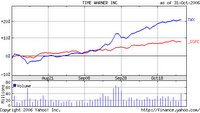 As the Yahoo-sourced chart nearby shows (click on the chart to enlarge), over the past 3 months, TW has risen some 20%, while the S&P is up less than 10%. However, looking at 2 year (below) and 5 year (unable to get Blogger to paste it) charts, TW and the index are both up about 20% for the first period, but TW is down slightly less than 50% for the second period, while the S&P is up between 20% and 30%.
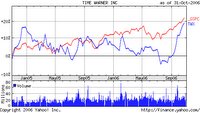
The WSJ piece provides some insights into what has gone wrong with the magazine group under Moore's stewardship. Although the article quotes Moore as saying,
"Everyone is so worried that we're late coming to the party....this party is not over...The party just started. We've gotten to the real tipping point. The one thing I've learned this year is that there is a real business here."
Now, that is sad. Only this year has Moore realized what Google, Yahoo and other online sites have known for some time- that people now receive their important news online. Breaking news is online, and immediate followup coverage of breaking news can be in the form of a daily newspaper. But the weekly plain vanilla "news" magazine is in trouble, i.e., Time. That Sports Illustrated and CNNMoney are the major recipients of Time, Inc.'s online attentions only highlight that they do not cover typical, generic news topics.
Moore has had the top job at Time, Inc. for four years now, but, before that, was credited, in her 28 years with the company, with a knack for creating new titles, such as InStyle and Real Simple.
However, one only needs to step back and view the overall media landscape to see that Moore is probably as wrong a fit for her job as Parsons is for his. The company overall, and its magazine division particularly, suffer from being an old media giant, with its assets and brand values rooted in print distribution, while most of the people who value that information have already headed for the internet to find such content. That Moore thinks the game is just starting demonstrates how seriously she misunderstands the manner in which media consumption habits are developed, and brands are built. Meanwhile, her boss, Parsons, was characterized on CNBC this morning as being a "diplomat," selected to replace Gerald Levin at a time of tremendous organizational crisis at the firm, in the wake of the AOL merger disaster. Now, Parsons' skills as a lawyer and mediator seem badly deficient for the rather basic task of operational management of the current business portfolio, and strategic development of it for the future.
Again, taking that large step backward to view overall media, you can see that, with internet-based information distribution, the old boundaries between print and video, instant, daily, weekly, and monthly, are gone. Content distribution, consumer consumption, and, with them, advertising, have all been migrating to the web in increasing volumes. In this environment, what tangible value propositions do print magazines like Time and People now offer?
The Journal article mentions that, among the alternatives being discussed, is to make Time more like The Economist. I subscribe to the latter, and I frankly can't ever see the former mounting a serious challenge. Part of what makes The Economist what it is, is the international outlook from its British base. I doubt that Time will never be able to match that, let alone attract the talent to deepen its analytical capabilities.
Truth is, TW is holding media assets that are dwindling in value, as the plunging ad revenues indicate. Thus, the layoffs and cost-cutting at Time, Inc., parallel similar actions at the nation's struggling newspapers. As further evidence of both the magnitude of the problem, and the ineptitude and lack of confidence of the division's management, it has retained McKinsey to study its options for solutions.
All of which causes me to ignore the recent bounce in TW's stock price, and take, as usual, my longer-term view. I think this company is only gaining value for short-term reasons; either a divestiture of AOL, or radical one-time cost cuts which may fall to the bottom line. But on an ongoing basis, I believe the company's brands are, for the most part, damaged goods. The management team isn't up to fixing them, or even competently developing a strategy to maximize the value to shareholders of what's left. That's why they called in McKinsey.
In my opinion, TimeWarner will continue to deliver, over the long term, inferior total returns to its shareholders, while it is still around in its current incarnation.
It looks like Dick Parsons is presiding over the erosion of a core business, and still doesn't know what is driving TW's stock price. There's a lot of hubbub right now over TW's recent stock price rise, as if it is "turning around." For more on this topic, see my recent post, here. Three months, however, do not a turnaround make. Not when one of the company's main businesses is hemorrhaging revenues, due to inept strategic management and planning.
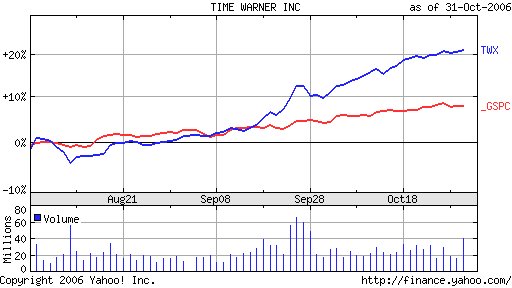 As the Yahoo-sourced chart nearby shows (click on the chart to enlarge), over the past 3 months, TW has risen some 20%, while the S&P is up less than 10%. However, looking at 2 year (below) and 5 year (unable to get Blogger to paste it) charts, TW and the index are both up about 20% for the first period, but TW is down slightly less than 50% for the second period, while the S&P is up between 20% and 30%.
The WSJ piece provides some insights into what has gone wrong with the magazine group under Moore's stewardship. Although the article quotes Moore as saying,
"Everyone is so worried that we're late coming to the party....this party is not over...The party just started. We've gotten to the real tipping point. The one thing I've learned this year is that there is a real business here."
Now, that is sad. Only this year has Moore realized what Google, Yahoo and other online sites have known for some time- that people now receive their important news online. Breaking news is online, and immediate followup coverage of breaking news can be in the form of a daily newspaper. But the weekly plain vanilla "news" magazine is in trouble, i.e., Time. That Sports Illustrated and CNNMoney are the major recipients of Time, Inc.'s online attentions only highlight that they do not cover typical, generic news topics.
Moore has had the top job at Time, Inc. for four years now, but, before that, was credited, in her 28 years with the company, with a knack for creating new titles, such as InStyle and Real Simple.
However, one only needs to step back and view the overall media landscape to see that Moore is probably as wrong a fit for her job as Parsons is for his. The company overall, and its magazine division particularly, suffer from being an old media giant, with its assets and brand values rooted in print distribution, while most of the people who value that information have already headed for the internet to find such content. That Moore thinks the game is just starting demonstrates how seriously she misunderstands the manner in which media consumption habits are developed, and brands are built. Meanwhile, her boss, Parsons, was characterized on CNBC this morning as being a "diplomat," selected to replace Gerald Levin at a time of tremendous organizational crisis at the firm, in the wake of the AOL merger disaster. Now, Parsons' skills as a lawyer and mediator seem badly deficient for the rather basic task of operational management of the current business portfolio, and strategic development of it for the future.
Again, taking that large step backward to view overall media, you can see that, with internet-based information distribution, the old boundaries between print and video, instant, daily, weekly, and monthly, are gone. Content distribution, consumer consumption, and, with them, advertising, have all been migrating to the web in increasing volumes. In this environment, what tangible value propositions do print magazines like Time and People now offer?
The Journal article mentions that, among the alternatives being discussed, is to make Time more like The Economist. I subscribe to the latter, and I frankly can't ever see the former mounting a serious challenge. Part of what makes The Economist what it is, is the international outlook from its British base. I doubt that Time will never be able to match that, let alone attract the talent to deepen its analytical capabilities.
Truth is, TW is holding media assets that are dwindling in value, as the plunging ad revenues indicate. Thus, the layoffs and cost-cutting at Time, Inc., parallel similar actions at the nation's struggling newspapers. As further evidence of both the magnitude of the problem, and the ineptitude and lack of confidence of the division's management, it has retained McKinsey to study its options for solutions.
All of which causes me to ignore the recent bounce in TW's stock price, and take, as usual, my longer-term view. I think this company is only gaining value for short-term reasons; either a divestiture of AOL, or radical one-time cost cuts which may fall to the bottom line. But on an ongoing basis, I believe the company's brands are, for the most part, damaged goods. The management team isn't up to fixing them, or even competently developing a strategy to maximize the value to shareholders of what's left. That's why they called in McKinsey.
In my opinion, TimeWarner will continue to deliver, over the long term, inferior total returns to its shareholders, while it is still around in its current incarnation.
Tuesday, October 31, 2006
When Growth Goes Bad: Wal-Mart & JetBlue
Monday's WSJ carried an article by Justin Lahart in his "Ahead of the Tape" column. It looks like Mr. Lahart needs some remedial financial theory work.
Yesterday's piece focused on how Wal-Mart's and JetBlue's stock prices rose when the companies announced plans to trim growth, via spending cuts.
Mr Lahart's bolded lead sentence reads,
"Advice for companies looking to jump-start their stock price: Stop spending."
Well, Mr. Lahart, at least you got it half-right. What he has observed is a simple example of the effects of unprofitable growth. When it slows, the company's total return may actually rise. Hard as this may be to believe, this concept has actually been understood by business people across America for over a quarter of a century.
Thus, when badly managed companies announce the abandonment of badly implemented or reasoned spending on ill-advised growth strategies, their stock prices may well rise.
This by no means implies that companies such as Apple, Google, or other profitably and productively growing companies should trim their growth spending. However, Amazon, which has had management problems for some time, also saw its stock price benefit from an announcement concerning its slowing of spending on growth initiatives.
Conditionality is everything in these situations.
On a related note, on the same day, CNBC's resident human version of a ticker tape, Bob Pisani, on the floor of the NYSE, attempted to project Wal-Mart's slowing sales growth to the entire sector and economy.
Memo to Bob:
FYI, Wal-Mart undertook a massive retail merchandising transformation last year, and it has failed. This is a major reason why its sales are disappointing. It does not necessarily have any bearing on other, better managed retailers.
Best regards,
-The Reasoned Sceptic.
It's sort of scary- and perhaps appropriately so, on this Halloween afternoon- that CNBC disseminates such ill-informed, half-baked reasoning live from the exchange's floor, and implies that it constitutes "news" on which investors may rely for their portfolio management.
So, to summarize, we have one reporter at the nation's premier business daily, and the on-air reporter for the nation's major business news television channel, both missing the nuances of cause and effect in Wal-Mart's recent actions and announcement of disappointing sales performance. And, though differently, each reporter then erroneously attempted to base further conclusions about the economy on factors particular to Wal-Mart, and, in the case of the WSJ's Lahart, a few other mismanaged, investment-spending paring firms.
God save us from our national business news media "news" reporters.
Yesterday's piece focused on how Wal-Mart's and JetBlue's stock prices rose when the companies announced plans to trim growth, via spending cuts.
Mr Lahart's bolded lead sentence reads,
"Advice for companies looking to jump-start their stock price: Stop spending."
Well, Mr. Lahart, at least you got it half-right. What he has observed is a simple example of the effects of unprofitable growth. When it slows, the company's total return may actually rise. Hard as this may be to believe, this concept has actually been understood by business people across America for over a quarter of a century.
Thus, when badly managed companies announce the abandonment of badly implemented or reasoned spending on ill-advised growth strategies, their stock prices may well rise.
This by no means implies that companies such as Apple, Google, or other profitably and productively growing companies should trim their growth spending. However, Amazon, which has had management problems for some time, also saw its stock price benefit from an announcement concerning its slowing of spending on growth initiatives.
Conditionality is everything in these situations.
On a related note, on the same day, CNBC's resident human version of a ticker tape, Bob Pisani, on the floor of the NYSE, attempted to project Wal-Mart's slowing sales growth to the entire sector and economy.
Memo to Bob:
FYI, Wal-Mart undertook a massive retail merchandising transformation last year, and it has failed. This is a major reason why its sales are disappointing. It does not necessarily have any bearing on other, better managed retailers.
Best regards,
-The Reasoned Sceptic.
It's sort of scary- and perhaps appropriately so, on this Halloween afternoon- that CNBC disseminates such ill-informed, half-baked reasoning live from the exchange's floor, and implies that it constitutes "news" on which investors may rely for their portfolio management.
So, to summarize, we have one reporter at the nation's premier business daily, and the on-air reporter for the nation's major business news television channel, both missing the nuances of cause and effect in Wal-Mart's recent actions and announcement of disappointing sales performance. And, though differently, each reporter then erroneously attempted to base further conclusions about the economy on factors particular to Wal-Mart, and, in the case of the WSJ's Lahart, a few other mismanaged, investment-spending paring firms.
God save us from our national business news media "news" reporters.
Rx for Citigroup From the Wall Street Journal
This past weekend's Wall Street Journal contained an article with a prescription for Citigroup's future health. For a change, it's one with which I agree. At last, someone else sees that financial utilities cannot consistently grow profitably for long.
The WSJ piece suggests that Citi CEO Chuck Prince dismantle Citigroup. It's a good idea, and not just for Citi. Who knows, maybe it will catch on. I wrote about the similarities of the three large US commercial banks here in April, and about Citi here, in July, and about banking as a commodity here, more recently. Unfortunately, Blogger is not cooperating with my attempt to paste the one-year stock price performance chart for BofA, Citi and Chase. However, it depicts three nearly lock-step institutions, in terms of price moves.
 In general, my point has been that none of these financial super-utilities has the slightest chance to consistently outperform the S&P500 anymore. A look at the nearby Yahoo-sourced chart (please click on the chart to see a larger version of it) of the five year performance of Citi, Chase, BofA and the S&P500 illustrates how consistently mediocre the banks have been. Citi is currently the only one which has not, on a point-to-point basis, outperformed the index over five years, although the other banks are doing so only thanks to a recent price runup. Citi, though, has underperformed the index for more than a year, and tracked it, at best, prior to that.
 None of these financial utilities will consistently earn superior total returns for their shareholders over time. They are simply too large, way beyond the minimum economic size required to operate a financial services business. And their attempts at coordination cost more than the value of the conglomerations.
As this longer term chart of stock prices depicts, Chase is the only bank to underperform the S&P over the 21 year period, but Citi ceased to outperform the index as of roughly 2000. It's noteworthy that all two of the banks, Chase and Citi, have essentially flat-lined their stock price performance since that year. BofA has merely tracked the S&P for the last few years. None of these financial titans appear to be able to break out of a rut underperforming or merely tracking what an investor can get for total returns from the broader market.
Thus, it can't hurt for Citi to begin undoing the damage that Sandy Weill did to it since his ascension to the top job there so many years ago. If the bank were successfully integrating all of its business in some non-linear, more-than-additive manner, it would show up in the total returns. But it isn't. Like GE, we have a conglomerate that now exists more for senior staff and executive job preservation than for shareholder value creation.
At this point, it's hard to see how shareholders would be worse off by owning, and being offered the opportunity to hold or sell, separated interests in mortgage banking, retail banking, brokerage, institutional banking, and insurance. Each of these Citi units is sufficiently large to self-fund, and would likely prosper when forced to compete and prosper on their own, rather than spend significant resources simply being a compliant part of a financial super-utility.
The WSJ piece suggests that Citi CEO Chuck Prince dismantle Citigroup. It's a good idea, and not just for Citi. Who knows, maybe it will catch on. I wrote about the similarities of the three large US commercial banks here in April, and about Citi here, in July, and about banking as a commodity here, more recently. Unfortunately, Blogger is not cooperating with my attempt to paste the one-year stock price performance chart for BofA, Citi and Chase. However, it depicts three nearly lock-step institutions, in terms of price moves.
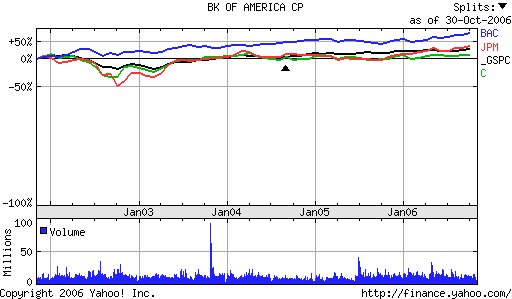 In general, my point has been that none of these financial super-utilities has the slightest chance to consistently outperform the S&P500 anymore. A look at the nearby Yahoo-sourced chart (please click on the chart to see a larger version of it) of the five year performance of Citi, Chase, BofA and the S&P500 illustrates how consistently mediocre the banks have been. Citi is currently the only one which has not, on a point-to-point basis, outperformed the index over five years, although the other banks are doing so only thanks to a recent price runup. Citi, though, has underperformed the index for more than a year, and tracked it, at best, prior to that.
 None of these financial utilities will consistently earn superior total returns for their shareholders over time. They are simply too large, way beyond the minimum economic size required to operate a financial services business. And their attempts at coordination cost more than the value of the conglomerations.
As this longer term chart of stock prices depicts, Chase is the only bank to underperform the S&P over the 21 year period, but Citi ceased to outperform the index as of roughly 2000. It's noteworthy that all two of the banks, Chase and Citi, have essentially flat-lined their stock price performance since that year. BofA has merely tracked the S&P for the last few years. None of these financial titans appear to be able to break out of a rut underperforming or merely tracking what an investor can get for total returns from the broader market.
Thus, it can't hurt for Citi to begin undoing the damage that Sandy Weill did to it since his ascension to the top job there so many years ago. If the bank were successfully integrating all of its business in some non-linear, more-than-additive manner, it would show up in the total returns. But it isn't. Like GE, we have a conglomerate that now exists more for senior staff and executive job preservation than for shareholder value creation.
At this point, it's hard to see how shareholders would be worse off by owning, and being offered the opportunity to hold or sell, separated interests in mortgage banking, retail banking, brokerage, institutional banking, and insurance. Each of these Citi units is sufficiently large to self-fund, and would likely prosper when forced to compete and prosper on their own, rather than spend significant resources simply being a compliant part of a financial super-utility.
Monday, October 30, 2006
Corporate Governance : Firing the CEO
Today's Wall Street Journal is a gold mine of interesting articles and topics on which to comment.
For this post, I'll focus on the paper's Marketplace article, "How To Fire a CEO." The gist of the pieces is that few CEOs can, it appears, actually be fired for cause. Outside of grossly inappropriate personal behavior, fraud, or embezzlement, simple poor performance of the duties for which s/he is compensated does not, evidently, merit discharge of the modern CEO.
There seems to be a significant inconsistency between the CEO's office and even his or her executive team. Let's take Wal-Mart, for example. It has, I am sure, an SVP or VP of Sales. Sales, however, have been lackluster. The company's recent marketing strategies aren't working very well, and sales are disappointing.
Would we not expect, at some point, that Lee Scott, Wal-Mart's CEO, might replace his head of sales? And would this not be because that executive failed to meet his or her management objectives, presumably involving sales goals?
Why can't the board, upon extending a contract to a CEO, include performance objectives? As I wrote here in a prior post, why does a board not hire a CEO on terms which substantially enrich the CEO, on a lagged basis, if s/he meets growth and total return objectives, but does not if they are not met?
Some will argue that really qualified CEOs won't take that kind of risk. Really? I'd expect at least a few would rise to the challenge of running a large company, plus making substantially more if they succeed, than if they fail. Further, what does the company have to lose? Compensating a CEO to not succeed will probably just get you another Jeff Immelt, the now-wealthy, and becoming wealthier, under-performing CEO of GE.
Ought not sauce for the goose be sauce for the gander, as well? If a CEO can, and does, replace under-performing executives on her or his team, why does not the board of directors do likewise? Include performance objectives in the CEO's contract, and enforce them.
Here's the dirtiest little secret about that, by the way. At today's average CEO compensation levels of $11.8MM, as reported here by The Corporate Library, even a failure as CEO at a large-cap firm is well on the way to retirement after only a year's failure in the job. Changing compensation to more variable, and less fixed, as I suggested in the earlier linked post, will at least make failures less expensive for a company.
However, for starters, how about boards simply setting performance objectives for their CEOs, and then acting on failure to perform?
For this post, I'll focus on the paper's Marketplace article, "How To Fire a CEO." The gist of the pieces is that few CEOs can, it appears, actually be fired for cause. Outside of grossly inappropriate personal behavior, fraud, or embezzlement, simple poor performance of the duties for which s/he is compensated does not, evidently, merit discharge of the modern CEO.
There seems to be a significant inconsistency between the CEO's office and even his or her executive team. Let's take Wal-Mart, for example. It has, I am sure, an SVP or VP of Sales. Sales, however, have been lackluster. The company's recent marketing strategies aren't working very well, and sales are disappointing.
Would we not expect, at some point, that Lee Scott, Wal-Mart's CEO, might replace his head of sales? And would this not be because that executive failed to meet his or her management objectives, presumably involving sales goals?
Why can't the board, upon extending a contract to a CEO, include performance objectives? As I wrote here in a prior post, why does a board not hire a CEO on terms which substantially enrich the CEO, on a lagged basis, if s/he meets growth and total return objectives, but does not if they are not met?
Some will argue that really qualified CEOs won't take that kind of risk. Really? I'd expect at least a few would rise to the challenge of running a large company, plus making substantially more if they succeed, than if they fail. Further, what does the company have to lose? Compensating a CEO to not succeed will probably just get you another Jeff Immelt, the now-wealthy, and becoming wealthier, under-performing CEO of GE.
Ought not sauce for the goose be sauce for the gander, as well? If a CEO can, and does, replace under-performing executives on her or his team, why does not the board of directors do likewise? Include performance objectives in the CEO's contract, and enforce them.
Here's the dirtiest little secret about that, by the way. At today's average CEO compensation levels of $11.8MM, as reported here by The Corporate Library, even a failure as CEO at a large-cap firm is well on the way to retirement after only a year's failure in the job. Changing compensation to more variable, and less fixed, as I suggested in the earlier linked post, will at least make failures less expensive for a company.
However, for starters, how about boards simply setting performance objectives for their CEOs, and then acting on failure to perform?
Ford & GM: What Constitutes A "Turnaround?"
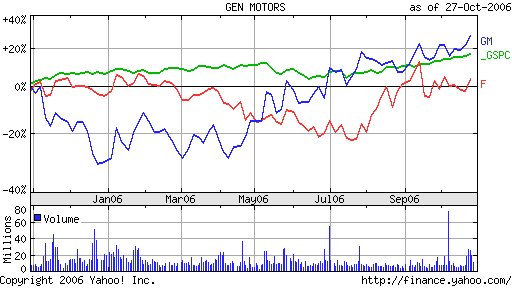
We keep hearing that GM is successfully turning itself around. That Alan Mulally, Ford's new CEO, is planning a turnaround for that ailing auto maker.
What constitutes a "turnaround?" How is it measured? Does it have to take place within some timeframe to qualify as a turnaround, as distinct from, say, an evolution? Or basic business management?
For example, look at the nearby Yahoo price chart (click on the chart to view an enlarged version) for Ford, GM, and the S&P500 for the past 12 months. To the casual eye, GM indeed appears to be "turning around," especially relative to the S&P and Ford.
 However, as this second chart, depicting GM's stock price for the past five years, shows, it would not be the only time in the past 60 months that the company's stock price has rallied. However, each prior time, it subsequently fell. Given that this period contains the technology bubble burst, one might argue that that was the reason for the first selloff. In a sense, this makes my point. How many contextual factors must be considered, in order to judge a brief stock price move as a "turnaround?" Is Rick Wagoner correct in celebrating the twin victories of rebuffing Carlos Ghosn and reviving GM already? Or is GM's stock price, and total return, destined to head downward again within a few months, making investors have to time their buying and selling of GM quite finely in order to capture the temporary value gain in the stock?
Is a turnaround measured in sales growth, or change in the rate of sales growth? Profit growth? Total return? All of these? Over what timeframes?
I'm curious, because when a firm like GM is claiming to already succeeding at its "turnaround," and then I hear and read analysis that casts doubt on their actual sales to end users, it gives me pause. It makes me think the entire concept has become a self-serving one.
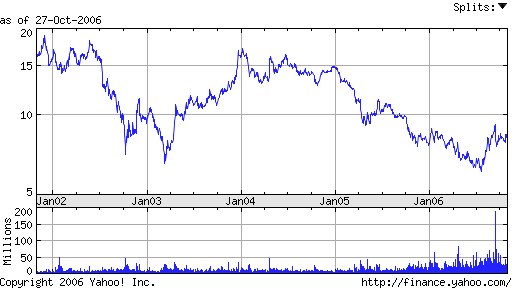 And what about Alan Mulally's Ford Motor Company? It has a similar pattern to that of GM's stock price over the past five years, as the nearby chart illustrates. Twice in the past five years, its price has risen, only to slump, either quickly, or gradually over two and a half years.
My own preference is to call a "turnaround" when a company's sales growth has placed it among the top large-cap or S&P companies on that measure, consistently, for several years. I feel the same about total returns. A few months, or even a year, of temporary sales growth and stock price rise does not, to me, sufficiently exceed normal S&P500 standard deviations from average performance to constitute anything more than random behavior.
For me, there's way too much going on in the auto sector to allow either Ford or GM to qualify for my portfolios any time soon. A genuine resurgence in sales, with accompanying profits that meet investors' expectations, over enough time to demonstrate lasting changes, not just one year's new models or one-off cost savings, will be required.
My portfolio strategy invests in companies which exhibit the hallmarks of consistently superior sales growth and total returns, not short-term gains, or long-term business uncertainty and inconsistencies in performance.
Subscribe to:
Posts (Atom)


