Windows Vista Demo Goes Awry
As I wrote a less than a month ago, websites like YouTube have opened up a new era in "small" media commentary. Now, video may be provided with commentary and analysis like that on this blog. My earlier example was for illustrative purposes, and not exactly "timely."
This one is.
I was watching CNBC this morning with a cup of capuccino when I saw a story featuring this video. As soon as the pieced had finished, I dutifully went to this computer, found the clip, and captured it for this post.
So, two points.
First, as I wrote last month, now it's possible for a totally "free" and expenseless source, me, to access news videos, as well as written pieces, like the post about Michael Wolff's Time Warner piece in Vanity Fair which I just published. The world of non-major-media analysis and commentary is expanding at a breakneck clip, and not just for trivia.
Second, if you still thought Microsoft was a successful, smoothly-functioning "technology" company that matters, watch this clip. How many total return performance failures and fundamental business operating gaffes (like delayed releases of the company's major products) does a large company need to make in order to be seen for what it really is- a once-successful tech company now in its dotage?
This clip of Vista's malfunctioning voice recognition capabilities is a howler. Do you not wonder how this could have occurred? Were you Steve Ballmer, would you not have required this experiment to have been tried successfully about, oh, 25 times, before allowing it to go "live" before the press?
Talk about mediocre, inept management. And Ballmer still can't explain the last five years of Microsoft's total return performance. Neither can Gates. See my posts here, here, and here for details.
I think this video clip is just one more example of why Microsoft has become a large company that was once a tremendous driver in the technology field, and also once a tremendous growth investment opportunity. But no more. Now it's mired in difficulty simply executing in its major product areas. As if, by the way, anyone really "wants" to be forced to buy a new operating system, rather than, say, simply receive a more secure, upgraded version of XP. For free, so it functions like a modern operating system "should."
Monday, August 07, 2006


Sunday, August 06, 2006
Time Warner Again: Michael Wolff's Analysis in Vanity Fair
You read it here first. And here. Time Warner no longer has a raison d'etre. Now, I'm in good company.
Michael Wolff of Vanity Fair wrote a wonderful piece this month discussing why Time Warner should be broken up. The occasion was his interview with Carl Icahn, the erstwhile corporate raider, now 'corporate governance' enforcer.
Rather than attempt to rephrase or summarize Wolff's article, I've provided the link to it, so you can read it for yourself.
What is comforting to me is that Wolff, although much later than I did, comes to the same conclusions regarding the company's current and long-term viability, for many of the same reasons. I've seen Wolff on several CNBC interviews. His candor and sensibility have impressed me, so I'm happy that he and I have similar feelings about the Time Warner situation. Only I didn't have the benefit of an afternoon with Carl Icahn to cement my conclusions.
Nevertheless, I think, based upon Wolff's piece, that perhaps Time Warner, its recent quarterly results notwithstanding, is headed for breakup within the next, say, 24 months?
Michael Wolff of Vanity Fair wrote a wonderful piece this month discussing why Time Warner should be broken up. The occasion was his interview with Carl Icahn, the erstwhile corporate raider, now 'corporate governance' enforcer.
Rather than attempt to rephrase or summarize Wolff's article, I've provided the link to it, so you can read it for yourself.
What is comforting to me is that Wolff, although much later than I did, comes to the same conclusions regarding the company's current and long-term viability, for many of the same reasons. I've seen Wolff on several CNBC interviews. His candor and sensibility have impressed me, so I'm happy that he and I have similar feelings about the Time Warner situation. Only I didn't have the benefit of an afternoon with Carl Icahn to cement my conclusions.
Nevertheless, I think, based upon Wolff's piece, that perhaps Time Warner, its recent quarterly results notwithstanding, is headed for breakup within the next, say, 24 months?
Friday, August 04, 2006
Fast Money on CNBC: Are We All Traders Now?
There's a new financial investment program on CNBC in the evenings now. Its host is Dylan Ratigan, one of the network's on-air anchors. He has a BA in political economy from Union College.
The program is called "Fast Money," and features Ratigan with four guest pundits who opine on stocks at a furious pace. Their promo picture has them standing together, sans jackets, arms folded, looking "tough." This is serious business. The show's slogan is, "Game On!"
There are two things which confuse me about this new program. First, does it not cover the same ground as CNBC's "Mad Money" with Jim Cramer? Second, in contrast to the networks gushing tributes to Lou Rukeyser upon his passing, does this show not emphasize exactly what the esteemed late financial program host constantly warned viewers against, e.g., 'short-termism?'
Since CNBC is a cable-TV network, I understand that Fast Money is supposed to have entertainment value. It looks like something a producer pitched to the CNBC brass as "Cramer's Mad Money meets Crossfire." Four guys arguing about how fast to pump and dump various name stocks, with Ratigan mugging for the camera, being jocular with his 4 buddies and directing the action on camera. I've caught some of the show, and it pointedly focuses on, well, "fast money," i.e., how to rapidly churn trades to make instant cash.
In fact, my clearest recollection of Ratigan, whether interviewing Cramer at 3:30PM each day for the "Stop Trading" segment, or on Fast money, is him uttering a phrases such as,
"Jimmy, what's your best trade right now," or, "So what's the trade here?"
Maybe CNBC is worried that Cramer, like all entertainers, eventually wear out his welcome with his viewers. In that event, they have a look-alike ready to slip into that slot and retain ad dollars. Or perhaps they think Cramer will simply blow up on camera one day, and want to hedge their bets. Or maybe that he'll finally go too far one day, and find himself subpoenaed by the SEC.
On the second point, though, I really am puzzled. If I'm not mistaken, Rukeyser had chosen, or allowed to be chosen, Ratigan to guest host Wall Street Week in its last days, as Lou became too ill to go on air. WSW's hallmark was patient, longterm investing, under the careful, calm guidance of its well-regarded host.
What happened all of a sudden to this investing ethic? Has CNBC gone "mad?"
Perhaps the network saw the same data in the media lately that I have, regarding the nearly-50% volume of daily trading that hedge funds now comprise. Since they certainly don't have 50% of the market's assets yet, this means they must be turning over positions at a furious rate.
Is it possible CNBC figures that what's good enough for hedge funds is good enough for its viewers?
The program is called "Fast Money," and features Ratigan with four guest pundits who opine on stocks at a furious pace. Their promo picture has them standing together, sans jackets, arms folded, looking "tough." This is serious business. The show's slogan is, "Game On!"
There are two things which confuse me about this new program. First, does it not cover the same ground as CNBC's "Mad Money" with Jim Cramer? Second, in contrast to the networks gushing tributes to Lou Rukeyser upon his passing, does this show not emphasize exactly what the esteemed late financial program host constantly warned viewers against, e.g., 'short-termism?'
Since CNBC is a cable-TV network, I understand that Fast Money is supposed to have entertainment value. It looks like something a producer pitched to the CNBC brass as "Cramer's Mad Money meets Crossfire." Four guys arguing about how fast to pump and dump various name stocks, with Ratigan mugging for the camera, being jocular with his 4 buddies and directing the action on camera. I've caught some of the show, and it pointedly focuses on, well, "fast money," i.e., how to rapidly churn trades to make instant cash.
In fact, my clearest recollection of Ratigan, whether interviewing Cramer at 3:30PM each day for the "Stop Trading" segment, or on Fast money, is him uttering a phrases such as,
"Jimmy, what's your best trade right now," or, "So what's the trade here?"
Maybe CNBC is worried that Cramer, like all entertainers, eventually wear out his welcome with his viewers. In that event, they have a look-alike ready to slip into that slot and retain ad dollars. Or perhaps they think Cramer will simply blow up on camera one day, and want to hedge their bets. Or maybe that he'll finally go too far one day, and find himself subpoenaed by the SEC.
On the second point, though, I really am puzzled. If I'm not mistaken, Rukeyser had chosen, or allowed to be chosen, Ratigan to guest host Wall Street Week in its last days, as Lou became too ill to go on air. WSW's hallmark was patient, longterm investing, under the careful, calm guidance of its well-regarded host.
What happened all of a sudden to this investing ethic? Has CNBC gone "mad?"
Perhaps the network saw the same data in the media lately that I have, regarding the nearly-50% volume of daily trading that hedge funds now comprise. Since they certainly don't have 50% of the market's assets yet, this means they must be turning over positions at a furious rate.
Is it possible CNBC figures that what's good enough for hedge funds is good enough for its viewers?
Richard Moore's 15 Minutes of Fame
Yesterday morning, CNBC's guest host was Richard Moore, Treasurer of the State of North Carolina.
I'm not really sure what the financial officer of a non-profit entity has to offer viewers of the network. Perhaps he is one of those aggressive, 'proactive' State Treasurers who feel they must assume the role of Chief Market and Investment Guru for their state. But he did provide some interesting information from an investor standpoint.
For instance, he referred many times to the portfolio he manages for the State, and some of its larger holdings. One was either Wal-Mart or some other retailer-ish company which has been in a slump for several years. Moore cheerily assured the CNBC on-air staff that the company in question was 'a fine company, we're not worried, they'll do just fine over time. We're long term investors.' Things like that.
His next pronouncement really took me by surprise. Asked about Microsoft, one of his portfolio's major equity holding, he professed complete faith in keeping the position for the next several years. When asked why, he rambled on in the following sort of vein,
'Well, it's just a great company. It's been down for a while, but it's great. It will be back. They have that X-box, and it's great. My kids tell me they love it, so don't count Microsoft out. They'll do fine, and we're a long term investor."
My own view, based upon my proprietary research and portfolio history, is decidedly different. I wrote here about how no technology companies have ever reappeared, years apart, among my selections, as of the date of the November, 2005 post. Since then, Apple has reappeared in the portfolio, after an absence of more than 10 years. However, it's arguably not the "same" Apple at all. And the reason it is back is not computers, but special-purpose, application-specific digital processing hardware and software combinations, a/k/a, "iPods."
However, for all other technology companies to date, the rule seems to be that their deep commitment to their original technologies prohibits them from taking advantage of opportunities spawned by the very success of those technologies. They learn to work 'one way,' with one legacy technology orientation, and pretty much die with it. If Microsoft has any second act whatsoever, and I doubt that it does, it will be reinventing itself as a niche hardware vendor, rather than a resurgent software titan. Its 'software in a box' approach is dead, Ballmer is still in charge, and the company's arguably too big to be sufficiently nimble now. In fact, on this last point, see yesterday's piece about GE.
So here we have the Treasurer of what I would guess to be a multi-billion dollar portfolio, making stock picks on the advice of his pre-teen children. I'm sure Tarheels throughout the state will be thrilled.
So much for Mr. Moore's 15 minutes of fame.
As for me, I'm actually pretty happy. If this is the competition in the marketplace of investors, I'm sleeping more easily tonight.
I'm not really sure what the financial officer of a non-profit entity has to offer viewers of the network. Perhaps he is one of those aggressive, 'proactive' State Treasurers who feel they must assume the role of Chief Market and Investment Guru for their state. But he did provide some interesting information from an investor standpoint.
For instance, he referred many times to the portfolio he manages for the State, and some of its larger holdings. One was either Wal-Mart or some other retailer-ish company which has been in a slump for several years. Moore cheerily assured the CNBC on-air staff that the company in question was 'a fine company, we're not worried, they'll do just fine over time. We're long term investors.' Things like that.
His next pronouncement really took me by surprise. Asked about Microsoft, one of his portfolio's major equity holding, he professed complete faith in keeping the position for the next several years. When asked why, he rambled on in the following sort of vein,
'Well, it's just a great company. It's been down for a while, but it's great. It will be back. They have that X-box, and it's great. My kids tell me they love it, so don't count Microsoft out. They'll do fine, and we're a long term investor."
My own view, based upon my proprietary research and portfolio history, is decidedly different. I wrote here about how no technology companies have ever reappeared, years apart, among my selections, as of the date of the November, 2005 post. Since then, Apple has reappeared in the portfolio, after an absence of more than 10 years. However, it's arguably not the "same" Apple at all. And the reason it is back is not computers, but special-purpose, application-specific digital processing hardware and software combinations, a/k/a, "iPods."
However, for all other technology companies to date, the rule seems to be that their deep commitment to their original technologies prohibits them from taking advantage of opportunities spawned by the very success of those technologies. They learn to work 'one way,' with one legacy technology orientation, and pretty much die with it. If Microsoft has any second act whatsoever, and I doubt that it does, it will be reinventing itself as a niche hardware vendor, rather than a resurgent software titan. Its 'software in a box' approach is dead, Ballmer is still in charge, and the company's arguably too big to be sufficiently nimble now. In fact, on this last point, see yesterday's piece about GE.
So here we have the Treasurer of what I would guess to be a multi-billion dollar portfolio, making stock picks on the advice of his pre-teen children. I'm sure Tarheels throughout the state will be thrilled.
So much for Mr. Moore's 15 minutes of fame.
As for me, I'm actually pretty happy. If this is the competition in the marketplace of investors, I'm sleeping more easily tonight.
Thursday, August 03, 2006
Another Thought on Longshoremen
I was discussing my longshoremen's post with my business partner over lunch yesterday. Having just published it, I didn't want to go back and alter it.
However, this thought occurred to me as we chatted about my analysis of the situation involving US unionized ports, shipping lines, and the two large longshoremen's unions.
These unions, together, have about 100,000 members, according to the WSJ piece. I just checked the Yahoo profiles on Ford and GM. They have a combined total workforce of about 630,000. Figure roughly 600,000 are UAW members. Gross that up 50% for related workers at other auto producers, or parts manufacturers, like Delphi (184,000 employees). That's about 900,000 members, or between 9x the size of the longshoremen's unions.
My point is, the longshoremen are hardly the sort of "union" Samuel Gompers and Walter Reuther had in mind when they began organizing labor in the first half of the last century. The Teamsters and the UAW are still largely, legitimately, "blue" collar unions.
The longshoremen sound like they wear pastel polo shirts these days, with khakis, and maybe topsiders. Sort of like a private version of PATCO, the air traffic controller's union with which Ronald Reagen so effectively dealt in the 1980s.
As I reflect on yesterday's piece, and these numbers, I have to say, I don't really even consider the longshoremen a "union" in the classic sense. They just don't evoke hordes of minimum wage immigrants, clamoring to get "better conditions" or "more jobs." Heck, these guys don't care how many jobs get displaced, so long as they are paid for theirs. Talk about pulling up the ladder!
If anything, I'd consider the dockworkers of today a sort of min-professional association. More like an engineering, medical society or the attorney's bar than the classical union of old. Their intelligent outmaneuvering of the management of US ports and global shipping lines suggests that, though they may call themselves a union, they behave like one of the better-organized "businesses" I think I've observed.
However, this thought occurred to me as we chatted about my analysis of the situation involving US unionized ports, shipping lines, and the two large longshoremen's unions.
These unions, together, have about 100,000 members, according to the WSJ piece. I just checked the Yahoo profiles on Ford and GM. They have a combined total workforce of about 630,000. Figure roughly 600,000 are UAW members. Gross that up 50% for related workers at other auto producers, or parts manufacturers, like Delphi (184,000 employees). That's about 900,000 members, or between 9x the size of the longshoremen's unions.
My point is, the longshoremen are hardly the sort of "union" Samuel Gompers and Walter Reuther had in mind when they began organizing labor in the first half of the last century. The Teamsters and the UAW are still largely, legitimately, "blue" collar unions.
The longshoremen sound like they wear pastel polo shirts these days, with khakis, and maybe topsiders. Sort of like a private version of PATCO, the air traffic controller's union with which Ronald Reagen so effectively dealt in the 1980s.
As I reflect on yesterday's piece, and these numbers, I have to say, I don't really even consider the longshoremen a "union" in the classic sense. They just don't evoke hordes of minimum wage immigrants, clamoring to get "better conditions" or "more jobs." Heck, these guys don't care how many jobs get displaced, so long as they are paid for theirs. Talk about pulling up the ladder!
If anything, I'd consider the dockworkers of today a sort of min-professional association. More like an engineering, medical society or the attorney's bar than the classical union of old. Their intelligent outmaneuvering of the management of US ports and global shipping lines suggests that, though they may call themselves a union, they behave like one of the better-organized "businesses" I think I've observed.
GE : Sized to Perform for Investors?
Since my various posts on GE, Jeff Immelt and Jack Welch, I've been musing about why the company performs as it does. Which is to say, poorly.
I'm not a balance sheet type of guy. Most of my analysis focuses on changes in income statement items, because I believe that the ultimate goal of CEOs, and investors, should be to earn consistently superior total returns with a company's assets. My proprietary research has found that changes in income statement items are most associated with changes in total returns, especially for growth companies.
However, I am aware that GE is among the largest, if not the largest, US public company by assets. It's certainly among the top 5, I would think.
In the company's recent annual report, which you may find on the GE website, Immelt, the CEO, claims, in a bold headline, that GE is "sized to perform for investors."
Really?
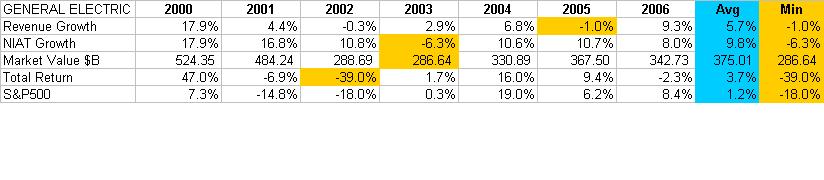
 Here's a table of GE's recent "performance," in terms of growth in revenues and NIAT, market value, and total return for its investors (click on the table to see an enlarged version) from July of 2000 to July of 2006. The S&P500 Index annual return is included for comparison purposes. The blue column provides the average for the last seven years, while the tan column and cells display the minimum values over the seven year period.
As I look at this table, what jumps out at me is how mediocre GE has been. Its sales growth is an S&P ballpark average of roughly 6%. NIAT growth is a bit higher, so that means management is squeezing profits out of the slow-growing company, to get the 10% average on that measure. Average total return is an anemic 3.7% over the period. Better than the 1.2% average for the S&P, but with 3 negative years, including one in which return plunged almost 40%. Immelt is responsible for the period 2002-2006, when the average total return of the company was -2.8%, compared to the S&P's +3.2%.
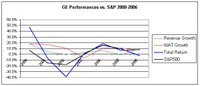 Here is some of the same data, in chart form (again, clicking on the chart will bring up a larger version). On balance, GE has been, for the last 7 12-month periods, an inconsistently mediocre company. The slim margin of 2.5 percentage points of outperformance over the S&P is hardly worth the risk entailed by holding the company's stock for 7 years.
So, I ask again, for "what" exactly is GE "sized to perform for investors?" Certainly not returns.
No, I've come to the conclusion that GE is sized to provide highly compensated jobs for its senior managers, particularly Jeff Immelt.
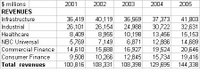 Consider this. The company now has a market value of roughly $350B. It is organized into six major business units, no one of which currently has revenues of less than $15B. Here is a table from the GE annual report providing the details (once again, click on it to enlarge). This is one huge company. And it's not all that lopsided. The largest major component, Infrastructure, has $41B in revenues, or less than 3x that of the smallest unit, NBC Universal.
In this era of private equity buyouts and plentiful capital, why do these business units need to be under one corporate umbrella? It's hard to believe finance and adminstration functions require such scale. In fact, each unit probably has its own basic administration functions. And if the vaunted GE research labs are really key to every unit, they could jointly fund those labs and buy desired research results, patents, and inventions.
With such a mediocre track record for the better part of a decade, while compensating Immelt so richly, as I have discussed here, what possible defense is there for keeping this behemoth intact anymore?
The days of Thomas Edison's end-to-end electrical system supply enterprise are long, long gone. I contend that each of these business units, and perhaps even more, at lower levels, could be spun off independently, to GE's investors' benefit. It's hard to believe that this collection of such different businesses can realistically derive value from being in a common corporate domicile, let alone generate excess returns because of that common home to pay for the lush compensation of the various senior executives.
I can't see any downside to breaking up GE into its component businesses. Does anyone else?
I'm not a balance sheet type of guy. Most of my analysis focuses on changes in income statement items, because I believe that the ultimate goal of CEOs, and investors, should be to earn consistently superior total returns with a company's assets. My proprietary research has found that changes in income statement items are most associated with changes in total returns, especially for growth companies.
However, I am aware that GE is among the largest, if not the largest, US public company by assets. It's certainly among the top 5, I would think.
In the company's recent annual report, which you may find on the GE website, Immelt, the CEO, claims, in a bold headline, that GE is "sized to perform for investors."
Really?
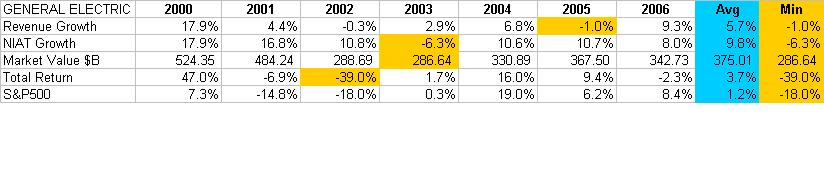 Here's a table of GE's recent "performance," in terms of growth in revenues and NIAT, market value, and total return for its investors (click on the table to see an enlarged version) from July of 2000 to July of 2006. The S&P500 Index annual return is included for comparison purposes. The blue column provides the average for the last seven years, while the tan column and cells display the minimum values over the seven year period.
As I look at this table, what jumps out at me is how mediocre GE has been. Its sales growth is an S&P ballpark average of roughly 6%. NIAT growth is a bit higher, so that means management is squeezing profits out of the slow-growing company, to get the 10% average on that measure. Average total return is an anemic 3.7% over the period. Better than the 1.2% average for the S&P, but with 3 negative years, including one in which return plunged almost 40%. Immelt is responsible for the period 2002-2006, when the average total return of the company was -2.8%, compared to the S&P's +3.2%.
 Here is some of the same data, in chart form (again, clicking on the chart will bring up a larger version). On balance, GE has been, for the last 7 12-month periods, an inconsistently mediocre company. The slim margin of 2.5 percentage points of outperformance over the S&P is hardly worth the risk entailed by holding the company's stock for 7 years.
So, I ask again, for "what" exactly is GE "sized to perform for investors?" Certainly not returns.
No, I've come to the conclusion that GE is sized to provide highly compensated jobs for its senior managers, particularly Jeff Immelt.
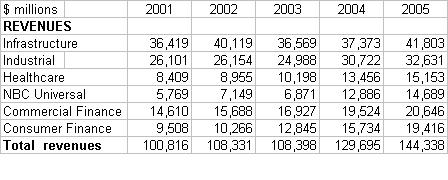 Consider this. The company now has a market value of roughly $350B. It is organized into six major business units, no one of which currently has revenues of less than $15B. Here is a table from the GE annual report providing the details (once again, click on it to enlarge). This is one huge company. And it's not all that lopsided. The largest major component, Infrastructure, has $41B in revenues, or less than 3x that of the smallest unit, NBC Universal.
In this era of private equity buyouts and plentiful capital, why do these business units need to be under one corporate umbrella? It's hard to believe finance and adminstration functions require such scale. In fact, each unit probably has its own basic administration functions. And if the vaunted GE research labs are really key to every unit, they could jointly fund those labs and buy desired research results, patents, and inventions.
With such a mediocre track record for the better part of a decade, while compensating Immelt so richly, as I have discussed here, what possible defense is there for keeping this behemoth intact anymore?
The days of Thomas Edison's end-to-end electrical system supply enterprise are long, long gone. I contend that each of these business units, and perhaps even more, at lower levels, could be spun off independently, to GE's investors' benefit. It's hard to believe that this collection of such different businesses can realistically derive value from being in a common corporate domicile, let alone generate excess returns because of that common home to pay for the lush compensation of the various senior executives.
I can't see any downside to breaking up GE into its component businesses. Does anyone else?
Wednesday, August 02, 2006
Ports, Shippers & Longshoremen: The Auto Industry & the UAW Redux?
Last Wednesday's Wall Street Journal carried a very informative article about the nation's longshoremen's unions.
According to the Journal's piece, there are 100,000 members of the two longshoremen's unions, with average annual compensation of $120,000. They are reputed to be the highest paid blue-collar workers in the country.
What struck me immediately about this union is how similar the country's shippers, ports, and other related business entities have dealt with the longshoremen's unions. Basically, it echoes how the once-Big 3 of the US auto industry, GM, Ford and Chrysler, handled the UAW. The WSJ piece describes how port management companies have agreed to pay longshoremen for containers they don't even touch, just because they come through a union port. In example after example, the unions exercised their power to extort...er....extract concessions from management that build costs into shipping and docking operations.
Technological improvements are allowed if the displaced longshoremen are paid as well, and the union workers given the jobs of operating the new equipment. Union ports won't handle goods from non-union ports, on penalty of the longshoremen simply refusing to unload the cargo. The West Coast's longshoremen's union pioneered the use of master agreements, whereby the shipping lines agree not to use non-union ports, in order to have union workers handle their ship's cargos in the valuable ports of California, Oregon and Washington.
At first, I thought that this might be highlighting a situation that could go the way of the automakers. Upon discussing this with my business partner, I was musing about whether, say, Mexico could create a parallel, non-union transportation system for goods. Perhaps upgrade a port on each of their coasts, link each by rail to the US, and proceed to undercut the American ports and, thus, longshoremen. Apparently, Wal-Mart and some other companies are using just such a fledgling operation already.
Apparently, the master operating agreements will preclude this gaining much ground. Such a parallel system would need its own fleet, and railroads as well. The entire operation would have to be replicated, from originating production point to end-user commercial site. Possible, but burdensome. Maybe a modest amount of production can move this way, but I wonder how much of the US total shipping by tonnage can go such a route within the existing port constraints.
What's similar in the longshoremen's unions case to the auto workers case is that the union has adroitly grabbed the choke points of its dependent business system, and created substantial value for its members.
What's different is that, unlike auto makers, who cannot prevent other companies from rendering their pacts with unions uncompetitive, there seems to be no alternative for anyone to using unionized ports and laborers for existing shipping and dockwork. Give these guys credit, the longshoremen's leaders seem to have sewn up every alternative to their control. The only way this would change is if the nascent efforts of a country like Mexico, mentioned in a prior paragraph, can build sufficient volume to threaten the competitiveness of the unionized port management company's profits, and, thus, the jobs of the union workers there.
So, perhaps the longshoremen more closely resemble the dairy and sugar farmers. They are relatively few in number, and thus gain substantially from the economically-indefensible tariffs they have created in the shipping and transport system. The real cost each of us 250+ million Americans pay, per item, is tiny, compared to the surplus wages the 100,000 longshoremen enjoy. Just like the few dairy and sugar producers, who split the various tariff revenues among a very few farmers. Who thinks sugar is overpriced in the US, despite the fact that it is at something like twice the world price?
At a 2500-to-1 US population to longshoremen ratio, each of us pays about $48/year to these union workers. That's why we probably won't see an industrial challenge to their monopolistic position astride the world's, and America's, logistics/supply chains. And since non-union ports can't be used, there's no real competition for Los Angeles or Seattle. Thus, the businesses aren't really incented to break ranks with the union, so to speak. Unlike foreign auto makers, who could, and did, enter the US and create disaster for GM, Ford and Chrysler, there's really nobody on the global scene who can effectively do that to ports in any country.
Here's the real eye-opener from the WSJ piece. It cited an anecdote of former white-collar managers successfully landing longshoremen's jobs in Charleston, SC. Could it be that your son or daughter should aspire to be come a longshoreman?
According to the Journal's piece, there are 100,000 members of the two longshoremen's unions, with average annual compensation of $120,000. They are reputed to be the highest paid blue-collar workers in the country.
What struck me immediately about this union is how similar the country's shippers, ports, and other related business entities have dealt with the longshoremen's unions. Basically, it echoes how the once-Big 3 of the US auto industry, GM, Ford and Chrysler, handled the UAW. The WSJ piece describes how port management companies have agreed to pay longshoremen for containers they don't even touch, just because they come through a union port. In example after example, the unions exercised their power to extort...er....extract concessions from management that build costs into shipping and docking operations.
Technological improvements are allowed if the displaced longshoremen are paid as well, and the union workers given the jobs of operating the new equipment. Union ports won't handle goods from non-union ports, on penalty of the longshoremen simply refusing to unload the cargo. The West Coast's longshoremen's union pioneered the use of master agreements, whereby the shipping lines agree not to use non-union ports, in order to have union workers handle their ship's cargos in the valuable ports of California, Oregon and Washington.
At first, I thought that this might be highlighting a situation that could go the way of the automakers. Upon discussing this with my business partner, I was musing about whether, say, Mexico could create a parallel, non-union transportation system for goods. Perhaps upgrade a port on each of their coasts, link each by rail to the US, and proceed to undercut the American ports and, thus, longshoremen. Apparently, Wal-Mart and some other companies are using just such a fledgling operation already.
Apparently, the master operating agreements will preclude this gaining much ground. Such a parallel system would need its own fleet, and railroads as well. The entire operation would have to be replicated, from originating production point to end-user commercial site. Possible, but burdensome. Maybe a modest amount of production can move this way, but I wonder how much of the US total shipping by tonnage can go such a route within the existing port constraints.
What's similar in the longshoremen's unions case to the auto workers case is that the union has adroitly grabbed the choke points of its dependent business system, and created substantial value for its members.
What's different is that, unlike auto makers, who cannot prevent other companies from rendering their pacts with unions uncompetitive, there seems to be no alternative for anyone to using unionized ports and laborers for existing shipping and dockwork. Give these guys credit, the longshoremen's leaders seem to have sewn up every alternative to their control. The only way this would change is if the nascent efforts of a country like Mexico, mentioned in a prior paragraph, can build sufficient volume to threaten the competitiveness of the unionized port management company's profits, and, thus, the jobs of the union workers there.
So, perhaps the longshoremen more closely resemble the dairy and sugar farmers. They are relatively few in number, and thus gain substantially from the economically-indefensible tariffs they have created in the shipping and transport system. The real cost each of us 250+ million Americans pay, per item, is tiny, compared to the surplus wages the 100,000 longshoremen enjoy. Just like the few dairy and sugar producers, who split the various tariff revenues among a very few farmers. Who thinks sugar is overpriced in the US, despite the fact that it is at something like twice the world price?
At a 2500-to-1 US population to longshoremen ratio, each of us pays about $48/year to these union workers. That's why we probably won't see an industrial challenge to their monopolistic position astride the world's, and America's, logistics/supply chains. And since non-union ports can't be used, there's no real competition for Los Angeles or Seattle. Thus, the businesses aren't really incented to break ranks with the union, so to speak. Unlike foreign auto makers, who could, and did, enter the US and create disaster for GM, Ford and Chrysler, there's really nobody on the global scene who can effectively do that to ports in any country.
Here's the real eye-opener from the WSJ piece. It cited an anecdote of former white-collar managers successfully landing longshoremen's jobs in Charleston, SC. Could it be that your son or daughter should aspire to be come a longshoreman?
Tuesday, August 01, 2006
Private Equity Buyouts: The Fairness Question
A few months ago, I wrote a post about private equity buyouts, triggered by the Kinder Morgan deal.
In that post, I discussed the larger trend of private equity buyouts as they may effect the larger pool of equities, the S&P500 Index, and, lastly, my equity portfolio strategy.
Last week, my partner and I were discussing this phenomenon again, as HCA is being taken private. And, further, a flurry of Wall Street Journal articles have focused on this trend, plus the trend of hedge funds to turn to private equity as a tool for asset allocation.
Whereas in my prior post, I deliberately chose to omit any discussion of the ethics of buyouts, and the multiple roles of investment banks, plus the question of fees charged to the buyouts. In this post, I will comment on those aspects of modern private equity buyouts.
First, it does seem, frankly, grossly unfair that a small group of managers of a firm like HCA, or Kinder Morgan, who clearly know more about the future prospects of a company than the average shareholder, would tender to take out those other owners at a price which, by definition, has to be below that felt to be attainable by the internal management leading the buyout.
It is inconceivable that a veteran management group would get into bed with a private equity group or a hedge fund, and then offer the remaining (soon to be ex-) shareholders a "fair" price for the latter's interest in the firm.
If there were ever to be legislation to clean up this ethical loophole, my partner and I reasoned something like the following would work. A sort of reverse greenmail. If a management tendered to take the firm private, regulation should provide for the offering of a similar ownership share in the newly-private firm, without voting rights, but with equity rights equal to that of the management's holdings. In effect, whatever management deals itself in for would be available to any shareholders who wished to stay on board for the ride. It would be interesting to see how such a change in the law to mitigate gross underpayment to existing shareholders by the buyout group would affect future private equity deals.
Another popular recent topic regarding private equity buyouts is the weight and number of fees connected with the deals which are ultimately charged back to the company being taken private. Add to this the multiple roles of some investment banks- advisor, participant, and perhaps even competitor to finance the deal- and you have another ethical mess.
I had to laugh recently when John Mack, CEO of Morgan Stanley, deadpanned that there would be 'some potential conflicts' as he planned to move his firm heavily into financing and participating in the private equity business in order to sustain and increase fee revenues at his firm.
The Journal ran a long piece on July 25th, providing some examples of he egregious fees with which the target companies are saddled during and after a buyout. Cash is looted to repay legal and financing fees, plus generous dividends, "just because." Now, mind you, as the new owners, the buyout firm and management team are perfectly within their rights to do this. However, one has to wonder, for a firm such as Burger King, if the company will have much of a chance of ever becoming a consistently superior total return company, post-IPO, when it has to incur all these questionable, largely non-economic costs on behalf of the short-term buyout owners.
I don't have information pertaining to this question, but I wonder how many private buyouts of size, when taken public again via IPOs, become reasonably attractive on the basis of total returns. It could well be that, my earlier legislative suggestion notwithstanding, prior shareholders are actually better off to take the cash and run before the buyout. Unless, of course, their receipts of the many rich fee and cash streams, as part of the new ownership class, make up for post-IPO weakness in the company's share price and returns.
Adding hedge funds to this mix seems to be like pouring gasoline on a fire. These guys are even shorter-term oriented than the buyout firms and their accomplices, the target firms' managements. One can just imagine the kind of explosions that could result from letting money managers who are essentially day-traders, self-privatized from Wall Street banks, play around with private equity buyouts lasting even as little as 18-24 months.
As my partner and I discussed these various aspects of the newly-popular private equity buyout trend, we reminded ourselves that our equity strategy will be largely unaffected. Managers take firms private when they feel that their company's stock price is 'getting no respect.' That doesn't typically describe our selections. So, fortunately, we will be watching this circus continue from the sidelines.
In that post, I discussed the larger trend of private equity buyouts as they may effect the larger pool of equities, the S&P500 Index, and, lastly, my equity portfolio strategy.
Last week, my partner and I were discussing this phenomenon again, as HCA is being taken private. And, further, a flurry of Wall Street Journal articles have focused on this trend, plus the trend of hedge funds to turn to private equity as a tool for asset allocation.
Whereas in my prior post, I deliberately chose to omit any discussion of the ethics of buyouts, and the multiple roles of investment banks, plus the question of fees charged to the buyouts. In this post, I will comment on those aspects of modern private equity buyouts.
First, it does seem, frankly, grossly unfair that a small group of managers of a firm like HCA, or Kinder Morgan, who clearly know more about the future prospects of a company than the average shareholder, would tender to take out those other owners at a price which, by definition, has to be below that felt to be attainable by the internal management leading the buyout.
It is inconceivable that a veteran management group would get into bed with a private equity group or a hedge fund, and then offer the remaining (soon to be ex-) shareholders a "fair" price for the latter's interest in the firm.
If there were ever to be legislation to clean up this ethical loophole, my partner and I reasoned something like the following would work. A sort of reverse greenmail. If a management tendered to take the firm private, regulation should provide for the offering of a similar ownership share in the newly-private firm, without voting rights, but with equity rights equal to that of the management's holdings. In effect, whatever management deals itself in for would be available to any shareholders who wished to stay on board for the ride. It would be interesting to see how such a change in the law to mitigate gross underpayment to existing shareholders by the buyout group would affect future private equity deals.
Another popular recent topic regarding private equity buyouts is the weight and number of fees connected with the deals which are ultimately charged back to the company being taken private. Add to this the multiple roles of some investment banks- advisor, participant, and perhaps even competitor to finance the deal- and you have another ethical mess.
I had to laugh recently when John Mack, CEO of Morgan Stanley, deadpanned that there would be 'some potential conflicts' as he planned to move his firm heavily into financing and participating in the private equity business in order to sustain and increase fee revenues at his firm.
The Journal ran a long piece on July 25th, providing some examples of he egregious fees with which the target companies are saddled during and after a buyout. Cash is looted to repay legal and financing fees, plus generous dividends, "just because." Now, mind you, as the new owners, the buyout firm and management team are perfectly within their rights to do this. However, one has to wonder, for a firm such as Burger King, if the company will have much of a chance of ever becoming a consistently superior total return company, post-IPO, when it has to incur all these questionable, largely non-economic costs on behalf of the short-term buyout owners.
I don't have information pertaining to this question, but I wonder how many private buyouts of size, when taken public again via IPOs, become reasonably attractive on the basis of total returns. It could well be that, my earlier legislative suggestion notwithstanding, prior shareholders are actually better off to take the cash and run before the buyout. Unless, of course, their receipts of the many rich fee and cash streams, as part of the new ownership class, make up for post-IPO weakness in the company's share price and returns.
Adding hedge funds to this mix seems to be like pouring gasoline on a fire. These guys are even shorter-term oriented than the buyout firms and their accomplices, the target firms' managements. One can just imagine the kind of explosions that could result from letting money managers who are essentially day-traders, self-privatized from Wall Street banks, play around with private equity buyouts lasting even as little as 18-24 months.
As my partner and I discussed these various aspects of the newly-popular private equity buyout trend, we reminded ourselves that our equity strategy will be largely unaffected. Managers take firms private when they feel that their company's stock price is 'getting no respect.' That doesn't typically describe our selections. So, fortunately, we will be watching this circus continue from the sidelines.
Searching for Patterns in Financial Information: Part 2
Recently, I discussed the similarities between entropy theory, information theory, and efficient markets theory. Essentially, my equity portfolio strategy is a pattern-seeking machine for use in financial markets.
Because all three phenomena make use of distributions, the concept of uncertainty applies to all of them.
In entropy, uncertainty is seen as the non-uniform distribution of, say, gas molecules in a container. Due to randomly differing energy levels, a gas tends not to be evenly distributed. Physicists came to the conclusion that the use of probabilistic distributions was necessary to accurately to make predictions of the behavior of gases in a container.
Similarly, Shannon's information theory deals with uncertainty. Until one can find sufficient symbol redundancy to ascertain "information" amidst a series of symbols, uncertainty is high. Finding the signal amidst the noise uses probabilistic distributions to ascertain likelihoods of information content, and what that content is.
In the same way, our equity portfolio selection and management process seeks out patterns amidst the noise of financial data. Taken on its face, this torrent of financial information, both market (technical), and company-specific (fundamental), is full of uncertainty. Especially over short periods of time, such as hours or days, the data may seem to contain little in the way of useful patterns. Indeed, in today's markets, with hedge funds accounting for up to 50% of the trading volume on many days, it would seem that rapid-fire trading and asset turnover preclude the search by most investors for patterns beyond a few days in duration.
On the contrary, we carefully sift through a variety of longer-term data which proprietary research has shown contains redundancy. That is, we have found that, when certain predictor data are of a certain pattern, then dependent variables, such as total return, have a high probability of also fitting a certain pattern. This redundancy, while not perfect, seems to provide for a significant amount of probability that the "tails" of distributions of certain data will contain desired information.
While much portfolio management and equity analysis seems to focus on point-estimates of prices and earnings, we prefer to make use of probabilistic distributions of key data in order to increase the chances that the equities we choose will continue to behave in a virtuous pattern, pursuant to our research findings.
As I discussed in my earlier post, the fact that tickers represent real companies, full of real people producing real products and services, increases our confidence that the patterns we seek, and find, are reliable and profitable. Borrowing from the probabilistic approaches to pattern discovery and uncertainty reduction in entropy and information theories, we believe we have developed something as powerful and functional in the management of equity portfolios in finance.
Because all three phenomena make use of distributions, the concept of uncertainty applies to all of them.
In entropy, uncertainty is seen as the non-uniform distribution of, say, gas molecules in a container. Due to randomly differing energy levels, a gas tends not to be evenly distributed. Physicists came to the conclusion that the use of probabilistic distributions was necessary to accurately to make predictions of the behavior of gases in a container.
Similarly, Shannon's information theory deals with uncertainty. Until one can find sufficient symbol redundancy to ascertain "information" amidst a series of symbols, uncertainty is high. Finding the signal amidst the noise uses probabilistic distributions to ascertain likelihoods of information content, and what that content is.
In the same way, our equity portfolio selection and management process seeks out patterns amidst the noise of financial data. Taken on its face, this torrent of financial information, both market (technical), and company-specific (fundamental), is full of uncertainty. Especially over short periods of time, such as hours or days, the data may seem to contain little in the way of useful patterns. Indeed, in today's markets, with hedge funds accounting for up to 50% of the trading volume on many days, it would seem that rapid-fire trading and asset turnover preclude the search by most investors for patterns beyond a few days in duration.
On the contrary, we carefully sift through a variety of longer-term data which proprietary research has shown contains redundancy. That is, we have found that, when certain predictor data are of a certain pattern, then dependent variables, such as total return, have a high probability of also fitting a certain pattern. This redundancy, while not perfect, seems to provide for a significant amount of probability that the "tails" of distributions of certain data will contain desired information.
While much portfolio management and equity analysis seems to focus on point-estimates of prices and earnings, we prefer to make use of probabilistic distributions of key data in order to increase the chances that the equities we choose will continue to behave in a virtuous pattern, pursuant to our research findings.
As I discussed in my earlier post, the fact that tickers represent real companies, full of real people producing real products and services, increases our confidence that the patterns we seek, and find, are reliable and profitable. Borrowing from the probabilistic approaches to pattern discovery and uncertainty reduction in entropy and information theories, we believe we have developed something as powerful and functional in the management of equity portfolios in finance.
Monday, July 31, 2006
Comcast's Big Internet Video Bet
There have been several pieces in the last month or so in the Wall Street Journal concerning Big Media's attempts to grapple with video on the internet.
Will consumers figure out how to watch video, even television programming, while bypassing broadcast and cable networks? Will it be possible, with the aid of boxes supplied by a number of companies said to be developing them, including Apple, to surf the web for content to play over your television, without resorting to using your cable television signal? In effect, finally treating your television as a giant monitor, having a web-enabled remote control, and accessing, say, producers' websites to buy serial program content, or movie libraries, directly?
Comcast sure hopes not. They have been busy trying to collect and organize a group of licenses, in order to provide 'direct' access to web content through their network. In other words, providing a sort of intermediated web-access, to stop their customers from terminating the entire cable television data, and revenue, stream.
Will it work?
When I first read the Journal's piece in late June, I thought Comcast might have a chance. It's expensive, and risky, but what choice do they have? I like seeing businesses at least go for the big strategic advantage, provided there's a reasonable chance of success, based upon consumer behavior and technical or other relevant factors.
Lately, though, I'm thinking differently. The WSJ's digital report a few weeks ago featured a long piece consisting of an interview with Disney's Bob Iger. In it, Iger casually mentioned licensing content to anyone Disney thinks will help them get more reach and revenue. He mentioned Comcast- but clearly as a non-exclusive license. This was a valuable tidbit, in my opinion.
Now, it seems, Comcast is probably collecting a variety of mismatched, non-homogeneous content licenses, some or many of them non-exclusive. This means that they will be in no position to actually stop customers from accessing content elsewhere. Comcast just hopes it will be easy enough to do it "their way," for their monthly television cable fee, to prevent most of their customer base from dropping half of their Comcast service and going surfing for the rest via high-speed digital broadband.
It should be very interesting to see how this plays out. On one hand, I can see plenty of customers taking a semi-packaged solution to this situation. On the other hand, I could also see plenty of early-adopters doing otherwise, being as this is a 'technology' product to begin with. That is, it's not like buying or using something rather mundane, like, say, a washing machine, an iron, or your toaster.
No, this is "technology" coming hard and fast into Comcast's customers' living rooms. We'll soon see if their stop-gap solution to stem their customer base from going surfing directly onto the web for video content works. Or if it proves to be their last-ditch, expensive rear-guard action as they sink into oblivion, along with once-mighty forces like your old telephone land-line provider.
Will consumers figure out how to watch video, even television programming, while bypassing broadcast and cable networks? Will it be possible, with the aid of boxes supplied by a number of companies said to be developing them, including Apple, to surf the web for content to play over your television, without resorting to using your cable television signal? In effect, finally treating your television as a giant monitor, having a web-enabled remote control, and accessing, say, producers' websites to buy serial program content, or movie libraries, directly?
Comcast sure hopes not. They have been busy trying to collect and organize a group of licenses, in order to provide 'direct' access to web content through their network. In other words, providing a sort of intermediated web-access, to stop their customers from terminating the entire cable television data, and revenue, stream.
Will it work?
When I first read the Journal's piece in late June, I thought Comcast might have a chance. It's expensive, and risky, but what choice do they have? I like seeing businesses at least go for the big strategic advantage, provided there's a reasonable chance of success, based upon consumer behavior and technical or other relevant factors.
Lately, though, I'm thinking differently. The WSJ's digital report a few weeks ago featured a long piece consisting of an interview with Disney's Bob Iger. In it, Iger casually mentioned licensing content to anyone Disney thinks will help them get more reach and revenue. He mentioned Comcast- but clearly as a non-exclusive license. This was a valuable tidbit, in my opinion.
Now, it seems, Comcast is probably collecting a variety of mismatched, non-homogeneous content licenses, some or many of them non-exclusive. This means that they will be in no position to actually stop customers from accessing content elsewhere. Comcast just hopes it will be easy enough to do it "their way," for their monthly television cable fee, to prevent most of their customer base from dropping half of their Comcast service and going surfing for the rest via high-speed digital broadband.
It should be very interesting to see how this plays out. On one hand, I can see plenty of customers taking a semi-packaged solution to this situation. On the other hand, I could also see plenty of early-adopters doing otherwise, being as this is a 'technology' product to begin with. That is, it's not like buying or using something rather mundane, like, say, a washing machine, an iron, or your toaster.
No, this is "technology" coming hard and fast into Comcast's customers' living rooms. We'll soon see if their stop-gap solution to stem their customer base from going surfing directly onto the web for video content works. Or if it proves to be their last-ditch, expensive rear-guard action as they sink into oblivion, along with once-mighty forces like your old telephone land-line provider.
Proctor & Gamble: Poised for Sustained Growth?
I mentioned in a recent post that I read an interview with James Stengel, chief marketing officer of Proctor & Gamble. His focus on customer problems, lifestyles, and how P&G can improve their customers' lives was quite impressive.
In discussing this with my business partner, I mused about whether P&G may be, for the first time, heading toward inclusion in our equity portfolio of consistently superior companies. After all, with a clear-headed, viable focus on consumers, and customer needs, one might think that the firm is within reach of becoming a really well-led, well-managed creator of shareholder returns, based upon solid business concepts and executions leading to consistently superior revenue growth.
 To get a better understanding of this, I did some analysis of the company's recent sales, NIAT, and total returns. They are presented in the table at left, on which you may click to enlarge.
The first thing I notice is that P&G's sales accelerated in 2004 and this year. A friend who works at the firm, locally, confirmed that these are the effects of the last two major acquisitions. The latter one being Gillette, last year.
This has an interesting effect on P&G, called "riding the tiger." Notice that its sales growth rates, pre-acquisitions, were in the single digits, on the low side, on average. In the years prior to 2002, they were also rather meager. Thus, P&G has bought growth, twice. The year in between the acquisitions displays a 10% sales growth- higher than the earlier years, but still not so high as with the immediate folding-in of the purchased sales bases.
My proprietary research shows that the market tends to favor companies which can consistently generate superior revenue growth. P&G has begun to buy its growth. Either of two things need to occur, if the company is to have a good chance of becoming a consistently superior total return-generating company.
Either it needs to generate organic growth to match that of the effects of the acquisitions, or it needs to be able to continue its acquisition program, making it a sort of 'standard operating procedure," for which investors are prepared to pay. The company is hitting some pretty high revenue growth targets for a consumer goods conglomerate. While the 10% revenue growth in 2005 was good, and better than the long-term S&P average, it was by no means near the upper end of the distribution of revenue growth in the S&P500.
NIAT growth at P&G has also been getting better, but the best years were in the earlier years of this period.
Taken together, the revenue and NIAT growth pictures lead to the total return performance shown in the table. P&G has a much better average than the S&P for the last five years. However, the last two years have been a close call. Most of the 12 point spread in average total return between the S&P and P&G is accounted for by 2002. I would guess that would have been from a "flight to quality" by investors, as the tech-bubble-bursting recession drove investors to safer havens. Too, the low returns in 2004 and 2006 could be the result of investor verdicts on the prices of each of the two major acquisitions in the the prior two years.
I like P&G's customer focus. I understand the broadening of their product and business portfolios recently. However, from the data above, I seriously wonder if they can sustain raw revenue growth in the next few years. This is where consistency of revenue growth at fairly high rates really challenges a company. If too much of the firm's recent success on this dimension was simply purchasing growth, then I think total returns will ebb, along with organic growth.
It will be very interesting to watch P&G in the next few years to see how their fundamental operating capabilities prove out, and whether the market rewards the firm, if they do.
In discussing this with my business partner, I mused about whether P&G may be, for the first time, heading toward inclusion in our equity portfolio of consistently superior companies. After all, with a clear-headed, viable focus on consumers, and customer needs, one might think that the firm is within reach of becoming a really well-led, well-managed creator of shareholder returns, based upon solid business concepts and executions leading to consistently superior revenue growth.
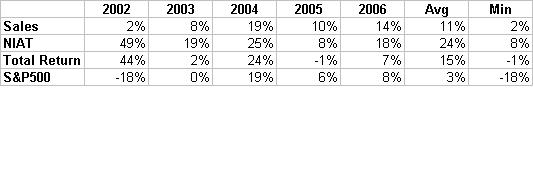 To get a better understanding of this, I did some analysis of the company's recent sales, NIAT, and total returns. They are presented in the table at left, on which you may click to enlarge.
The first thing I notice is that P&G's sales accelerated in 2004 and this year. A friend who works at the firm, locally, confirmed that these are the effects of the last two major acquisitions. The latter one being Gillette, last year.
This has an interesting effect on P&G, called "riding the tiger." Notice that its sales growth rates, pre-acquisitions, were in the single digits, on the low side, on average. In the years prior to 2002, they were also rather meager. Thus, P&G has bought growth, twice. The year in between the acquisitions displays a 10% sales growth- higher than the earlier years, but still not so high as with the immediate folding-in of the purchased sales bases.
My proprietary research shows that the market tends to favor companies which can consistently generate superior revenue growth. P&G has begun to buy its growth. Either of two things need to occur, if the company is to have a good chance of becoming a consistently superior total return-generating company.
Either it needs to generate organic growth to match that of the effects of the acquisitions, or it needs to be able to continue its acquisition program, making it a sort of 'standard operating procedure," for which investors are prepared to pay. The company is hitting some pretty high revenue growth targets for a consumer goods conglomerate. While the 10% revenue growth in 2005 was good, and better than the long-term S&P average, it was by no means near the upper end of the distribution of revenue growth in the S&P500.
NIAT growth at P&G has also been getting better, but the best years were in the earlier years of this period.
Taken together, the revenue and NIAT growth pictures lead to the total return performance shown in the table. P&G has a much better average than the S&P for the last five years. However, the last two years have been a close call. Most of the 12 point spread in average total return between the S&P and P&G is accounted for by 2002. I would guess that would have been from a "flight to quality" by investors, as the tech-bubble-bursting recession drove investors to safer havens. Too, the low returns in 2004 and 2006 could be the result of investor verdicts on the prices of each of the two major acquisitions in the the prior two years.
I like P&G's customer focus. I understand the broadening of their product and business portfolios recently. However, from the data above, I seriously wonder if they can sustain raw revenue growth in the next few years. This is where consistency of revenue growth at fairly high rates really challenges a company. If too much of the firm's recent success on this dimension was simply purchasing growth, then I think total returns will ebb, along with organic growth.
It will be very interesting to watch P&G in the next few years to see how their fundamental operating capabilities prove out, and whether the market rewards the firm, if they do.
Sunday, July 30, 2006
America's Largest Banks: It's About More Than Size
 This week's Wall Street Journal featured an article, on Friday, announcing that Bank of America (really the renamed NCNB of old) is about to become a larger bank, by market value, than Citigroup.
If this doesn't highlight the wrong measure, I don't know what does? Ranking the banks by deposits?
As it happens, BofA has been superior by a truly important measure for some time now. As the table above shows (click on it for a larger view), over the last five years, it's total return to shareholders has averaged 14.4%, while Sandy Weill/Chuck Prince's Citigroup has lost shareholders 3.9%, on average. During the same period, the S&P500 has gained 3.2% per year, on average. Further, BofA outperformed Citi for 3 of the 5 12-month periods, and nearly tied it in a fourth (2004).
Tying in with the Friday article, and another one earlier in the week, about Prince's vow to grow "operating leverage" are the upper rows of the table above. It clearly shows that Citi's revenue growth has been anemic for the past five years. Once again, except for 2002, BofA outgrew Citi in terms of revenues. Both have been accelerating since the bottom of the recent recession in 2002. Citi may be improving, but, again, BofA has done even better.
Granted, BofA is not yet sufficiently superior to make it into my portfolio selections. But at this rate, it'll be there years before Citi.
Size has nothing to do with the comparison of these two financial giants. Ken Lewis has been doing something a lot better than Chuck Prince and, or course, his predecessor, Sandy Weill. And the consistently better total returns prove it.
Friday, July 28, 2006
AMD in The News Again
This week, AMD moved to buy ATI Technologies, which manufactures chips for PC graphics, plus other accessories which may be integrated into chip sets.
On the plus side, the move helps AMD position itself as unique, vis a vis Intel, because the latter will not have a captive graphics chip maker. On the negative side, analysts are wondering if AMD can successfully handle its burgeoning price war with Intel, while integrating ATI and investing in both itself and its acquisition, to realize the long-term benefits of the combination.
What I find heartening about AMD's move is that the management evidently understands that it must "ride the tiger." Having made the moves to take on Intel and surpass it in growth, it now is planning to cement that lead.
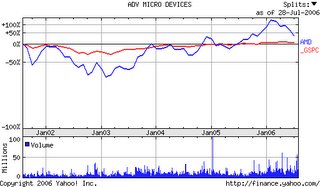 Will it work? Who knows? This is where consistently superior prior performance makes a difference, and right now, AMD does not seem to be there just yet. Its stock price performance has been uneven, versus the S&P, over the past five years. Only recently has it turned upward, outperforming the index. In the last five years, only two look to have seen AMD outperform.
Thus, its track record of surprising the market with results is not yet well-established.
I think, fundamentally, the ATI move is probably a good one. Not that this means I think it will work. I just think that, as I understand their situation, they needed to do something like the ATI acquisition to keep the pressure on Intel, and place their bets for future positioning.
It should be an exciting next few years, watching to see if AMD can decisively outgrow Intel, as well as earn consistently superior total returns while doing it.
On the plus side, the move helps AMD position itself as unique, vis a vis Intel, because the latter will not have a captive graphics chip maker. On the negative side, analysts are wondering if AMD can successfully handle its burgeoning price war with Intel, while integrating ATI and investing in both itself and its acquisition, to realize the long-term benefits of the combination.
What I find heartening about AMD's move is that the management evidently understands that it must "ride the tiger." Having made the moves to take on Intel and surpass it in growth, it now is planning to cement that lead.
 Will it work? Who knows? This is where consistently superior prior performance makes a difference, and right now, AMD does not seem to be there just yet. Its stock price performance has been uneven, versus the S&P, over the past five years. Only recently has it turned upward, outperforming the index. In the last five years, only two look to have seen AMD outperform.
Thus, its track record of surprising the market with results is not yet well-established.
I think, fundamentally, the ATI move is probably a good one. Not that this means I think it will work. I just think that, as I understand their situation, they needed to do something like the ATI acquisition to keep the pressure on Intel, and place their bets for future positioning.
It should be an exciting next few years, watching to see if AMD can decisively outgrow Intel, as well as earn consistently superior total returns while doing it.
Wednesday, July 26, 2006
Marketing & The Internet: The More Things Change.....
Despite what you might think about marketing management in the era of the internet, we don't appear to know much more about consumer behavior now than we did prior to this new era.
The Wall Street Journal has featured several pieces this month concerning marketing on the internet. Early in the month, they published a "special" report about it. Then Lee Gomes wrote a review of the internet-focused hot seller, "The Long Tail," by Chris Anderson, this week.
What struck me most about the WSJ special report was that it was so anecdotal. The piece featured stories of various retailers' and marketers' attempts to, and experiences with, internet advertising and/or promotion. From what I gathered, the time honored marketing dictum, attributed originally, I believe, to John Wannamaker, is still true,
"I know I'm wasting half of my advertising spending, but I don't know which half."
At the end of the report, the Journal printed an interview with Proctor & Gamble chief marketing officer, James Stengel.
I have to say, he seems, from his comments, like a very bright guy. His basic instinct is pure marketing- to use his company, and its products, to get into the very fabric of helping his customers live better lives. He seems similarly at sea about the internet, as the rest of the interviewees in the report were. But at least Stengel is clear about where he's going with any internet initiatives.
On the age-old split between lifestyle marketing, and benefit-bundle marketing, Stengel comes down on the side of the latter. That is, he focuses on what products can do for the customer, and how internet search and advertising can help a customer realize those benefits.
This stands in sharp contrast to efforts, most notably by product placements, to sell merchandise based upon a lifestyle with which they are prominently associated.
Given Stengel's focus, one might think that Anderson's new book, "The Long Tail," would be all about how the internet lets every niche product become a star. And that is what the author claims.
However, as Lee Gomes, the WSJ columnist discovers, the basic premise of the book is fraudulent. Anderson coins a new term, apparently prominent on the book's dust jacket, "The 98 Percent Rule." Basically, Anderson alleges that with the arrival of the internet, niche products get respect, and sales volume. Thus, the sainted "80/20" rule is dead, and the "98 Percent Rule" takes its place.
Except that Gomes debunks this myth. It turns out that all Anderson observed was the early days of hit-driven product websites, where consumers bought, downloaded, etc, nearly all the titles offered. As more product came into the inventories of companies like Netflix, Amazon, Ecast, and iTunes.
So, even before this new best-seller is a year old, its central message is found to be the flawed the conclusion of hasty and badly-done "research."
Oh, well. Maybe next year someone will decode internet buying behavior. For now, though, the usual suspects plod on. Advertisers can't quite measure consumer behavior, marketing managers throw tons of money at online promotion, in hopes that something will stick. And the poor, dull business of actually observing and reflecting on how a product will affect a customer's life continues to get little respect.
Except at P&G, about which I will write more imminently.
The Wall Street Journal has featured several pieces this month concerning marketing on the internet. Early in the month, they published a "special" report about it. Then Lee Gomes wrote a review of the internet-focused hot seller, "The Long Tail," by Chris Anderson, this week.
What struck me most about the WSJ special report was that it was so anecdotal. The piece featured stories of various retailers' and marketers' attempts to, and experiences with, internet advertising and/or promotion. From what I gathered, the time honored marketing dictum, attributed originally, I believe, to John Wannamaker, is still true,
"I know I'm wasting half of my advertising spending, but I don't know which half."
At the end of the report, the Journal printed an interview with Proctor & Gamble chief marketing officer, James Stengel.
I have to say, he seems, from his comments, like a very bright guy. His basic instinct is pure marketing- to use his company, and its products, to get into the very fabric of helping his customers live better lives. He seems similarly at sea about the internet, as the rest of the interviewees in the report were. But at least Stengel is clear about where he's going with any internet initiatives.
On the age-old split between lifestyle marketing, and benefit-bundle marketing, Stengel comes down on the side of the latter. That is, he focuses on what products can do for the customer, and how internet search and advertising can help a customer realize those benefits.
This stands in sharp contrast to efforts, most notably by product placements, to sell merchandise based upon a lifestyle with which they are prominently associated.
Given Stengel's focus, one might think that Anderson's new book, "The Long Tail," would be all about how the internet lets every niche product become a star. And that is what the author claims.
However, as Lee Gomes, the WSJ columnist discovers, the basic premise of the book is fraudulent. Anderson coins a new term, apparently prominent on the book's dust jacket, "The 98 Percent Rule." Basically, Anderson alleges that with the arrival of the internet, niche products get respect, and sales volume. Thus, the sainted "80/20" rule is dead, and the "98 Percent Rule" takes its place.
Except that Gomes debunks this myth. It turns out that all Anderson observed was the early days of hit-driven product websites, where consumers bought, downloaded, etc, nearly all the titles offered. As more product came into the inventories of companies like Netflix, Amazon, Ecast, and iTunes.
So, even before this new best-seller is a year old, its central message is found to be the flawed the conclusion of hasty and badly-done "research."
Oh, well. Maybe next year someone will decode internet buying behavior. For now, though, the usual suspects plod on. Advertisers can't quite measure consumer behavior, marketing managers throw tons of money at online promotion, in hopes that something will stick. And the poor, dull business of actually observing and reflecting on how a product will affect a customer's life continues to get little respect.
Except at P&G, about which I will write more imminently.
Tuesday, July 25, 2006
"Support" Your Local Retailer?: The Unseen Effects of Big Box Stores
Today is my father's 79th birthday. In honor of him, I would like to recount a story which is, to my way of thinking, his kind of humor. I can easily see him relating this story over dinner with our family when I was younger- much younger.
The tale begins with my athletic pursuits. I play a racquet sport. So I wear athletic supporters. Depending on how often you play, and how many you have, they last for varying amounts of time. I play a lot. Even with 6-7 supporters, the constant washing and drying eventually leaves them limp, the elastic overheated and stretched.
In the past, I would go to a local sporting goods store near my racquet club to buy more. The last time I did so, perhaps 5 years ago, they had a decent selection of styles and sizes. When I returned last month to buy several supporters, I was told they had none. Zero. Zippo.
"It's baseball season. We don't have any! Come back later and maybe we'll have some."
Okay. So I returned this week. They had one. One supporter in my size, although not the style I prefer. Upon asking them to order more, I was told,
"We only have one. We may not carry them anymore. Nobody comes in to buy them anymore."
I opined to the owner, apparently the son of the esteemed founder, that maybe he had it backwards. Maybe nobody came to buy supporters from him, because he had no inventory. His blank look told me I was wasting my time. But, for good measure, I uttered a prophetic,
"It's ok. Whatever you want. If you want to send me to Sports Authority, I'll go there."
Next, I visited my local sporting goods retailer, down the street from my home. Bob T's shop is the sort you remember from your childhood. Bob is a kindly, terrific guy. Like an old shoe. Perfect for the business of local sporting goods sales. He takes used ice skates on consignment. He provides the local high school uniforms, and various staples for children's and youth sports. I like to give him business when I can. So when a friend reminded me of Bob T's place, I went there the very next day. In search of supporters.
"No, sorry. We don't have any. Come back in a few weeks. We are backordered. Everything we have has cups."
When I remarked that I wanted to give them a chance, before going to Sports Authority, the woman at the counter smiled and simply repeated the facts of their inventory problem, how they'd be closed for a week, etc. Apparently, no worries over sending me to Sports Authority, either.
So, now, I've tried two friendly, local, family-owned sporting goods stores. Neither has an inventory of the rather basic piece of athletic clothing, a man's athletic supporter. Mind you, I live on the east coast of the US. Not Tibet, nor Nigeria, nor Croatia. I would have thought this search would be easier.
Today, I ran some errands. On my list was to visit another local shop. This one is a swim shop located about five miles from me. If Speedo makes it, they carry it. But before then, I found myself up on a local state highway, amidst the big box stores. So after concluding my business at ToysRUs, I decided to head for.......
Sports Authority!
As I was musing about driving to the swim shop, it occurred to me that there is a bit of a mystery in this story. Where are the nation's athletic supporters? Who has taken them, and why?
Surely, our nation's, nay, the world's athletic supporter manufacturer's and distributors cannot be leaving men "hanging out," or, well, you know what I mean.....
I formed a hypothesis on my short drive up Route 10 to Sports Authority. Perhaps SA has monopolized the provision of athletic supporters. If they had none, then, truly, there was a mystery. But if Sports Authority had supporters, that would suggest that vendors now found it difficult to bother with smaller retailers, when SA probably accounted for so much more volume.
I entered the huge store, got directions, and walked to the display of men's athletic supporters.
WOW! Mecca! The missing athletic supporters.....they were all there...at Sports Authority! All along!
They had it all. They had brands I hadn't seen in years. In all sizes and styles. Styles I was told at the small shops could not be had anymore. Bike, for one. And for the most popular style, SA sells them 2-for-1, at about half the price of the off-brand Martin supporter I bought at the first local sporting goods shop.
Now I see what has occurred with the entry of Sports Authority into my local market. I would guess it's similar for many other big box retailers in their respective product spaces. SA seems to have become a giant sponge for inventory of basic sporting goods. Your local sporting goods shop can't even get inventory on basic goods anymore. The manufacturers and distributors probably cannot afford to short Sports Authority, so they simply don't respond to requests from the small retailers.
I think that most manufacturers and distributors direct their product and inventory flow to SA not just for the volume, but for the relative lack of volatility of their demand.
Think about it. Sports Authority must be the size of about 10 local sporting goods shops. They concentrate the volume of all sorts of equipment, and by virtue of accounting for it in one store, reduce order volatility immensely. That has to be valuable for the vendors and distributors. By being so large, SA draws a huge flow of local shoppers. Their prices and assortments of basic goods are better than the local shops, so the circle becomes virtuous for SA.
The result, I believe, is that distributors don't even bother filling orders for a lot of basics in the small quantities that local sporting goods shops order. Where's the benefit? The volume must be microscopic, next to that of Sports Authority. The cost of sending small lots, and handling the varying order sizes and frequency, can't be profitable, relative to handling a constant flow of product for Sports Authority.
So, there you have it. Athletic supporters galore! They were always "there." Just not in the usual places I had learned to look. In only about five years, Sports Authority's one store in my area has altered the entire complexion of buying basic sports clothing. They so dominate the market that you literally cannot find an athletic supporter anywhere else within 10 miles of their store.
So I don't live in Croatia after all. I just have come to the realization of what big box retailing does to even those small retailers who find niches that allow them to hang on in the face of outfits like Sports Authority. The supply of basic goods dries up for the small guys. They don't even get deliveries of products like athletic supporters anymore.
Welcome to the new world of retailing.
The tale begins with my athletic pursuits. I play a racquet sport. So I wear athletic supporters. Depending on how often you play, and how many you have, they last for varying amounts of time. I play a lot. Even with 6-7 supporters, the constant washing and drying eventually leaves them limp, the elastic overheated and stretched.
In the past, I would go to a local sporting goods store near my racquet club to buy more. The last time I did so, perhaps 5 years ago, they had a decent selection of styles and sizes. When I returned last month to buy several supporters, I was told they had none. Zero. Zippo.
"It's baseball season. We don't have any! Come back later and maybe we'll have some."
Okay. So I returned this week. They had one. One supporter in my size, although not the style I prefer. Upon asking them to order more, I was told,
"We only have one. We may not carry them anymore. Nobody comes in to buy them anymore."
I opined to the owner, apparently the son of the esteemed founder, that maybe he had it backwards. Maybe nobody came to buy supporters from him, because he had no inventory. His blank look told me I was wasting my time. But, for good measure, I uttered a prophetic,
"It's ok. Whatever you want. If you want to send me to Sports Authority, I'll go there."
Next, I visited my local sporting goods retailer, down the street from my home. Bob T's shop is the sort you remember from your childhood. Bob is a kindly, terrific guy. Like an old shoe. Perfect for the business of local sporting goods sales. He takes used ice skates on consignment. He provides the local high school uniforms, and various staples for children's and youth sports. I like to give him business when I can. So when a friend reminded me of Bob T's place, I went there the very next day. In search of supporters.
"No, sorry. We don't have any. Come back in a few weeks. We are backordered. Everything we have has cups."
When I remarked that I wanted to give them a chance, before going to Sports Authority, the woman at the counter smiled and simply repeated the facts of their inventory problem, how they'd be closed for a week, etc. Apparently, no worries over sending me to Sports Authority, either.
So, now, I've tried two friendly, local, family-owned sporting goods stores. Neither has an inventory of the rather basic piece of athletic clothing, a man's athletic supporter. Mind you, I live on the east coast of the US. Not Tibet, nor Nigeria, nor Croatia. I would have thought this search would be easier.
Today, I ran some errands. On my list was to visit another local shop. This one is a swim shop located about five miles from me. If Speedo makes it, they carry it. But before then, I found myself up on a local state highway, amidst the big box stores. So after concluding my business at ToysRUs, I decided to head for.......
Sports Authority!
As I was musing about driving to the swim shop, it occurred to me that there is a bit of a mystery in this story. Where are the nation's athletic supporters? Who has taken them, and why?
Surely, our nation's, nay, the world's athletic supporter manufacturer's and distributors cannot be leaving men "hanging out," or, well, you know what I mean.....
I formed a hypothesis on my short drive up Route 10 to Sports Authority. Perhaps SA has monopolized the provision of athletic supporters. If they had none, then, truly, there was a mystery. But if Sports Authority had supporters, that would suggest that vendors now found it difficult to bother with smaller retailers, when SA probably accounted for so much more volume.
I entered the huge store, got directions, and walked to the display of men's athletic supporters.
WOW! Mecca! The missing athletic supporters.....they were all there...at Sports Authority! All along!
They had it all. They had brands I hadn't seen in years. In all sizes and styles. Styles I was told at the small shops could not be had anymore. Bike, for one. And for the most popular style, SA sells them 2-for-1, at about half the price of the off-brand Martin supporter I bought at the first local sporting goods shop.
Now I see what has occurred with the entry of Sports Authority into my local market. I would guess it's similar for many other big box retailers in their respective product spaces. SA seems to have become a giant sponge for inventory of basic sporting goods. Your local sporting goods shop can't even get inventory on basic goods anymore. The manufacturers and distributors probably cannot afford to short Sports Authority, so they simply don't respond to requests from the small retailers.
I think that most manufacturers and distributors direct their product and inventory flow to SA not just for the volume, but for the relative lack of volatility of their demand.
Think about it. Sports Authority must be the size of about 10 local sporting goods shops. They concentrate the volume of all sorts of equipment, and by virtue of accounting for it in one store, reduce order volatility immensely. That has to be valuable for the vendors and distributors. By being so large, SA draws a huge flow of local shoppers. Their prices and assortments of basic goods are better than the local shops, so the circle becomes virtuous for SA.
The result, I believe, is that distributors don't even bother filling orders for a lot of basics in the small quantities that local sporting goods shops order. Where's the benefit? The volume must be microscopic, next to that of Sports Authority. The cost of sending small lots, and handling the varying order sizes and frequency, can't be profitable, relative to handling a constant flow of product for Sports Authority.
So, there you have it. Athletic supporters galore! They were always "there." Just not in the usual places I had learned to look. In only about five years, Sports Authority's one store in my area has altered the entire complexion of buying basic sports clothing. They so dominate the market that you literally cannot find an athletic supporter anywhere else within 10 miles of their store.
So I don't live in Croatia after all. I just have come to the realization of what big box retailing does to even those small retailers who find niches that allow them to hang on in the face of outfits like Sports Authority. The supply of basic goods dries up for the small guys. They don't even get deliveries of products like athletic supporters anymore.
Welcome to the new world of retailing.
Monday, July 24, 2006
On The Recent Decline in Equity Markets
Last week's .3% return for the S&P 500 index was the first positive weekly return in the last four. However, the total return for the week is somewhat misleading, as the index plunged roughly 1.6% over the last two days of the week.
The usual culprits were implicated: worries over current interest rates; concerns over energy prices causing economic growth to abate; some unexpectedly weak corporate earnings reports, and; continuing violence in the Mideast, leading investors to worry that energy supplies will be affected, thus affecting prices, and, again, economic growth, possibly leading to recession.
In equity market conditions like these, growth stocks typically take the first hit. Technology stocks, being focused on innovation and growth, are especially vulnerable. A Wall Street Journal article focused on this aspect of the recent market declines. However, by highlighting Dell and Microsoft, I am caused to wonder if they are truly "tech" stocks anymore. Both are large, sluggish, derivative purveyors of "technology" wrapped up in consumer-oriented boxes.
On the other hand, AMD was reportedly suffering from a price war with Intel, and saw its share price slide 16%.
Nevertheless, I think it's worth pausing to consider the long term perspective for equity markets right now.
First, as I learned on a recent CNBC report, most large-cap companies reporting earnings this season, for the 2nd quarter, are meeting or exceeding analysts' "expectations." Some of the major names cited as disappointments have already been in trouble, e.g., Dell, Yahoo and Ford.
Second, interest rates, while having risen, are still not yet high by historical standards. Money at 5-6% hardly constitutes a reason to believe the economy is shutting down.
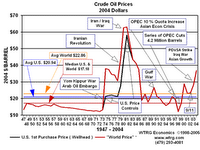 Third, real gasoline prices are still below those of several decades ago. Admittedly, crude oil is not. However, as the accompanying chart shows (click on it to view the enlarged version), it's not astronomically higher than it was, on a real basis, during the 1973-74 Arab oil embargo. At today's $75/bbl price, oil is roughly $72 in 2004 dollars, as displayed on the chart. Our economy produces much more GNP per barrel of oil today than it did in 1974. If I'm not mistaken, as much as 4 times more.
And this higher price has already triggered investments in alternative energy sources of more traditional means, as I wrote here recently. It's likely that demand and supply will continue to move about before settling at a level that fosters continued global economic growth.
I think that what we are seeing right now is the usual lemming behavior of many average investors, both institutional and retail, heading for the sidelines, and cash. They cannot see the underlying strength of the US economy, nor the relatively benign nature of current interest rates, which should forestall future inflation.
My proprietary market signaling methodology continues to register a healthy "long" position. As yet, I do not see a reason to panic, sell, or otherwise lose faith in the superior management of those companies which have shown track records of consistently superior performance.
The usual culprits were implicated: worries over current interest rates; concerns over energy prices causing economic growth to abate; some unexpectedly weak corporate earnings reports, and; continuing violence in the Mideast, leading investors to worry that energy supplies will be affected, thus affecting prices, and, again, economic growth, possibly leading to recession.
In equity market conditions like these, growth stocks typically take the first hit. Technology stocks, being focused on innovation and growth, are especially vulnerable. A Wall Street Journal article focused on this aspect of the recent market declines. However, by highlighting Dell and Microsoft, I am caused to wonder if they are truly "tech" stocks anymore. Both are large, sluggish, derivative purveyors of "technology" wrapped up in consumer-oriented boxes.
On the other hand, AMD was reportedly suffering from a price war with Intel, and saw its share price slide 16%.
Nevertheless, I think it's worth pausing to consider the long term perspective for equity markets right now.
First, as I learned on a recent CNBC report, most large-cap companies reporting earnings this season, for the 2nd quarter, are meeting or exceeding analysts' "expectations." Some of the major names cited as disappointments have already been in trouble, e.g., Dell, Yahoo and Ford.
Second, interest rates, while having risen, are still not yet high by historical standards. Money at 5-6% hardly constitutes a reason to believe the economy is shutting down.
 Third, real gasoline prices are still below those of several decades ago. Admittedly, crude oil is not. However, as the accompanying chart shows (click on it to view the enlarged version), it's not astronomically higher than it was, on a real basis, during the 1973-74 Arab oil embargo. At today's $75/bbl price, oil is roughly $72 in 2004 dollars, as displayed on the chart. Our economy produces much more GNP per barrel of oil today than it did in 1974. If I'm not mistaken, as much as 4 times more.
And this higher price has already triggered investments in alternative energy sources of more traditional means, as I wrote here recently. It's likely that demand and supply will continue to move about before settling at a level that fosters continued global economic growth.
I think that what we are seeing right now is the usual lemming behavior of many average investors, both institutional and retail, heading for the sidelines, and cash. They cannot see the underlying strength of the US economy, nor the relatively benign nature of current interest rates, which should forestall future inflation.
My proprietary market signaling methodology continues to register a healthy "long" position. As yet, I do not see a reason to panic, sell, or otherwise lose faith in the superior management of those companies which have shown track records of consistently superior performance.
Saturday, July 22, 2006
Intel's Big Review Completed
Back in May, I noted that Intel's CEO, Paul Otellini, was conducting a major review of Intel's troubled operations. In this post, and this one, I opined that perhaps Intel is the victim of its considerable success of the past 20 years. And that its current sales and marketing troubles are quite possibly a natural result of too much growth, diversification, and loss of detailed customer focus over the years.
Now comes a piece in the Wall Street Journal announcing Otellini's fixes for the firm. Apparently, two and a half months of soul-searching and deep analysis at Intel has resulted in a senior management reorganization of roles. Two retirements, no firings, and, otherwise, just a shuffling of spans of control, reporting lines, and such. The stated goal of all this shuffling is improved efficiency.
Given that Intel's problems seem to stem from not listening to customers, I'm a little puzzled to read that their solution is to rearrange current senior managment, but not directly address competitive marketing and product development. If anything, the apparent assignment of development and pricing activities to single senior executives would seem to make those functions even more abstracted from individual customers and business units.
Maybe I'm wrong. Time will tell. But thus far, it's fairly disappointing to see Intel limit its rehabilitation to essentially rearranging deck chairs, while AMD continues to surge forward with sales and market share growth.
Now comes a piece in the Wall Street Journal announcing Otellini's fixes for the firm. Apparently, two and a half months of soul-searching and deep analysis at Intel has resulted in a senior management reorganization of roles. Two retirements, no firings, and, otherwise, just a shuffling of spans of control, reporting lines, and such. The stated goal of all this shuffling is improved efficiency.
Given that Intel's problems seem to stem from not listening to customers, I'm a little puzzled to read that their solution is to rearrange current senior managment, but not directly address competitive marketing and product development. If anything, the apparent assignment of development and pricing activities to single senior executives would seem to make those functions even more abstracted from individual customers and business units.
Maybe I'm wrong. Time will tell. But thus far, it's fairly disappointing to see Intel limit its rehabilitation to essentially rearranging deck chairs, while AMD continues to surge forward with sales and market share growth.
Friday, July 21, 2006
Searching for Patterns in Financial Information: Part 1
Lately, my business partner has been reading about the similarities between the development of entropy theory in physics, and Claude Shannon's development of information theory. The parallels are striking, down to the similar forms of the equations for calculating the amount of entropy in a container of gas, or the amount of information in a set of symbols.
As we discussed this, we realized that, in an abstract form, "efficient market" theory is a crude way of approximating the same result. That is, a very efficient market would have little differentiation in prices for a security, much as an end state of a gas in a container is total dispersion to a (largely) uniform density.
However, of some interest to him, and me, was the development of probability distributions to account for the non-uniform density of dispersed gases. In a similar way, one might observe distributions of prices for a given security within a short period of time.
We realized that, according to efficient market theory, absent new information, the investors in a market are assumed to act in such a way as to arrive at a state of price entropy. Just as there is no more movement once a gas is perfectly dispersed, so prices are expected not to move, absent new information.
So far, an interesting comparison. But perhaps seen as just that, and of no particular value to understanding equity markets, or selecting equity portfolios.
As we discussed this further, he dwelt more on Shannon's information theory. Shannon focused on how to identify a signal amidst the noise of a stream of "information." This, my partner conjectured, is virtually identical to the task of a portfolio manager. The manager must attempt to identify relevant information, which is related to particular price changes, and ignore the noise in the distribution of information in the market.
At this point, I interjected that market information not random in the same way as naturally occurring phenomena may be. There are actors on each side of securities prices. Securities prices are not just streams of random numbers attached to a meaningless ticker.
Rather, there are real companies, composed of real people, behind each ticker. They are engaged in teleological behavior- hopefully, the production of profits, in order to increase total returns for their shareholders.
On the other side, there are real investors attempting to discern patterns from the torrent of market and fundamental information about the companies. These investors buy and sell securities, based upon their interpretations of this information, thus providing some goal-oriented impetus to prices.
I believe that because securities prices are, ultimately, the product of these goal-oriented activities, the process of identifying patterns in fundamental and technical market data, in order to find equities which have a high probability of earning consistently superior total returns, is actually easier than dealing with truly random data.
However, due to the differing abilities of the actors on both sides- company employees and managers, and investors- finding the patterns is not simple.
But, like distributions of energy levels in particles, or distributions of information content among symbols in a series, there are distributions of information with respect to equities selection among the fundamental and technical information available for observation. As a distribution, this means that there will be occasions in which information content is high. Meaning that not all the value in knowing it has been removed via discovery.
When this happens, portfolios of such equities can outperform the market averages, contradicting efficient market theory. Thus, in effect, we find that efficient market theory posits simple point-estimates of prices, whereas viewing the problem in the same manner as entropy or information theory allows for "tails" of value-laden information which can cause equities to be mis-priced, and allow for consistently superior returns to be earned.
As we discussed this, we realized that, in an abstract form, "efficient market" theory is a crude way of approximating the same result. That is, a very efficient market would have little differentiation in prices for a security, much as an end state of a gas in a container is total dispersion to a (largely) uniform density.
However, of some interest to him, and me, was the development of probability distributions to account for the non-uniform density of dispersed gases. In a similar way, one might observe distributions of prices for a given security within a short period of time.
We realized that, according to efficient market theory, absent new information, the investors in a market are assumed to act in such a way as to arrive at a state of price entropy. Just as there is no more movement once a gas is perfectly dispersed, so prices are expected not to move, absent new information.
So far, an interesting comparison. But perhaps seen as just that, and of no particular value to understanding equity markets, or selecting equity portfolios.
As we discussed this further, he dwelt more on Shannon's information theory. Shannon focused on how to identify a signal amidst the noise of a stream of "information." This, my partner conjectured, is virtually identical to the task of a portfolio manager. The manager must attempt to identify relevant information, which is related to particular price changes, and ignore the noise in the distribution of information in the market.
At this point, I interjected that market information not random in the same way as naturally occurring phenomena may be. There are actors on each side of securities prices. Securities prices are not just streams of random numbers attached to a meaningless ticker.
Rather, there are real companies, composed of real people, behind each ticker. They are engaged in teleological behavior- hopefully, the production of profits, in order to increase total returns for their shareholders.
On the other side, there are real investors attempting to discern patterns from the torrent of market and fundamental information about the companies. These investors buy and sell securities, based upon their interpretations of this information, thus providing some goal-oriented impetus to prices.
I believe that because securities prices are, ultimately, the product of these goal-oriented activities, the process of identifying patterns in fundamental and technical market data, in order to find equities which have a high probability of earning consistently superior total returns, is actually easier than dealing with truly random data.
However, due to the differing abilities of the actors on both sides- company employees and managers, and investors- finding the patterns is not simple.
But, like distributions of energy levels in particles, or distributions of information content among symbols in a series, there are distributions of information with respect to equities selection among the fundamental and technical information available for observation. As a distribution, this means that there will be occasions in which information content is high. Meaning that not all the value in knowing it has been removed via discovery.
When this happens, portfolios of such equities can outperform the market averages, contradicting efficient market theory. Thus, in effect, we find that efficient market theory posits simple point-estimates of prices, whereas viewing the problem in the same manner as entropy or information theory allows for "tails" of value-laden information which can cause equities to be mis-priced, and allow for consistently superior returns to be earned.
Thursday, July 20, 2006
Revenue Growth Targets in Large Cap Firms
A recent article by Carol Hymowitz in her Wall Street Journal column, "In The Lead," which focuses on CEOs, featured Robert Lane of John Deere, the farm equipment maker.
The piece discussed Deere's commitment to R&D and innovation, though it cited no specific revenue growth target. By way of demonstrating that revenue growth is now a top priority among CEOs, Hymowitz quoted Jeff Immelt, CEO of GE, as setting an 8% annual revenue growth rate.
From my proprietary research, I can confirm that GE's sales growth target is too low to ever place it among the consistently high-growth, superior total return companies of the S&P500.
That is not to say that revenue growth below double-digits is useless. For those companies mired....er...positioned in largely slower-growth sectors, new products and services are necessary to offset the Schumpeterian effects of eroding value-added of older offerings. Rather like Lewis Carroll's "Through the Looking Glass, the Red Queen has characters run, and explains,
"HERE, you see, it takes all the running YOU can do, to keep in the same place. If you want to get somewhere else, you must run at least twice as fast as that!"
Just so. Without attention to innovation to drive revenue growth, even slower-growth companies will slowly experience flattening, then shrinking sales. Sort of like...GM.
It's great to see that even relatively staid companies such as farm equipment manufacturer John Deere is attending to innovation and growth. And it is also reassuring to see its CEO attending to revenue growth through innovation. However, targeting only 8-9% annual growth rates won't result in its escaping the gravitational-like pull of the large number of middling large-cap firms that experience inconsistent, or just slightly-above-average revenue growth.
And, thus, it's unlikely that Deere, or GE, will soon, if ever, be selected for our equity portfolios. It's hard work, but not exceptional, for a firm to generate consistent single-digit sales growth for years. Thus, the likelihood that such a firm will consistently outperform the S&P on total return is not as great as it is for consistently higher-growth firms.
The piece discussed Deere's commitment to R&D and innovation, though it cited no specific revenue growth target. By way of demonstrating that revenue growth is now a top priority among CEOs, Hymowitz quoted Jeff Immelt, CEO of GE, as setting an 8% annual revenue growth rate.
From my proprietary research, I can confirm that GE's sales growth target is too low to ever place it among the consistently high-growth, superior total return companies of the S&P500.
That is not to say that revenue growth below double-digits is useless. For those companies mired....er...positioned in largely slower-growth sectors, new products and services are necessary to offset the Schumpeterian effects of eroding value-added of older offerings. Rather like Lewis Carroll's "Through the Looking Glass, the Red Queen has characters run, and explains,
"HERE, you see, it takes all the running YOU can do, to keep in the same place. If you want to get somewhere else, you must run at least twice as fast as that!"
Just so. Without attention to innovation to drive revenue growth, even slower-growth companies will slowly experience flattening, then shrinking sales. Sort of like...GM.
It's great to see that even relatively staid companies such as farm equipment manufacturer John Deere is attending to innovation and growth. And it is also reassuring to see its CEO attending to revenue growth through innovation. However, targeting only 8-9% annual growth rates won't result in its escaping the gravitational-like pull of the large number of middling large-cap firms that experience inconsistent, or just slightly-above-average revenue growth.
And, thus, it's unlikely that Deere, or GE, will soon, if ever, be selected for our equity portfolios. It's hard work, but not exceptional, for a firm to generate consistent single-digit sales growth for years. Thus, the likelihood that such a firm will consistently outperform the S&P on total return is not as great as it is for consistently higher-growth firms.
Heavy Oil Reserves: Economics Still Works
There was a terrific article in the Wall Street Journal the other day describing Chevron's work on the recovery of heavy oil in Saudi Arabia.
What I found reassuring about the piece is that it reinforces my faith in human behavior and economics, which studies that behavior in the area of value exchange.
Basically, as light-oil reserves are drawn down, and crude oil prices rise, the incentive to recover deposits of heavy oil has risen. Chevron is working to recover the substantial Saudi reserves of this molasses-like material. According to the piece, including heavy oil reserves to the Saudi offical reserves would add "tens of billions of barrels" to their current 260 billion barrel estimate.
Buried in the article was a passing reference to the "peak oil" theory. According to the WSJ piece, adding recoverable heavy-oil reserves to the world's oil supply would put a major dent in the theory that we are on the brink of pumping ever-declining amounts of crude each year. This would appear to be no small thing. With India and China bidding up the price of existing supplies of crude in the past year, the prospect of declining crude supply would be a potentially civilization-altering phenomenon.
It's nice to see economic theory still describes how humans react to shortages. As crude prices have more than tripled since 2002, alternatives such as gassified coal, liquified natural gas, tar sands, and, now, heavy-oil are coming onstream to compete with the higher-priced light crude supplies.
Even at $3/gallon, gasoline is cheaper on a real basis now, in the US, than it was at the height of the Arab oil embargo of the mid-1970s. It remains to be seen if these admittedly-higher gasoline, and related, energy prices cause a global recession, but it is by no means at all certain. Recent estimates by economists put the chances at perhaps as high as 36%, up from 17% six months ago. When I read that, I thought it made sense. With higher energy prices and mideast violence, there is a natural concern that energy security issues will contribute to higher prices, and, thus, economic slowdown.
However, as recently as yesterday, Fed Chairman Bernanke reiterated Greenspan's comments of last year, that the US economy has displayed amazing resilience in the face of higher energy costs.
With the price signals of higher energy costs, new supplies are predictably coming onstream. Julian Simons would be so pleased to see his beliefs once again sustained. When these various alternative energy sources provide supply to the market, we should expect to have a near-term ceiling on energy prices and more supply for some time to come.
Crisis identified. Crisis resolved. Free-market style.
Like other resource supply issues of the past, such as silk (nylon, et al), rubber (synthetic rubber in WWII), and steel (minimills), energy, too, will fall to human ingenuity and the desire of people to make a buck solving economic problems.
What I found reassuring about the piece is that it reinforces my faith in human behavior and economics, which studies that behavior in the area of value exchange.
Basically, as light-oil reserves are drawn down, and crude oil prices rise, the incentive to recover deposits of heavy oil has risen. Chevron is working to recover the substantial Saudi reserves of this molasses-like material. According to the piece, including heavy oil reserves to the Saudi offical reserves would add "tens of billions of barrels" to their current 260 billion barrel estimate.
Buried in the article was a passing reference to the "peak oil" theory. According to the WSJ piece, adding recoverable heavy-oil reserves to the world's oil supply would put a major dent in the theory that we are on the brink of pumping ever-declining amounts of crude each year. This would appear to be no small thing. With India and China bidding up the price of existing supplies of crude in the past year, the prospect of declining crude supply would be a potentially civilization-altering phenomenon.
It's nice to see economic theory still describes how humans react to shortages. As crude prices have more than tripled since 2002, alternatives such as gassified coal, liquified natural gas, tar sands, and, now, heavy-oil are coming onstream to compete with the higher-priced light crude supplies.
Even at $3/gallon, gasoline is cheaper on a real basis now, in the US, than it was at the height of the Arab oil embargo of the mid-1970s. It remains to be seen if these admittedly-higher gasoline, and related, energy prices cause a global recession, but it is by no means at all certain. Recent estimates by economists put the chances at perhaps as high as 36%, up from 17% six months ago. When I read that, I thought it made sense. With higher energy prices and mideast violence, there is a natural concern that energy security issues will contribute to higher prices, and, thus, economic slowdown.
However, as recently as yesterday, Fed Chairman Bernanke reiterated Greenspan's comments of last year, that the US economy has displayed amazing resilience in the face of higher energy costs.
With the price signals of higher energy costs, new supplies are predictably coming onstream. Julian Simons would be so pleased to see his beliefs once again sustained. When these various alternative energy sources provide supply to the market, we should expect to have a near-term ceiling on energy prices and more supply for some time to come.
Crisis identified. Crisis resolved. Free-market style.
Like other resource supply issues of the past, such as silk (nylon, et al), rubber (synthetic rubber in WWII), and steel (minimills), energy, too, will fall to human ingenuity and the desire of people to make a buck solving economic problems.
Tuesday, July 18, 2006
Home Depot Revisited: Before Nardelli
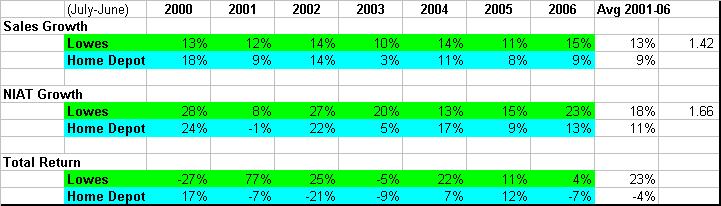 Yesterday, I compared the recent performances of Lowes and Home Depot, in an attempt to understand the accolades given Bob Nardelli for allegedly "turning around" the fundamentals at the latter company since his arrival in late 2000.
In that piece, I found, using the data in the table above, from Compustat, that Nardelli does not seem to have outperformed his main competitor over the last 5 years. Home Depot's sales growth rate is not so impressive and is inconsistent as well. From my proprietary research, I would conclude that these operating characteristics alone account for Home Depot's dismal total returns since Nardelli's taking the CEO position. NIAT performance isn't much better, confirming the low regard in which investors seem to hold the company now.
It wasn't always thus. Back in July, 1999, I held Home Depot in my equity portfolio. It's performance was so strong and consistent, among that of the S&P500 field, that it was selected for inclusion, among other consistently superior companies. It subsequently returned roughly 60% from July to December, 1999.
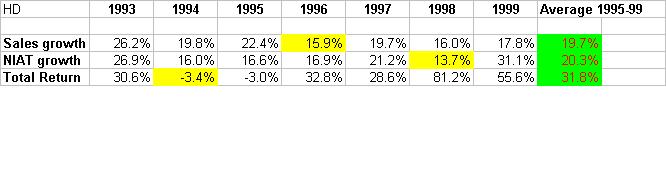 As the table at the left shows, the Home Depot of that era was a much differently performing company. Note the much higher growth rates for sales and NIAT. The green backgrounded column provides the simple averages for sales and NIAT growth, and total returns, for mid-1993 to mid-1999. The yellow highlighted cells indicate the minimum value for the measure during the period shown. Clicking on the table will bring up an enlarged view.
Comparing these values to the ones describing Home Depot recently, one can see why the firm was much more highly valued seven years ago. It was a consistently superior, growing large-cap firm.
It's total returns were correspondingly above-average. This type of performance of a large-cap company should earn the CEO extraordinary compensation. By contrast, Nardelli's 5 year record justifies nothing even close to a compensation package suggesting he has brought success to Home Depot.
Whether Home Depot's performance was bound to decline, due to time and probabilities, is arguable. But, if it were, even more reason not to overcompensate the next CEO for failing to offset those odds. However, what is curious to me is that Home Depot hasn't underperformed on total return because investors learned to expect excellent fundamental performance from the firm. Rather, its fundamental performance simply fell apart. And that has nothing to do with "uncontrollable market forces." Those are the types of problems CEOs are well-paid to fix. And Nardelli has not done that during his five years leading Home Depot.
Monday, July 17, 2006
Lowes vs. Home Depot: Nardelli's Performance
There has been considerable discussion of Bob Nardelli's performance and personal behavior during his stint as CEO of Home Depot. Nardelli arrived at HD in late 2000, fresh from GE, where he was also known as, I learned recently, "little Jack." I'm not sure one can say it was affectionately, unless perhaps by Welch.
While discussing the Nardelli/Home Depot flap with my partner yesterday morning, I contended that the reason for Home Depot's lackluster total returns under Nardelli are probably accounted for by the pattern of sales growth during his reign. My partner asked me to compare Lowes and Home Depot to see if my contention is correct. During the recent flare up of criticism over Nardelli's handling of Home Depot's annual meeting, several people commented that Nardelli has turned the company around, in terms of fundamental operating performance. He is apparently pitied for doing the right operating things, but getting "no credit" from the market, in the form of total returns for his shareholders. I wanted to see if this is, in fact, true, as did my partner.
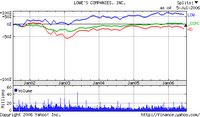 In order to evaluate these comments, I first looked at a Yahoo chart of Lowes and Home Depot's stock prices over the past 5 years. As I mentioned in a prior post, Lowes has clearly outperformed over this recent period.
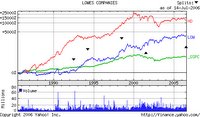 This is in stark contrast to the longer term performance of the two companies' stock prices. The Yahoo price chart at the left, going back to 1985, shows a much different picture.
Here, we see that Home Depot was on a tear, until ....oops...2000. Just before Nardelli took over, the company hit a flat spot, from which it has yet to recover. In fact, it's stock price has actually declined since Nardelli took the helm.
Lowes, on the other hand, has had a rather constant, although slower, stock price rise over the last 21 years. It was a little flat in the late '80s, then began a reasonably monotonic rise in stock price that continued until very recently.
Over the entire period, Home Depot was the better investment, and both Lowes and Home Depot outperformed the S&P500 Index. But, these views don't include dividends, in case they make a significant difference, nor fundamental data, such as sales or profit growth.
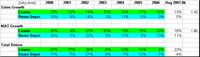 For that view, I went to my Compustat data and retrieved the total returns, sales and NIAT data for Lowes and Home Depot from July, 1999, to June, 2006. The table at the left displays the performances for the two companies on these fundamental and technical dimensions. You may click on it to see the enlarged view.
The top two rows display the annual nominal sales growth of the two companies since 2000. Leaving out 2000, in order to only measure the Nardelli years, we see that Lowes has an average annual sales growth of 13% during the period. This is 1.42x that of Home Depot's average annual sales growth of 9%. That seems to be to be a good reason why Lowes has done better for its shareholders lately. But look at the worst sales growth years for each firm. Lowes never dropped below 10%, while Home Depot had two years in which its sales growth was 3% and an 8%. And these were after 2002, well into the Nardelli era.
If Bob Nardelli has turned Home Depot around, we haven't seen it in the sales growth numbers.
Looking at NIAT (net income after tax), we see a similar pattern. Lowes' average annual NIAT growth is 1.66x that of Home Depot, or 18% vs. 11%. Again, Lowes' worst year featured an 8% growth rate, while Home Depot's was -1%. A decline. Not good for investor confidence.
Here, again, we see no evidence of the 'Nardelli operating turnaround' at Home Depot. I have to confess, I just don't see what Welch, Maria Bartiromo, and others are squawking about. Nardelli's company has lousy stock price performance because its operating performance is uneven and below that of its major competitor.
But, just to be thorough, let's take a look at the actual annual total returns since 2001. That is the third set of paired rows of data in the table. Home Depot's simple average annual return for the period is -4%. Lowes earned an average annual total return of 23% for the same period. Neither company has had a very consistent total return. Which would be at least one reason why neither would be among my equity portfolio selections for the past few years.
However, it seems pretty clear to me that, since 2001, Lowes has exhibited higher and more consistent sales and income growth than has Home Depot. The data doesn't seem to support a "turnaround" by Nardelli, unless his company was doing even worse before he got there. But the stock price data suggest that isn't true.
When you look at the data, Nardelli hasn't performed well for his shareholders on fundamental operating measures like sales and income growth. Is it really surprising the stock price is down, and the company's total returns have trailed both its major competitor, Lowes, and the S&P?
While discussing the Nardelli/Home Depot flap with my partner yesterday morning, I contended that the reason for Home Depot's lackluster total returns under Nardelli are probably accounted for by the pattern of sales growth during his reign. My partner asked me to compare Lowes and Home Depot to see if my contention is correct. During the recent flare up of criticism over Nardelli's handling of Home Depot's annual meeting, several people commented that Nardelli has turned the company around, in terms of fundamental operating performance. He is apparently pitied for doing the right operating things, but getting "no credit" from the market, in the form of total returns for his shareholders. I wanted to see if this is, in fact, true, as did my partner.
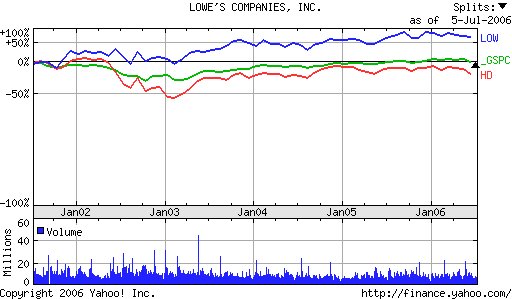 In order to evaluate these comments, I first looked at a Yahoo chart of Lowes and Home Depot's stock prices over the past 5 years. As I mentioned in a prior post, Lowes has clearly outperformed over this recent period.
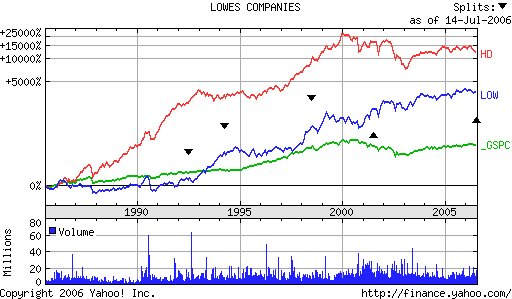 This is in stark contrast to the longer term performance of the two companies' stock prices. The Yahoo price chart at the left, going back to 1985, shows a much different picture.
Here, we see that Home Depot was on a tear, until ....oops...2000. Just before Nardelli took over, the company hit a flat spot, from which it has yet to recover. In fact, it's stock price has actually declined since Nardelli took the helm.
Lowes, on the other hand, has had a rather constant, although slower, stock price rise over the last 21 years. It was a little flat in the late '80s, then began a reasonably monotonic rise in stock price that continued until very recently.
Over the entire period, Home Depot was the better investment, and both Lowes and Home Depot outperformed the S&P500 Index. But, these views don't include dividends, in case they make a significant difference, nor fundamental data, such as sales or profit growth.
 For that view, I went to my Compustat data and retrieved the total returns, sales and NIAT data for Lowes and Home Depot from July, 1999, to June, 2006. The table at the left displays the performances for the two companies on these fundamental and technical dimensions. You may click on it to see the enlarged view.
The top two rows display the annual nominal sales growth of the two companies since 2000. Leaving out 2000, in order to only measure the Nardelli years, we see that Lowes has an average annual sales growth of 13% during the period. This is 1.42x that of Home Depot's average annual sales growth of 9%. That seems to be to be a good reason why Lowes has done better for its shareholders lately. But look at the worst sales growth years for each firm. Lowes never dropped below 10%, while Home Depot had two years in which its sales growth was 3% and an 8%. And these were after 2002, well into the Nardelli era.
If Bob Nardelli has turned Home Depot around, we haven't seen it in the sales growth numbers.
Looking at NIAT (net income after tax), we see a similar pattern. Lowes' average annual NIAT growth is 1.66x that of Home Depot, or 18% vs. 11%. Again, Lowes' worst year featured an 8% growth rate, while Home Depot's was -1%. A decline. Not good for investor confidence.
Here, again, we see no evidence of the 'Nardelli operating turnaround' at Home Depot. I have to confess, I just don't see what Welch, Maria Bartiromo, and others are squawking about. Nardelli's company has lousy stock price performance because its operating performance is uneven and below that of its major competitor.
But, just to be thorough, let's take a look at the actual annual total returns since 2001. That is the third set of paired rows of data in the table. Home Depot's simple average annual return for the period is -4%. Lowes earned an average annual total return of 23% for the same period. Neither company has had a very consistent total return. Which would be at least one reason why neither would be among my equity portfolio selections for the past few years.
However, it seems pretty clear to me that, since 2001, Lowes has exhibited higher and more consistent sales and income growth than has Home Depot. The data doesn't seem to support a "turnaround" by Nardelli, unless his company was doing even worse before he got there. But the stock price data suggest that isn't true.
When you look at the data, Nardelli hasn't performed well for his shareholders on fundamental operating measures like sales and income growth. Is it really surprising the stock price is down, and the company's total returns have trailed both its major competitor, Lowes, and the S&P?
Friday, July 14, 2006
Carlos Goshn Speaks Out On CNBC
Carlos Goshn, CEO of Nissan and Renault, appeared yesterday in an interview on CNBC with that network's talking head, Maria Bartiromo. His visit was no doubt a coup for the network, as Goshn is now the most sought-after executive in all of the automotive sector.
Kirk Kerkorian, GM's largest, and predatory, shareholder, is desperately trying to find a way that Mr. Goshn can, effectively, run GM. To that end, Kerkorian and his associate, now GM board member, Jerry York, have proposed that GM enter an alliance with Nissan/Renault, thus hopefully securing Goshn's services on GM's behalf.
Judging from Goshn's statements in the interview, Kerkorian had better start praying that something else comes along to help GM and its stock price. Because Carlos Goshn made it crystal clear that he had no spare time for GM. However, most interesting were his remarks on what an alliance does for the parties involved.
Goshn explained that while such an alliance might help GM with shared parts, engines, perhaps platforms and designs, each alliance member is responsible for fixing their own company's problems.
Thus, Goshn ruled out being the white knight to come riding in, replace Rick Wagoner, and rescue GM. At best, he left the door open for GM to join the Nissan/Renault alliance, swap equity stakes, and help itself with access to knowledge from the other two members.
I'd say this puts another nail in GM's coffin for the long term. While Rick Wagoner may not be out of a job because of this proposed alliance, he may well be out of a job due to continued unsolved problems and lackluster performance at GM.
Goshn came off as a very resolute, no-nonsense, pragmatic and realistic executive. Pretty much the opposite of Wagoner. I can see why Goshn solved Nissan's problems. And from some of his remarks, I think, were he to actually assume the title of GM CEO, he'd "rescue" GM by carving out a much-reduced core company of decent products and cost structures, while summarily shedding much of the giant's outmoded asset and personnel bases.
It should be very interesting to watch Kerkorian's moves during the rest of the summer, as the alliance discussions and subsequent maneuvers pan out. But, suffice to say, I wouldn't go buy GM stock based upon what I heard from Goshn yesterday.
Kirk Kerkorian, GM's largest, and predatory, shareholder, is desperately trying to find a way that Mr. Goshn can, effectively, run GM. To that end, Kerkorian and his associate, now GM board member, Jerry York, have proposed that GM enter an alliance with Nissan/Renault, thus hopefully securing Goshn's services on GM's behalf.
Judging from Goshn's statements in the interview, Kerkorian had better start praying that something else comes along to help GM and its stock price. Because Carlos Goshn made it crystal clear that he had no spare time for GM. However, most interesting were his remarks on what an alliance does for the parties involved.
Goshn explained that while such an alliance might help GM with shared parts, engines, perhaps platforms and designs, each alliance member is responsible for fixing their own company's problems.
Thus, Goshn ruled out being the white knight to come riding in, replace Rick Wagoner, and rescue GM. At best, he left the door open for GM to join the Nissan/Renault alliance, swap equity stakes, and help itself with access to knowledge from the other two members.
I'd say this puts another nail in GM's coffin for the long term. While Rick Wagoner may not be out of a job because of this proposed alliance, he may well be out of a job due to continued unsolved problems and lackluster performance at GM.
Goshn came off as a very resolute, no-nonsense, pragmatic and realistic executive. Pretty much the opposite of Wagoner. I can see why Goshn solved Nissan's problems. And from some of his remarks, I think, were he to actually assume the title of GM CEO, he'd "rescue" GM by carving out a much-reduced core company of decent products and cost structures, while summarily shedding much of the giant's outmoded asset and personnel bases.
It should be very interesting to watch Kerkorian's moves during the rest of the summer, as the alliance discussions and subsequent maneuvers pan out. But, suffice to say, I wouldn't go buy GM stock based upon what I heard from Goshn yesterday.
Thursday, July 13, 2006
Free Media Publishing Leaps Into Video
Bill Gates Praising the Mac
Here's a little example of why Time Warner and other "old" media conglomerates are in trouble. It's a video clip of a much younger (than now) Bill Gates at an Apple developers conference. I found it on YouTube, and linked it to this blog post. Mostly just to demonstrate a point about technological advances in free online publishing.
I wrote a piece about YouTube recently. It's the online video clip site which functions somewhat like ShutterFly or PhotoBucket. My consulting friend S remarked to me the other day that YouTube allows clips to be linked to blogs. In her words, now "everybody is a star." Or soon could be.
She and I have debated the coming integration of online video entertainment and broadcast/cable content. YouTube adds another interesting bit into the mosaic.
Consider what has now happened.
This blog is free to you and me. Google supplies Blogger for free, even without the ads. Dominating more content in a surging product/service space is reasonable strategy, if the basic cost of doing so is buying more servers. I eventually realize something like the price of a cup of coffee for any click-through revenue from the ads on this blogsite.
Now, YouTube seamlessly links its clips to Blogger. Anyone who shoots digital video of interest can post it for free on YouTube. Competition for content has become so stiff already, that YouTube's competitors, such as Revver, are paying people larger slices of ad revenues to post videos on their site.
This morning, the on-air staff of CNBC held a hand-wringing debate over blogs. Apparently, there was a recent incident in which some blogger posted false information about a company, and its stock price suffered.
Aside from the hilarity of an entertainment show like SquawkBox, the show on which the 'debate' aired, treating blogs from a 'news' standpoint, their discussion demonstrates how much reach independent, "free" published media now may have.
Commentary and editorial blogs, such as this one, are unlikely to be running afoul of any laws regarding insider trading. With increasing amounts of online media available on which to comment, and a free base of operations, how much value added can large media conglomerates create anymore, outside of pure entertainment? It seems even they can't make their news operations pay for themselves. And commentary can be published by anyone for free.
Granted, distribution is a challenge. But it's a far cry from a decade ago, when it wasn't even feasible for someone to write a daily "column" without a syndicated deal with a newspaper chain.
If I wanted to, I could "cast" this blog in video, and post it, without cost, on iTunes or YouTube. In the case of YouTube, I can automatically link my video back here to a post. Somebody else's business model is paying for all the transmission bandwidth, disc storage, and server processing to make this happen. In fact, Google's, and other new media firms' business models are all about generating revenues from viewers, not providers. And not even making the viewers pay directly or explicitly, but, rather, through advertising.
Now, where did I see this before? Oh, right. It's the new version of the "old" televsion business model. Except, this time, it's eviscerating broadcast television.
With the arrival of direct viewing of media content on your television, from the internet, cable revenues from "repackaging" content from "channels" and networks will begin to suffer as well.
My, how times have changed. Now, I can read or hear a story, or view a clip, and write about it the same day. Even link, in many cases, to the story or clip. As I did in my recent piece about Jack Welch in Fortune Magazine. Or downloaded this Bill Gates clip from YouTube.
In a world that supports and embraces this sort of inexpensive integration of multi-media, editorializing, and analysis, what does that portend for the media giants of our time- NewsCorp, Time Warner, McGraw-Hill?
Consider what this integration means to the music divisions of media conglomerates, such as Time Warner. Would a new band not now be able to digitally shoot a video of their performance, and post it free to YouTube? Then link the video(s) to their website, and publish the website URL at their concerts? Then go straight to iTunes with the content they record from digital tools on their iMacs, and....voila! Where's the big publishing giant in the middle? Gone.
Suffice to say, I'll be surprised if any of them appear in my portfolio's selections of consistently superior, high-growth companies.
Here's a little example of why Time Warner and other "old" media conglomerates are in trouble. It's a video clip of a much younger (than now) Bill Gates at an Apple developers conference. I found it on YouTube, and linked it to this blog post. Mostly just to demonstrate a point about technological advances in free online publishing.
I wrote a piece about YouTube recently. It's the online video clip site which functions somewhat like ShutterFly or PhotoBucket. My consulting friend S remarked to me the other day that YouTube allows clips to be linked to blogs. In her words, now "everybody is a star." Or soon could be.
She and I have debated the coming integration of online video entertainment and broadcast/cable content. YouTube adds another interesting bit into the mosaic.
Consider what has now happened.
This blog is free to you and me. Google supplies Blogger for free, even without the ads. Dominating more content in a surging product/service space is reasonable strategy, if the basic cost of doing so is buying more servers. I eventually realize something like the price of a cup of coffee for any click-through revenue from the ads on this blogsite.
Now, YouTube seamlessly links its clips to Blogger. Anyone who shoots digital video of interest can post it for free on YouTube. Competition for content has become so stiff already, that YouTube's competitors, such as Revver, are paying people larger slices of ad revenues to post videos on their site.
This morning, the on-air staff of CNBC held a hand-wringing debate over blogs. Apparently, there was a recent incident in which some blogger posted false information about a company, and its stock price suffered.
Aside from the hilarity of an entertainment show like SquawkBox, the show on which the 'debate' aired, treating blogs from a 'news' standpoint, their discussion demonstrates how much reach independent, "free" published media now may have.
Commentary and editorial blogs, such as this one, are unlikely to be running afoul of any laws regarding insider trading. With increasing amounts of online media available on which to comment, and a free base of operations, how much value added can large media conglomerates create anymore, outside of pure entertainment? It seems even they can't make their news operations pay for themselves. And commentary can be published by anyone for free.
Granted, distribution is a challenge. But it's a far cry from a decade ago, when it wasn't even feasible for someone to write a daily "column" without a syndicated deal with a newspaper chain.
If I wanted to, I could "cast" this blog in video, and post it, without cost, on iTunes or YouTube. In the case of YouTube, I can automatically link my video back here to a post. Somebody else's business model is paying for all the transmission bandwidth, disc storage, and server processing to make this happen. In fact, Google's, and other new media firms' business models are all about generating revenues from viewers, not providers. And not even making the viewers pay directly or explicitly, but, rather, through advertising.
Now, where did I see this before? Oh, right. It's the new version of the "old" televsion business model. Except, this time, it's eviscerating broadcast television.
With the arrival of direct viewing of media content on your television, from the internet, cable revenues from "repackaging" content from "channels" and networks will begin to suffer as well.
My, how times have changed. Now, I can read or hear a story, or view a clip, and write about it the same day. Even link, in many cases, to the story or clip. As I did in my recent piece about Jack Welch in Fortune Magazine. Or downloaded this Bill Gates clip from YouTube.
In a world that supports and embraces this sort of inexpensive integration of multi-media, editorializing, and analysis, what does that portend for the media giants of our time- NewsCorp, Time Warner, McGraw-Hill?
Consider what this integration means to the music divisions of media conglomerates, such as Time Warner. Would a new band not now be able to digitally shoot a video of their performance, and post it free to YouTube? Then link the video(s) to their website, and publish the website URL at their concerts? Then go straight to iTunes with the content they record from digital tools on their iMacs, and....voila! Where's the big publishing giant in the middle? Gone.
Suffice to say, I'll be surprised if any of them appear in my portfolio's selections of consistently superior, high-growth companies.
Stop the Presses: Goshn & GM
Yesterday's Wall Street Journal carried a very illuminating piece on Carlos Goshn, Renault, and the potential alliance between Renault, Nissan and GM. This is Kirk Kerkorian's hopeful gambit to exit his considerable position in GM stock at a profit.
What the Journal pointed out, however, is that, while Goshn did turn around Nissan, as he promised, he hasn't yet succeeded with Renault. After 18 months of work, according to the article, Renault is still valued at zero, awaiting Goshn's magic touch. The other pieces of the alliance allegedly comprise the value of the outstanding stock, indicating that investors are awaiting Renault's rehabilitation.
What this means, as the article pointed out, is that GM & Kerkorian may have to wait in line for quite a while for this alliance to develop. Or to show results, if it does develop.
Maybe Rick Wagoner doesn't have much to worry about from Goshn & Co. just yet. And maybe I was premature in suggesting, earlier this week, that my prediction of one less CEO in Detroit is nearing reality faster than I had expected.
Still, it's not good news for GM's shareholders. I think the suggestion of the alliance simply puts GM in the "intensive care" unit for the forseeable future. And as I've written before, I would not look to the prior and current management team to fix what they messed up, on such a large scale, to begin with. My guess is that this new revelation about Goshn's capacity to help GM means the latter will likely be foundering a while longer.
In any case, it highlights a potential pitfall in GM's path out of its misery. And its shareholders are by no means out of the woods yet, by a long shot.
What the Journal pointed out, however, is that, while Goshn did turn around Nissan, as he promised, he hasn't yet succeeded with Renault. After 18 months of work, according to the article, Renault is still valued at zero, awaiting Goshn's magic touch. The other pieces of the alliance allegedly comprise the value of the outstanding stock, indicating that investors are awaiting Renault's rehabilitation.
What this means, as the article pointed out, is that GM & Kerkorian may have to wait in line for quite a while for this alliance to develop. Or to show results, if it does develop.
Maybe Rick Wagoner doesn't have much to worry about from Goshn & Co. just yet. And maybe I was premature in suggesting, earlier this week, that my prediction of one less CEO in Detroit is nearing reality faster than I had expected.
Still, it's not good news for GM's shareholders. I think the suggestion of the alliance simply puts GM in the "intensive care" unit for the forseeable future. And as I've written before, I would not look to the prior and current management team to fix what they messed up, on such a large scale, to begin with. My guess is that this new revelation about Goshn's capacity to help GM means the latter will likely be foundering a while longer.
In any case, it highlights a potential pitfall in GM's path out of its misery. And its shareholders are by no means out of the woods yet, by a long shot.
Subscribe to:
Posts (Atom)