Steve Jobs on Microsoft (Extended Version)
I found this little clip on YouTube the other day, when I was testing the blogging link on that site.
Jobs' accusation of Microsoft's lack of innovative ideas and being cultural philistines doesn't seem to have changed in the years since this interview occurred.
The video clip doesn't have a date, but I'm guessing, by Jobs' look and his references, that it is sometime in the early-mid 1990s.
What I find ironic is that this clip would work today, only for the iPod vs. Microsoft's latest Apple knock-off, the imminent Zune digital music player.
True, Apple stole its Mac OS from Xerox. But what they did with it was inspired and beautiful, if expensive and lacking in troubleshooting capability. Microsoft began its tradition of workmanlike copying of Apple with its Windows OS.
Now, we have the same companies, and the same behaviors, except that this time Apple actually created the digital music download-playing systems itself.
And, of course, this time, the market shares are reversed, and probably will stay that way.
In discussing this with my partner the other day over lunch, I opined that Jobs has already left music playing behind, and is now heading for the higher, virgin ground of digital video content downloading and playing. By the time Microsoft and RealNetworks catch up, Apple will probably have captured the dominant market position, and a proprietary storage method, again.
It's just so eerie that this would all be playing out once more, with the same two companies, and same two leaders, so many years later......
Friday, September 22, 2006


Thursday, September 21, 2006
One Year Anniversary
This month marks my first anniversary writing this blog. Since my first posts, here, beginning on September 15th of 2005, I've written almost 250 pieces.
As I've made this a more routine, daily commentary, my focus has left politics, and focused nearly exclusively on business.
One of the things I've noticed is that writing a daily "column" has sharpened my own sense of the essentials in the business stories on which I comment. It's also helped me to understand how technology has become such a great leveler in recent years. With online publications, cable news, and free online video services such as YouTube, a writer like me is at no disadvantage with respect to news flow, when it comes to selecting topics and having access to information about those topics, on which to opine.
Beyond that, it's also given me many opportunities to test and reinforce my contention, initially born out of my proprietary empirical research, that there are certain hallmarks of companies and sectors that seem to lend themselves to achieving consistently superior returns for their shareholders. Since this is the focus of my companion large-cap equity investment strategy, writing a daily piece for this blog has added a visceral, approachable feel to the rather theoretical notions which originated from my research ten years ago.
If you read this blog regularly, thanks for visiting, and I hope you continue to read and enjoy my work.
As I've made this a more routine, daily commentary, my focus has left politics, and focused nearly exclusively on business.
One of the things I've noticed is that writing a daily "column" has sharpened my own sense of the essentials in the business stories on which I comment. It's also helped me to understand how technology has become such a great leveler in recent years. With online publications, cable news, and free online video services such as YouTube, a writer like me is at no disadvantage with respect to news flow, when it comes to selecting topics and having access to information about those topics, on which to opine.
Beyond that, it's also given me many opportunities to test and reinforce my contention, initially born out of my proprietary empirical research, that there are certain hallmarks of companies and sectors that seem to lend themselves to achieving consistently superior returns for their shareholders. Since this is the focus of my companion large-cap equity investment strategy, writing a daily piece for this blog has added a visceral, approachable feel to the rather theoretical notions which originated from my research ten years ago.
If you read this blog regularly, thanks for visiting, and I hope you continue to read and enjoy my work.
The Business of Entertainment Ticket Sales & Reselling
Tuesday's Wall Street Journal featured an article about the business of selling, and reselling, entertainment event tickets. Ticketmaster, a part of Barry Diller's IAC/Interactive Corp., and the market leader, is portrayed as having reversed its long-held position against reselling, and now trying to cut itself in on scalpers' profits. In fact, many states are now reconsidering, or simply not enforcing, their laws against the resale of tickets for more than $1 above the original price.
The key facet of the business which has brought it to this point is described in a quote by Ticketmaster's chairman, Terry Barnes,
"We're in an industry that prices its product worse than anybody else."
The result is frequently either unfilled stadii, or scalpers realizing healthy profits from underpriced tickets. A revealing statistic is that the estimated sales of tickets in the US secondary market was roughly $5B last year, or nearly Ticketmaster's own revenue from ticket sales.
Now, artists whose events are handled by Ticketmaster complain that more of the end user prices of tickets should belong to them, including the extra revenues from online resales, or "scalping," in general.
In the other "corner" of the competitive ring is a smaller, but significant, rival, StubHub, along with eBay's use for ticket resale auctions. Founded in 2000 by two Stanford Business School graduates, the Journal piece reports that StubHub will have $400MM in ticket sales, double that of 2005, on which it makes 25% for its own revenue.
The two major competitors, Ticketmaster and StubHub, view the "market" in radically different terms. The former sees all end-sale ticket revenues as prospectively belonging to the artist and itself, while the latter views all secondary sales as simply between consumers.
It's hard to fault StubHub. Ticketmaster admits its own pricing strategies are so inept as to leave "5% to 10%, that are priced well below their market value," and a further "over 50% of tickets go unsold." Meaning, taken together, that over half of venue tickets are improperly prices, so as to yield sub-maximal, or no, revenues.
Two similar markets come to mind- IPOs and airline seats. Of the two, IPOs have more than simply revenue maximization as an objective. Typically, the offering is meant to create widespread distribution of shares, so that foregone gains on the day of the initial offering, and later, can be somewhat characterized as a "price" paid by the issuing owners, whose equity is up for sale, in order to create a large and liquid market in the shares for the future.
It's possible that musicians and other entertainers, be they sports figures or others, have similar secondary objectives. However, according to Ticketmaster's new position, it seems like this is ebbing in importance. The company began, in 2003, to auction some tickets online, in an attempt at revenue maximization. Apparently, even this hasn't yet resulted in the successful initial sales of prime seats for desired prices.
This would seem to suggest that the artists, and Ticketmaster, should be calling Bob Crandall's old outfit, American Airlines, to consult with it on yield management for entertainment ticket sales.
On a more basic level, however, it seems that artists are trying to have their cake, and eat it, too. In the past, artists have wanted cash up front to fund them, and allegedly do what they do 'for art's sake.' Until, that is, it pays a lot. Then, it seems, they want the full end sales value of the seats for their events, without the risk of that value being less than they might get upfront via the current process.
But if they want the money, shouldn't entertainers take the risk of unsold seats? Cashflow risk? Timing of sales risk?
Why should Ticketmaster and the entertainers they represent get scalper's prices without the risks?
Painters don't get a cut of their painting's eventual high prices, if their canvases ultimately trade for much higher sums among and between collectors.
I think StubHub is correct on this one. Ticketmaster, it points out, brokers deals for artists to play venues. The ticket seller estimates what to charge for tickets, and artists get a cut. However pricing is done, it is their choice.
Would Ticketmaster, the venue, and artists all be OK with a simple online bidding process? Reserving the timing of various tickets for maximum yield? Calling on an airline for help with yield management of the scarce and perishable inventory of event tickets?
On one hand, they may realize better ticket sales by volume and percentage of seats, as well as total revenues. On the other hand, Ticketmaster's stable of entertainers may lose fans, as they are seen as directly involved and complicit in the move to a total auction market for live performance tickets, possibly moving most tickets beyond the price range of many of their fans.
Doesn't it really boil down to the opening quote by Ticketmaster's chairman? The company appears to simply be inept at a key operating function, price setting and yield management, in its major business line, selling tickets to venue seating for its entertainment clients.
The key facet of the business which has brought it to this point is described in a quote by Ticketmaster's chairman, Terry Barnes,
"We're in an industry that prices its product worse than anybody else."
The result is frequently either unfilled stadii, or scalpers realizing healthy profits from underpriced tickets. A revealing statistic is that the estimated sales of tickets in the US secondary market was roughly $5B last year, or nearly Ticketmaster's own revenue from ticket sales.
Now, artists whose events are handled by Ticketmaster complain that more of the end user prices of tickets should belong to them, including the extra revenues from online resales, or "scalping," in general.
In the other "corner" of the competitive ring is a smaller, but significant, rival, StubHub, along with eBay's use for ticket resale auctions. Founded in 2000 by two Stanford Business School graduates, the Journal piece reports that StubHub will have $400MM in ticket sales, double that of 2005, on which it makes 25% for its own revenue.
The two major competitors, Ticketmaster and StubHub, view the "market" in radically different terms. The former sees all end-sale ticket revenues as prospectively belonging to the artist and itself, while the latter views all secondary sales as simply between consumers.
It's hard to fault StubHub. Ticketmaster admits its own pricing strategies are so inept as to leave "5% to 10%, that are priced well below their market value," and a further "over 50% of tickets go unsold." Meaning, taken together, that over half of venue tickets are improperly prices, so as to yield sub-maximal, or no, revenues.
Two similar markets come to mind- IPOs and airline seats. Of the two, IPOs have more than simply revenue maximization as an objective. Typically, the offering is meant to create widespread distribution of shares, so that foregone gains on the day of the initial offering, and later, can be somewhat characterized as a "price" paid by the issuing owners, whose equity is up for sale, in order to create a large and liquid market in the shares for the future.
It's possible that musicians and other entertainers, be they sports figures or others, have similar secondary objectives. However, according to Ticketmaster's new position, it seems like this is ebbing in importance. The company began, in 2003, to auction some tickets online, in an attempt at revenue maximization. Apparently, even this hasn't yet resulted in the successful initial sales of prime seats for desired prices.
This would seem to suggest that the artists, and Ticketmaster, should be calling Bob Crandall's old outfit, American Airlines, to consult with it on yield management for entertainment ticket sales.
On a more basic level, however, it seems that artists are trying to have their cake, and eat it, too. In the past, artists have wanted cash up front to fund them, and allegedly do what they do 'for art's sake.' Until, that is, it pays a lot. Then, it seems, they want the full end sales value of the seats for their events, without the risk of that value being less than they might get upfront via the current process.
But if they want the money, shouldn't entertainers take the risk of unsold seats? Cashflow risk? Timing of sales risk?
Why should Ticketmaster and the entertainers they represent get scalper's prices without the risks?
Painters don't get a cut of their painting's eventual high prices, if their canvases ultimately trade for much higher sums among and between collectors.
I think StubHub is correct on this one. Ticketmaster, it points out, brokers deals for artists to play venues. The ticket seller estimates what to charge for tickets, and artists get a cut. However pricing is done, it is their choice.
Would Ticketmaster, the venue, and artists all be OK with a simple online bidding process? Reserving the timing of various tickets for maximum yield? Calling on an airline for help with yield management of the scarce and perishable inventory of event tickets?
On one hand, they may realize better ticket sales by volume and percentage of seats, as well as total revenues. On the other hand, Ticketmaster's stable of entertainers may lose fans, as they are seen as directly involved and complicit in the move to a total auction market for live performance tickets, possibly moving most tickets beyond the price range of many of their fans.
Doesn't it really boil down to the opening quote by Ticketmaster's chairman? The company appears to simply be inept at a key operating function, price setting and yield management, in its major business line, selling tickets to venue seating for its entertainment clients.
Wednesday, September 20, 2006
Conglomerates' Value-Added: Another Perspective
Last week's WSJ article about United Technology's new corporate ad campaign caught my attention.
The topic is an old one, going back at least as far as my own graduate business school education in the late 1970s. In that sense, nothing in the piece was really "new" That is, how does a conglomerate provide a clear presence to the market for itself? And is it even necessary?
However, times have changed since I was a grad student, in that, now, a publicly-held company's long-term success measure is usually its total return.
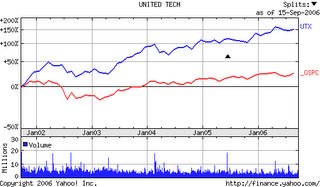 So, the first thing I did, upon reading the piece, was to call up the Yahoo five-year price chart for UTC and the S&P500. That chart is displayed on the left.
It's clear that UTC has nothing to worry about. The company's five-year performance is vastly superior to that of the index, and has had no significant downturns which lasted more than a few months.
Why waste money on corporate advertising, when the investors are getting such stupendous returns? Exactly who needs to know about UTC, the conglomerate, when the constituent businesses are delivering such surprisingly consistently superior performance?
It would seem that being a conglomerate is not, in this case, hurting UTC at all.
What is George David's, UTC CEO's, purpose in this matter? How will spending the planned $20 million affect the company's performance?
If UTC had stellar financial operating performance, but poor total returns, it might be different. But that's not the case.
And citing GE as an example of what it wants to emulate seems misguided, too. GE's returns have been abysmal under its CEO, Jeff Immelt, for five years.
Perhaps George David should save the $20MM for product development, and continue to improve his chances of continuing the difficult task of earning consistently superior total returns for his shareholders.
The topic is an old one, going back at least as far as my own graduate business school education in the late 1970s. In that sense, nothing in the piece was really "new" That is, how does a conglomerate provide a clear presence to the market for itself? And is it even necessary?
However, times have changed since I was a grad student, in that, now, a publicly-held company's long-term success measure is usually its total return.
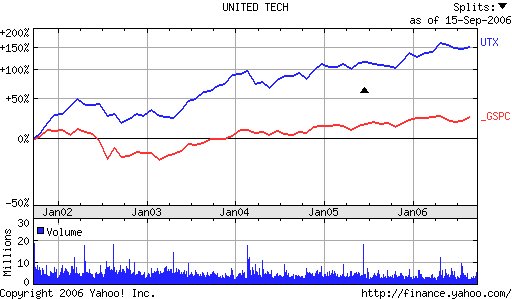 So, the first thing I did, upon reading the piece, was to call up the Yahoo five-year price chart for UTC and the S&P500. That chart is displayed on the left.
It's clear that UTC has nothing to worry about. The company's five-year performance is vastly superior to that of the index, and has had no significant downturns which lasted more than a few months.
Why waste money on corporate advertising, when the investors are getting such stupendous returns? Exactly who needs to know about UTC, the conglomerate, when the constituent businesses are delivering such surprisingly consistently superior performance?
It would seem that being a conglomerate is not, in this case, hurting UTC at all.
What is George David's, UTC CEO's, purpose in this matter? How will spending the planned $20 million affect the company's performance?
If UTC had stellar financial operating performance, but poor total returns, it might be different. But that's not the case.
And citing GE as an example of what it wants to emulate seems misguided, too. GE's returns have been abysmal under its CEO, Jeff Immelt, for five years.
Perhaps George David should save the $20MM for product development, and continue to improve his chances of continuing the difficult task of earning consistently superior total returns for his shareholders.
Tuesday, September 19, 2006
Rhapsody, iTunes, Zune and The Evolving Competitive Market for Digital Media Downloads
It seems that there is now a concerted effort by both RealNetworks and Microsoft to enter the integrated digital music device and download service market.
According to Monday's Wall Street Journal article, both companies are eyeing Apple's 75% share of a market which accounted for $1.5B in revenues for the company in just the last quarter. The firm has, according to the WSJ, sold 60 million iPods since the product line's introduction.
That must be nearly, on average, one per household in the US. Not that all sales are in the US, but as a benchmark, it's a huge installed base penetration for the device and its companion download service.
There's a really good quote in the article by Mike McGuire, an analyst with the Gartner Group,
"You've got to come to the party with something pretty special."
RealNetworks' Rhapsody service is more or less a musical rental business model. One pays a monthly subscription to keep downloaded material activated. Rhapsody will now work with SanDisk's Sansa player, the leading rival company to Apple in this market.
Microsoft is now approaching the product/market in the same manner as it did the XBox360, and with the same senior executives responsible for this new digital music/media business group. Rather than rely on outside developers, they are now mirroring Apple's total system provision of a player, the Zune, and its own net-based downloading service.
Apple has had this market largely to itself for at least five years. It's prices are very low now. Even more than a year ago, they had penetrated the lower end of the market with a $100, 512KB Shuffle. I can't see anyone undercutting them on price.
So it's difficult to see just what is left in the marketplace for Microsoft and RealNetworks to serve with significantly superior or different, value-adding functions and features.
In Microsoft's case, I'd even go so far as to suggest that this may mark their second major step toward dis-integrating the monolith that has been the Redmond software titan. As I opined to my consulting friend, S, some months ago, I think that way lies any hope of rescue and financial success for Microsoft.
From what I've read, there is no mention of the Xbox or Zune being integrated into or with other Microsoft products, notably Windows. But I don't know if wireless transfers of music is enough to dethrone Apple after a five-year headstart.
It will likely come down to a preference for the online interface experience. Or perhaps upgrading and replacing an older player with the same brand, in order to keep one's music library intact. Funny how well-designed products just naturally promote legal and profitable tying.
In the final analysis, based on what I've read so far, Apple doesn't have much to worry about in the near term. They've made their platform into a multi-media one, from simply music, in order to facilitate future growth. And adeptly sidestep competition from pure music players.
If this is the best RealNetworks and Microsoft can do, they may be in for a bad time in the digital media device and download product/market.
According to Monday's Wall Street Journal article, both companies are eyeing Apple's 75% share of a market which accounted for $1.5B in revenues for the company in just the last quarter. The firm has, according to the WSJ, sold 60 million iPods since the product line's introduction.
That must be nearly, on average, one per household in the US. Not that all sales are in the US, but as a benchmark, it's a huge installed base penetration for the device and its companion download service.
There's a really good quote in the article by Mike McGuire, an analyst with the Gartner Group,
"You've got to come to the party with something pretty special."
RealNetworks' Rhapsody service is more or less a musical rental business model. One pays a monthly subscription to keep downloaded material activated. Rhapsody will now work with SanDisk's Sansa player, the leading rival company to Apple in this market.
Microsoft is now approaching the product/market in the same manner as it did the XBox360, and with the same senior executives responsible for this new digital music/media business group. Rather than rely on outside developers, they are now mirroring Apple's total system provision of a player, the Zune, and its own net-based downloading service.
Apple has had this market largely to itself for at least five years. It's prices are very low now. Even more than a year ago, they had penetrated the lower end of the market with a $100, 512KB Shuffle. I can't see anyone undercutting them on price.
So it's difficult to see just what is left in the marketplace for Microsoft and RealNetworks to serve with significantly superior or different, value-adding functions and features.
In Microsoft's case, I'd even go so far as to suggest that this may mark their second major step toward dis-integrating the monolith that has been the Redmond software titan. As I opined to my consulting friend, S, some months ago, I think that way lies any hope of rescue and financial success for Microsoft.
From what I've read, there is no mention of the Xbox or Zune being integrated into or with other Microsoft products, notably Windows. But I don't know if wireless transfers of music is enough to dethrone Apple after a five-year headstart.
It will likely come down to a preference for the online interface experience. Or perhaps upgrading and replacing an older player with the same brand, in order to keep one's music library intact. Funny how well-designed products just naturally promote legal and profitable tying.
In the final analysis, based on what I've read so far, Apple doesn't have much to worry about in the near term. They've made their platform into a multi-media one, from simply music, in order to facilitate future growth. And adeptly sidestep competition from pure music players.
If this is the best RealNetworks and Microsoft can do, they may be in for a bad time in the digital media device and download product/market.
Monday, September 18, 2006
Energy Prices, Investors and the Economy and Markets
This has been a rather peculiar year for equity investing. Last week's Wall Street Journal, on Wednesday, featured two articles on disappointing investment performance at two very well-regarded firms- Goldman Sachs and Convexity Capital.
Our own equity strategy is doing poorly at the moment, as a result of energy prices, and investors' near term reactions to those prices.
My partner emailed me a recent NY Times piece which repeated many of the comments I've made regarding this situation. It is, to me, perplexing.
First, it's notable that so many hedge funds and veteran managers are doing poorly as well this year. It's not really a "growth" economy, so far as investors perceive it. The S&P500 Index has not had a monthly closing annual return above 6% yet this year. Many have been below 4%. Hardly a year of confident investing in a growing economy.
Which brings us to energy. The track record of energy firms which have entered our portfolio is one of consistently superior revenue growth and total returns for quite a few years. They are not simply timing bets on oil and gas prices. However, this year, more than even last year, has really caused confusion in the energy markets.
If economies are growing, then investors fear the Fed raising rates to check inflationary pressures. Pressures brought on by......energy prices! Rising rates will slow the economy. And lead to less energy usage.
If economies are slowing, investors feel energy will be in less demand, and, thus, have less value. As will, they feel, the companies producing and distributing the necessary fuels and their precursors.
It would seem that, for now, and for much of the past few months, the broad middle swathe of "average" investors, and I use the term pejoratively, feel that it is an inescapable conclusion that any probably economic outcome must lead to lower growth and lower energy prices, and, thus, lower prices for energy company equities.
To be sure, the way the S&P has bumped along near zero returns for so much of this year, and in the low single-digits the rest of the time, doesn't help. Nevermind that real economic growth has been pretty good for more than two years now. And that, per Arthur Laffer's comments recently, related in this post, we aren't seeing inflationary pressures, so much as the effects of commodity prices filtered through exchange rates.
I just don't see an economic recession among the various better pundits who forecast such things. ChIndia still seems to be growing and planning to consume copious amounts of energy. No imminent additions to supply are in sight, and demand doesn't seem to have materially slowed. True, current inventories are high for oil, gasoline and natural gas. Is this a long-term effect, or simply a snapshot in the early fall? Is it truly the basis for long-term declines in energy prices?
Granted, Chevron and Devon have announced a large new find in the deep waters of the Gulf of Mexico. As the NYTimes article my partner sent me, written by Daniel Akst reminds us,
"WhatÂ’s that you say? You think this sounds like good news rather than bad? You figure cheaper oil would boost economic growth while slashing the income of such lovable oil exporters as Iran?
Don’t kid yourself. Anything that reinforces the role of fossil fuels — particularly oil — as the industrial world’s primary energy source is bad, not good. Anything that prolongs the life of the internal combustion engine is a negative, not a positive. Anything that makes it cheaper to pump greenhouse gases into the atmosphere is cause for mourning rather than celebration.What we need is not lower oil prices but higher ones — significantly higher, enough to deter consumption and make us look seriously at alternatives........HIGHER prices have worked wonders before. Today, Americans can generate a dollar of gross domestic product using just half the energy required in 1973, that watershed year of the oil embargo and lines at gas stations. In countries where energy is more expensive, a dollar of G.D.P. requires considerably less energy still. Unlike a tax, moreover, higher prices have the advantage of applying all over the world, to everyone."
The point about the growth in US productivity with respect to oil is a fact I like to quote. However, the correspoinformationmation about countries where energy is even more expensive was welcome news to me.
It's a tumultuous time in the equity markets, and the energy markets, to be sure. Occurring at such relatively modest market returns, with questions about inflation, growth and recession in the air, all of this has a depressing effect on growth equity strategies.
I'm not completely sold on the idea that energy prices are down for the count, and their equity prices, with them. For a while, I do believe the weight of average market participants will continue to keep prices low. But it won't take much to send both commodity prices, and those of their producers, rocketing upwards again, once the broad, "average" investors, meinstitutionaltional managers, realize that supply and demand fundamentals of energy have not changed materially in the last twelve months.
Our own equity strategy is doing poorly at the moment, as a result of energy prices, and investors' near term reactions to those prices.
My partner emailed me a recent NY Times piece which repeated many of the comments I've made regarding this situation. It is, to me, perplexing.
First, it's notable that so many hedge funds and veteran managers are doing poorly as well this year. It's not really a "growth" economy, so far as investors perceive it. The S&P500 Index has not had a monthly closing annual return above 6% yet this year. Many have been below 4%. Hardly a year of confident investing in a growing economy.
Which brings us to energy. The track record of energy firms which have entered our portfolio is one of consistently superior revenue growth and total returns for quite a few years. They are not simply timing bets on oil and gas prices. However, this year, more than even last year, has really caused confusion in the energy markets.
If economies are growing, then investors fear the Fed raising rates to check inflationary pressures. Pressures brought on by......energy prices! Rising rates will slow the economy. And lead to less energy usage.
If economies are slowing, investors feel energy will be in less demand, and, thus, have less value. As will, they feel, the companies producing and distributing the necessary fuels and their precursors.
It would seem that, for now, and for much of the past few months, the broad middle swathe of "average" investors, and I use the term pejoratively, feel that it is an inescapable conclusion that any probably economic outcome must lead to lower growth and lower energy prices, and, thus, lower prices for energy company equities.
To be sure, the way the S&P has bumped along near zero returns for so much of this year, and in the low single-digits the rest of the time, doesn't help. Nevermind that real economic growth has been pretty good for more than two years now. And that, per Arthur Laffer's comments recently, related in this post, we aren't seeing inflationary pressures, so much as the effects of commodity prices filtered through exchange rates.
I just don't see an economic recession among the various better pundits who forecast such things. ChIndia still seems to be growing and planning to consume copious amounts of energy. No imminent additions to supply are in sight, and demand doesn't seem to have materially slowed. True, current inventories are high for oil, gasoline and natural gas. Is this a long-term effect, or simply a snapshot in the early fall? Is it truly the basis for long-term declines in energy prices?
Granted, Chevron and Devon have announced a large new find in the deep waters of the Gulf of Mexico. As the NYTimes article my partner sent me, written by Daniel Akst reminds us,
"WhatÂ’s that you say? You think this sounds like good news rather than bad? You figure cheaper oil would boost economic growth while slashing the income of such lovable oil exporters as Iran?
Don’t kid yourself. Anything that reinforces the role of fossil fuels — particularly oil — as the industrial world’s primary energy source is bad, not good. Anything that prolongs the life of the internal combustion engine is a negative, not a positive. Anything that makes it cheaper to pump greenhouse gases into the atmosphere is cause for mourning rather than celebration.What we need is not lower oil prices but higher ones — significantly higher, enough to deter consumption and make us look seriously at alternatives........HIGHER prices have worked wonders before. Today, Americans can generate a dollar of gross domestic product using just half the energy required in 1973, that watershed year of the oil embargo and lines at gas stations. In countries where energy is more expensive, a dollar of G.D.P. requires considerably less energy still. Unlike a tax, moreover, higher prices have the advantage of applying all over the world, to everyone."
The point about the growth in US productivity with respect to oil is a fact I like to quote. However, the correspoinformationmation about countries where energy is even more expensive was welcome news to me.
It's a tumultuous time in the equity markets, and the energy markets, to be sure. Occurring at such relatively modest market returns, with questions about inflation, growth and recession in the air, all of this has a depressing effect on growth equity strategies.
I'm not completely sold on the idea that energy prices are down for the count, and their equity prices, with them. For a while, I do believe the weight of average market participants will continue to keep prices low. But it won't take much to send both commodity prices, and those of their producers, rocketing upwards again, once the broad, "average" investors, meinstitutionaltional managers, realize that supply and demand fundamentals of energy have not changed materially in the last twelve months.
Thursday, September 14, 2006
More Bad News At Ford
Poor Alan Mulally, Ford's new CEO. When it rains, it pours.
I've written here, and here, recently, of Ford's rather interesting, if perilous, changes.
From article in The Wall Street Journal this morning, it appears that Ford is making a combination of the worst choices among its various options on several fronts.
The company is looking to buyout out as much as 30% of its workforce, but is not announcing the termination or sale of any of its auto brands. Further, and one of the reasons for the sudden move to shed employees, is Ford's new forecast that profitability will not be in sight until after 2008, rather than during that year. It turns out, as I wondered last year, in this October post, that Ford is running out of time and money.
Throughout all of this information, I am reminded of Holman Jenkins' stressing how much is already going on at Ford, in an almost unstoppable manner, as Mulally arrives. The plant closings, buyouts, layoffs, and cost-cutting have been either underway or are now culminating in agreements with the UAW.
Then, this week, several senior executive departures were announced. Anne Stevens, a senior North American manager involved in the company's turnaround plans, has left. A few other managers are retiring. To Jenkins' point, were Mulally bringing in his own team, this might be opportune. Instead, he'll be attempting to sail the Titanic short-handed.
When I consider the two articles I cited recently offering free advice to Ford, and the actions announced today, the company's future does, indeed, seem a bit dimmer suddenly. Expensive, cash-consuming labor buyouts on one hand, and the retention of bloated brands, product lines and business units on the other, portray a company still in denial. Perhaps, as Jenkins suggested, a family still in denial.
Based upon today's events, it would seem that Ford, should it survive the next few years, will be a much smaller car company, if it manages to remain independent.
I've written here, and here, recently, of Ford's rather interesting, if perilous, changes.
From article in The Wall Street Journal this morning, it appears that Ford is making a combination of the worst choices among its various options on several fronts.
The company is looking to buyout out as much as 30% of its workforce, but is not announcing the termination or sale of any of its auto brands. Further, and one of the reasons for the sudden move to shed employees, is Ford's new forecast that profitability will not be in sight until after 2008, rather than during that year. It turns out, as I wondered last year, in this October post, that Ford is running out of time and money.
Throughout all of this information, I am reminded of Holman Jenkins' stressing how much is already going on at Ford, in an almost unstoppable manner, as Mulally arrives. The plant closings, buyouts, layoffs, and cost-cutting have been either underway or are now culminating in agreements with the UAW.
Then, this week, several senior executive departures were announced. Anne Stevens, a senior North American manager involved in the company's turnaround plans, has left. A few other managers are retiring. To Jenkins' point, were Mulally bringing in his own team, this might be opportune. Instead, he'll be attempting to sail the Titanic short-handed.
When I consider the two articles I cited recently offering free advice to Ford, and the actions announced today, the company's future does, indeed, seem a bit dimmer suddenly. Expensive, cash-consuming labor buyouts on one hand, and the retention of bloated brands, product lines and business units on the other, portray a company still in denial. Perhaps, as Jenkins suggested, a family still in denial.
Based upon today's events, it would seem that Ford, should it survive the next few years, will be a much smaller car company, if it manages to remain independent.
Apple Announces the Missing Link
Yesterday, Apple announced its iTV device to stream content to the Apple computer-like box, essentially a video-application digital file storage and management device, wired to a TV's video and audio inputs. As expected, and described in the Wall Street Journal, it will use a home wireless network to receive files from a Mac or PC. It even has a wireless controller, as I expected (ok, who wouldn't, at this point, right?).
Finally, the end game is now in sight for network television, and physical film distribution. This device, and its competitors from various other electronics purveyors, will finally allow consumers to shop for video content online, and download it in custom fashion to their home digital storage devices for play/temporary usage/ownership.
I've opined on this development over the past few months in prior posts like this one from February. It spells the final draining of value from the network television model, not to mention Blockbuster, and probably even Netflix. It's even possible this could be the next "killer app" in the consumer digital device world which forces massive upgrading of what one still calls "personal computers."
In any event, by June of 2007, the instrument of broadcast and physical video content distribution will be tangibly at hand, for about $300 (again, more or less my expectation of the price point). So, give things a year or so to shake out, and basic models of competitive units should sell for about $250-300.
As I wrote late last month, here, the less obvious victims of this innocuous little digital box will, I predict, be Verizon, AT&T, and the cable companies. With this final wireless link to what amounts to a digital video server wired to your TV, who needs Comcast's predetermined menu of channels and air times? Just start paying for the content you want, either from a "general store" like iTunes, or Amazon, or, go directly to URLs of the content producers and use your credit card or PayPal.
I am, in any case, quite excited at this new development. Even now, as I finish composing this, I am listening to CNBC's review of the new Microsoft iPod competitor, a type of video/audio file viewing/listening device that wirelessly shares with other users.
The race to market a wide variety of wireless multi-media devices is full on now. The winners and losers will probably include many accidents along the way- unintended casualties, and lucky successes. I'm looking forward to the competition, but I expect that, in the end, this will benefit unbundled, superior producers in every area of the new markets- content, device design, and selective disintermediation of content management.
Finally, the end game is now in sight for network television, and physical film distribution. This device, and its competitors from various other electronics purveyors, will finally allow consumers to shop for video content online, and download it in custom fashion to their home digital storage devices for play/temporary usage/ownership.
I've opined on this development over the past few months in prior posts like this one from February. It spells the final draining of value from the network television model, not to mention Blockbuster, and probably even Netflix. It's even possible this could be the next "killer app" in the consumer digital device world which forces massive upgrading of what one still calls "personal computers."
In any event, by June of 2007, the instrument of broadcast and physical video content distribution will be tangibly at hand, for about $300 (again, more or less my expectation of the price point). So, give things a year or so to shake out, and basic models of competitive units should sell for about $250-300.
As I wrote late last month, here, the less obvious victims of this innocuous little digital box will, I predict, be Verizon, AT&T, and the cable companies. With this final wireless link to what amounts to a digital video server wired to your TV, who needs Comcast's predetermined menu of channels and air times? Just start paying for the content you want, either from a "general store" like iTunes, or Amazon, or, go directly to URLs of the content producers and use your credit card or PayPal.
I am, in any case, quite excited at this new development. Even now, as I finish composing this, I am listening to CNBC's review of the new Microsoft iPod competitor, a type of video/audio file viewing/listening device that wirelessly shares with other users.
The race to market a wide variety of wireless multi-media devices is full on now. The winners and losers will probably include many accidents along the way- unintended casualties, and lucky successes. I'm looking forward to the competition, but I expect that, in the end, this will benefit unbundled, superior producers in every area of the new markets- content, device design, and selective disintermediation of content management.
"Free Advice for Ford"
Tuesday's and Wednesday's editions of the Wall Street Journal featured incredibly good pieces about Ford.
The first piece, written by Charlie Hughes (former CEO of Land Rover) and William Jeanes (former editor in chief of Car and Driver), succinctly pares suggestions for Ford's new CEO, Alan Mulally, down to three.
First, they recommend that Mulally's main objective be to make "the Ford brand the most successful brand in the world." Toyota, they believe, is Mulally's "new Airbus." A simple, compelling objective on which to focus the beleaguered firm.
Next, they advocate combining, divesting and eliminating the company's car brands to leave just the three remaining, and then put the full force of the company's efforts behind those brands. The brands they recommend retaining are Ford, Volvo and Jaguar. There is a sense to this, because those three, together, cover a maximal spectrum of customer segments, while being few enough in number to allow each brand to have similar products, but without any real chance of product/market overlap.
Finally, they suggest that Mulally has to create a new culture at Ford, to have any chance of success. They posit, reasonably, that a combination of years of careerist management, with a recent drumbeat of failure, has left the company bereft of much chance of success in its current condition.
I found their article elegantly reasonable, powerful and simple in its messages. Of course, much quantitative work will be required, whatever direction the new CEO takes, in order to have any hope of turning Ford around. But Hughes and Jeanes articulate a nice combination of suggestions which touch on problems involving customer confusion with overlapping and/or unprofitable brands, the company's own cultural malaise, and an objective which is, they write, "noble."
Yesterday, on the heels of that editorial, came Holman Jenkins' very different approach to offering welcoming advice to Alan Mulally. I like it equally well.
Holman focuses on Mulally's isolation at his new employer. Not only does Mulally have no troops with him from Boeing, obviating his ability to dismiss unwanted existing staff, but the "old king" still reigns. Not an enviable position.
Then Holman goes off on a truly inspired track. To those who doubt the viability of a private equity buyout at Ford, he notes that one was just done in the semiconductor sector of similar size. The difference, he notes, is the Ford family's intransigence at acknowledging reality. So long as the Fords insist on control, nobody else will use fresh money to bail them out. A condition for their rescue is to surrender control. After all, who got Ford into this mess in the first place?
The overall impression one gets from Mr. Jenkins' piece, especially its discussion of Ford's labor woes, and Mulally's background, is that Ford's new CEO may have his biggest impact not on the firm's strategy, or operations, but on the structure of the firm going forward. Perhaps privately owned, perhaps with significantly different labor dynamics.
Taken together, I find both pieces extremely candid and reasonable regarding Ford's, and Mulally's, options in the near term. Neither necessarily thinks Ford will survive, or independently and publicly. But they highlight some very valid concerns for the ailing auto maker's new CEO.
The first piece, written by Charlie Hughes (former CEO of Land Rover) and William Jeanes (former editor in chief of Car and Driver), succinctly pares suggestions for Ford's new CEO, Alan Mulally, down to three.
First, they recommend that Mulally's main objective be to make "the Ford brand the most successful brand in the world." Toyota, they believe, is Mulally's "new Airbus." A simple, compelling objective on which to focus the beleaguered firm.
Next, they advocate combining, divesting and eliminating the company's car brands to leave just the three remaining, and then put the full force of the company's efforts behind those brands. The brands they recommend retaining are Ford, Volvo and Jaguar. There is a sense to this, because those three, together, cover a maximal spectrum of customer segments, while being few enough in number to allow each brand to have similar products, but without any real chance of product/market overlap.
Finally, they suggest that Mulally has to create a new culture at Ford, to have any chance of success. They posit, reasonably, that a combination of years of careerist management, with a recent drumbeat of failure, has left the company bereft of much chance of success in its current condition.
I found their article elegantly reasonable, powerful and simple in its messages. Of course, much quantitative work will be required, whatever direction the new CEO takes, in order to have any hope of turning Ford around. But Hughes and Jeanes articulate a nice combination of suggestions which touch on problems involving customer confusion with overlapping and/or unprofitable brands, the company's own cultural malaise, and an objective which is, they write, "noble."
Yesterday, on the heels of that editorial, came Holman Jenkins' very different approach to offering welcoming advice to Alan Mulally. I like it equally well.
Holman focuses on Mulally's isolation at his new employer. Not only does Mulally have no troops with him from Boeing, obviating his ability to dismiss unwanted existing staff, but the "old king" still reigns. Not an enviable position.
Then Holman goes off on a truly inspired track. To those who doubt the viability of a private equity buyout at Ford, he notes that one was just done in the semiconductor sector of similar size. The difference, he notes, is the Ford family's intransigence at acknowledging reality. So long as the Fords insist on control, nobody else will use fresh money to bail them out. A condition for their rescue is to surrender control. After all, who got Ford into this mess in the first place?
The overall impression one gets from Mr. Jenkins' piece, especially its discussion of Ford's labor woes, and Mulally's background, is that Ford's new CEO may have his biggest impact not on the firm's strategy, or operations, but on the structure of the firm going forward. Perhaps privately owned, perhaps with significantly different labor dynamics.
Taken together, I find both pieces extremely candid and reasonable regarding Ford's, and Mulally's, options in the near term. Neither necessarily thinks Ford will survive, or independently and publicly. But they highlight some very valid concerns for the ailing auto maker's new CEO.
Wednesday, September 13, 2006
The Boomer Generation's New Behavior Patterns with Aging
Autonation's CEO, Mike Jackson, guest hosted part of CNBC's Squawkbox this morning. For a car salesman, as he described himself, he's a very interesting guy.
He talked at some length about the new patterns of aging spending seen in boomers. That is to say, the Americans now aging into their sixties, near retirement, are spending quite differently than did previous generations of Americans upon approaching retirement.
Essentially, he said that research with which he is familiar shows that this near-retirement generation is working at full throttle later into life, and spending like that as well. They are not slowing down.
He enumerated some examples, mostly of activity-oriented and self-indulgent purchases, such as cars, homes, electronics, etc. The point he drove home is that the impact of these very different spending patterns is causing a number of business-related disciplines to reconsider their assumptions about economic activity for the years ahead.
For instance, he noted the effect this different aged-person behavior would have on product development, calling for different feature mixes than were previously supposed for those advancing into their sixties. Additionally, their increased discretionary, luxury- and comfort-oriented spending should probably lead to changes in economists' assumptions regarding the impact of this generation on various aspects of the economy, including sector stimuli, savings rates, etc.
All in all, a rather thought-provoking appearance from Mr. Jackson. One which reminded me, per my marketing background and training, that fresh data is worth so much, in order to avoid incorrectly extrapolating trends that are no longer valid.
He talked at some length about the new patterns of aging spending seen in boomers. That is to say, the Americans now aging into their sixties, near retirement, are spending quite differently than did previous generations of Americans upon approaching retirement.
Essentially, he said that research with which he is familiar shows that this near-retirement generation is working at full throttle later into life, and spending like that as well. They are not slowing down.
He enumerated some examples, mostly of activity-oriented and self-indulgent purchases, such as cars, homes, electronics, etc. The point he drove home is that the impact of these very different spending patterns is causing a number of business-related disciplines to reconsider their assumptions about economic activity for the years ahead.
For instance, he noted the effect this different aged-person behavior would have on product development, calling for different feature mixes than were previously supposed for those advancing into their sixties. Additionally, their increased discretionary, luxury- and comfort-oriented spending should probably lead to changes in economists' assumptions regarding the impact of this generation on various aspects of the economy, including sector stimuli, savings rates, etc.
All in all, a rather thought-provoking appearance from Mr. Jackson. One which reminded me, per my marketing background and training, that fresh data is worth so much, in order to avoid incorrectly extrapolating trends that are no longer valid.
Tuesday, September 12, 2006
Perspective on Banking: Commodity or Not?
My long-time friend and some-time business partner, Bob, recently sent me a three-part series on the banking industry which appeared in the American Banker recently.
Contained in the third installment of the series was this passage,
"....Brand matters to bankers, even though many observers see banking as a commodity business.
"It's not like we are selling steel; there is a real customer interaction that occurs, both in the branch, on the Internet, over the phone," said Sallie Krawcheck, the chief financial officer of Citigroup Inc. "When you interact with the customer as often as a bank does on an issue that is as important as money, I don't think it is a commodity at all. There is real brand equity in the client experience of these financial services companies." "
I must say that I beg to differ. While branding may matter to bankers, it has historically rarely mattered to customers. Money may be important, but, then, so is oil or copper.
They are commodities, despite their occasional high prices and short supply. Money is no different.
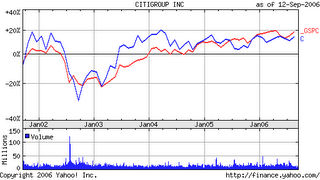 Despite what Krawcheck would like to believe, money is a commodity, and so is credit. If it weren't, we wouldn't have interest rate competition among lenders during periods of healthy growth and credit demand. In fact, her company, Citigroup, is a prime example of how credit and financial services businesses are not well-branded.
Consider the chart on the left, from Yahoo, displaying Citigroup's stock price relative to the S&P500, for the past five years.
Doesn't look much like a branded goods purveyor with healthy growth and good margins, does it? Unless, of course, it only meets market expectations. However, I'd suggest that whatever Citi has been doing, isn't working.
And that probably includes Krawcheck's insistence that the company's basic product, money and forms thereof, is not a commodity. The whole point of money, credit, and tradeable financial products is to be commodities.
Most consumers resent having to pay and ask a bank for access to their own money. Credit is the one product they go begging for. But even there, in this era of oversupply of credit sources, consumers are more judicious, and less desperate, than they had to be in decades past.
No, I don't think financial services has done very well trying to make credit and money a branded, provider-unique product or service.
Contained in the third installment of the series was this passage,
"....Brand matters to bankers, even though many observers see banking as a commodity business.
"It's not like we are selling steel; there is a real customer interaction that occurs, both in the branch, on the Internet, over the phone," said Sallie Krawcheck, the chief financial officer of Citigroup Inc. "When you interact with the customer as often as a bank does on an issue that is as important as money, I don't think it is a commodity at all. There is real brand equity in the client experience of these financial services companies." "
I must say that I beg to differ. While branding may matter to bankers, it has historically rarely mattered to customers. Money may be important, but, then, so is oil or copper.
They are commodities, despite their occasional high prices and short supply. Money is no different.
 Despite what Krawcheck would like to believe, money is a commodity, and so is credit. If it weren't, we wouldn't have interest rate competition among lenders during periods of healthy growth and credit demand. In fact, her company, Citigroup, is a prime example of how credit and financial services businesses are not well-branded.
Consider the chart on the left, from Yahoo, displaying Citigroup's stock price relative to the S&P500, for the past five years.
Doesn't look much like a branded goods purveyor with healthy growth and good margins, does it? Unless, of course, it only meets market expectations. However, I'd suggest that whatever Citi has been doing, isn't working.
And that probably includes Krawcheck's insistence that the company's basic product, money and forms thereof, is not a commodity. The whole point of money, credit, and tradeable financial products is to be commodities.
Most consumers resent having to pay and ask a bank for access to their own money. Credit is the one product they go begging for. But even there, in this era of oversupply of credit sources, consumers are more judicious, and less desperate, than they had to be in decades past.
No, I don't think financial services has done very well trying to make credit and money a branded, provider-unique product or service.
Monday, September 11, 2006
Intel's Restructuring
Intel's long-awaited restructuring was announced last week. Wednesday's Wall Street Journal featured an article detailing the company's plans. The market has been in suspense since this spring, when Intel's CEO, Paul Otellini, admitted the company was thoroughly reviewing all of its operations. I wrote about that in a post here.
My initial observations are largely sustained by the Intel restructuring plan details. They are cutting 10% of their workforce, mostly middle management. The company's senior management actually admits that they have become bloated and slower at decision-making in the middle ranks. This fits with my overall suspicion that Intel has become a victim of "sand in the gears," the term I use for what happens to a company experiencing successful growth for too long. Mediocre employees and bloated processes combine to begin to gradually silt up the company's ability to recognize and quickly react to changing environmental and/or competitive circumstances.
In this case, the combination of AMD's technological challenge to Intel, and the lowering of desktop and laptop PC systems which constitute so much of the end-user demand for the company's signature microprocessors.
Otellini is quoted as saying, "These actions, while difficult, are essential to Intel becoming a more agile and efficient company, not just for this year or the next, but for years to come." Probably true, but, unfortunately, as my old boss and mentor, Gerry Weiss, SVP of Chase Manhattan Bank's Planning and Corporate Development function would, and did say, 'When a company has to "restructure," that generally means it has failed to adapt to changing conditions in a timely manner. It is an indicator of management failure.'
The company is disposing of various smaller new business units connected with communications equipment, as well as focusing on trimming marketing personnel. This is puzzling to me, as I would have thought that product design was the problem, not marketing.
Typically, cutting resources at a company does not foster growth. While Otellini's restructuring program may, in fact, produce near-term profits, it is not at all clear that the results of the program will re-ignite Intel's ability to create superior value-added for its customers at profitable prices. And, thus, consistently superior total returns for its shareholders over the longer term.
My initial observations are largely sustained by the Intel restructuring plan details. They are cutting 10% of their workforce, mostly middle management. The company's senior management actually admits that they have become bloated and slower at decision-making in the middle ranks. This fits with my overall suspicion that Intel has become a victim of "sand in the gears," the term I use for what happens to a company experiencing successful growth for too long. Mediocre employees and bloated processes combine to begin to gradually silt up the company's ability to recognize and quickly react to changing environmental and/or competitive circumstances.
In this case, the combination of AMD's technological challenge to Intel, and the lowering of desktop and laptop PC systems which constitute so much of the end-user demand for the company's signature microprocessors.
Otellini is quoted as saying, "These actions, while difficult, are essential to Intel becoming a more agile and efficient company, not just for this year or the next, but for years to come." Probably true, but, unfortunately, as my old boss and mentor, Gerry Weiss, SVP of Chase Manhattan Bank's Planning and Corporate Development function would, and did say, 'When a company has to "restructure," that generally means it has failed to adapt to changing conditions in a timely manner. It is an indicator of management failure.'
The company is disposing of various smaller new business units connected with communications equipment, as well as focusing on trimming marketing personnel. This is puzzling to me, as I would have thought that product design was the problem, not marketing.
Typically, cutting resources at a company does not foster growth. While Otellini's restructuring program may, in fact, produce near-term profits, it is not at all clear that the results of the program will re-ignite Intel's ability to create superior value-added for its customers at profitable prices. And, thus, consistently superior total returns for its shareholders over the longer term.
Saturday, September 09, 2006
More on Wal-Mart's Store Strategy Changes
As I mentioned in my previous post, Wal-Mart is overhauling its single-store format, in favor of six ethnic-income segmented styles of stores.
At the same time, the head of US store operations, Eduardo Castro-Wright, is relocating regional executives to their regions, from Bentonville. This, by itself, is not such a big deal, one would think.
However, read the comment in the WSJ article from Todd Libbra, responsible for 132 stores in Illinois,
"By reading the newspapers, watching the TV stations and being part of the community, I have a better flavor for what's going on."
In Chicago, perhaps. I happen to be from Illinois- downstate Illinois. He isn't getting a clue as to what is happening outside of the Cook County environs while he's nestled up there near the Windy City.
And, by the way, Todd, ever hear of newspapers online? A little thing you can get via something called the "internet?" I'm sure Todd could have been subscribing to numerous Illinois city and town newspapers via the internet, or his staff could have covered this base. Is this manager a good example of the caliber of executive at, and general awareness level of the world outside, Wal-Mart? exec and getting the tribune
Regarding the ethnic basis of segmentation, lots of companies cater to ethnic tastes, but none that I know of trumpet this as a segmentation lever. What are these guys thinking? Didn't they have even racial trouble last year and this already?
Perhaps the largely white senior executives in Bentonville, starting with CEO Lee Scott, think that by having a Mexican chief of US stores they will deflect further charges of racism. Instead, I wonder if they risk having a truly primitive segmentation strategy, imported from a less-sophisticated consumer society ,Mexico, derail their firm.
And what about the 'other' ethnic groups? Is this an opportunity for Target to welcome them with open arms?
My guess is that a really good segmentation strategy focused on differentiating store types would have resulted in something like three types of stores: rural, ex-urban middle class, and ex-urban on the fringes of upper class locales. Assortments of goods could easily be changed more granularly than merely with store type.
As it is, I wonder if Wal-Mart's historically in-bred management isn't totally fumbling its new segmentation and store-type strategy. They have been successful and well-regarded for doing one thing well throughout America and much of the world- leveraging tremendous purchasing power to offer large assortments of goods to mostly, though not exclusively, lower-income individuals, at very low prices. And, apparently, they have had some success attracting upper-income individuals to the stores to buy basic, low-priced goods for which the source of the product is unimportant.
I just don't see their new move into this complicated, multi-store approach taking full advantage of Wal-Mart's historic strength in low-cost sourcing of supply, while it seems to put them squarely opposite some more savvy retailing competitors in what is, for Wal-Mart, an entirely new product/market space.
At the same time, the head of US store operations, Eduardo Castro-Wright, is relocating regional executives to their regions, from Bentonville. This, by itself, is not such a big deal, one would think.
However, read the comment in the WSJ article from Todd Libbra, responsible for 132 stores in Illinois,
"By reading the newspapers, watching the TV stations and being part of the community, I have a better flavor for what's going on."
In Chicago, perhaps. I happen to be from Illinois- downstate Illinois. He isn't getting a clue as to what is happening outside of the Cook County environs while he's nestled up there near the Windy City.
And, by the way, Todd, ever hear of newspapers online? A little thing you can get via something called the "internet?" I'm sure Todd could have been subscribing to numerous Illinois city and town newspapers via the internet, or his staff could have covered this base. Is this manager a good example of the caliber of executive at, and general awareness level of the world outside, Wal-Mart? exec and getting the tribune
Regarding the ethnic basis of segmentation, lots of companies cater to ethnic tastes, but none that I know of trumpet this as a segmentation lever. What are these guys thinking? Didn't they have even racial trouble last year and this already?
Perhaps the largely white senior executives in Bentonville, starting with CEO Lee Scott, think that by having a Mexican chief of US stores they will deflect further charges of racism. Instead, I wonder if they risk having a truly primitive segmentation strategy, imported from a less-sophisticated consumer society ,Mexico, derail their firm.
And what about the 'other' ethnic groups? Is this an opportunity for Target to welcome them with open arms?
My guess is that a really good segmentation strategy focused on differentiating store types would have resulted in something like three types of stores: rural, ex-urban middle class, and ex-urban on the fringes of upper class locales. Assortments of goods could easily be changed more granularly than merely with store type.
As it is, I wonder if Wal-Mart's historically in-bred management isn't totally fumbling its new segmentation and store-type strategy. They have been successful and well-regarded for doing one thing well throughout America and much of the world- leveraging tremendous purchasing power to offer large assortments of goods to mostly, though not exclusively, lower-income individuals, at very low prices. And, apparently, they have had some success attracting upper-income individuals to the stores to buy basic, low-priced goods for which the source of the product is unimportant.
I just don't see their new move into this complicated, multi-store approach taking full advantage of Wal-Mart's historic strength in low-cost sourcing of supply, while it seems to put them squarely opposite some more savvy retailing competitors in what is, for Wal-Mart, an entirely new product/market space.
Friday, September 08, 2006
Wal-Mart's New Store-Segmentation Strategy
I think Wal-Mart's recently unveiled strategy of breaking with its standard store format, and moving to one of six types of stores, reflecting buyer types, will fail.
Based upon the information contained in the Wall Street Journal article yesterday, I don't see how Wal-Mart can maintain the value and/or meaning of its brand as it purposely fractures that brand's image in to six different pieces this year.
 There are now several aspects to the Wal-Mart dilemma. To begin with, for the past five years, the company's stock price has underperformed the S&P500, which rose modestly, as shown in the chart on the left, with a stock price decline. For comparison, Target, a competitor, saw its stock price rise 50% during the same period.
 Looking more closely at the last two years, though, as the table on the left shows, Wal-Mart's Net Income After Tax growth underperformed Target's, meaning the former has suffered margin pressure or SG&A costs increases that it can't recover through its low prices.
According to the Journal article, Target's same-store sales are now outpacing Wal-Mart's, 6% vs. 3%.
If you think back to mid-2005, the general business media sentiment was that Wal-Mart was in trouble for two reasons. On the one hand, high gasoline prices were thought to be crimping the discretionary purchasing power of the average Wal-Mart customer, who is generally typified as among the lower income groups. On the other hand, when the pundits admitted that there has been a consistently healthy, growing US economy for the past three years or so, they worried that Wal-Mart's customers were moving upmarket to.....Target.
And so it seems they were. In fact, it appears as if both assessments were true.
Around that time, in mid-late 2005, Lee Scott, the CEO of Wal-Mart, heralded the company's commitment to move upmarket, too. There was a presence established on New York City's upper 5th Avenue, in order to tap into America's upscale fashion pulse.
At the time, I wrote this post to go on record opining that it would not work. Nothing in the WSJ piece has changed my mind. If anything, it's made me even more convinced that Wal-Mart is about to commit a marketing disaster of Edsel proportions.
Here's why I think this.
First, the architect of the strategy is Eduardo Castro-Wright, the former chief of Wal-Mart stores in Mexico. He did something similar there, stratifying store types based solely on incomes. Sales rose.
Now, Mr. Castro Wright is attempting to apply consumer marketing from Mexico to the more complex US market. Interesting approach. The article states that Wal-Mart has hired various PhDs in ethnicity and food disciplines. And some types of 'research,' though precisely what type is not mentioned.
I don't think transferring a simple, one-dimensional segmentation scheme, based upon income, from the Mexican market to the much more diverse and sophisticated US market, will work. Adding the simplistic dimension of race.....er...ethnicity, won't do much better. The Journal piece lists the ethnic store variants as including those targeted at Black and Hispanic populations.
Most modern market segmentation work involves oceans of data, immense amounts of sophisticated multivariate analysis and modeling, usually done by a well-respected professor from a reputable Graduate School of Business somewhere in the US, and results in a few, less clear-cut segmentation dimensions. This is what factor analysis does- it loads many relevant segmentation bases onto a few operationally-addressable ones. But never have I seen a segmentation strategy expressed in dimensions so crude and tired as, solely, race and income.
Nevermind that Wal-Mart has enough problems with its images among certain ethnic groups already. And, am I the only person who finds it too ironic that Wal-Mart unveils a racially-oriented segmentation strategy only weeks after their now-departed ethnic ambassador, Andrew Young, embarrassed himself and the company with his on-air ethnic slurs against Koreans and Indians?
My second reason for believing Wal-Mart's new strategy will fail is that it undercuts the company's main competitive weapon, which is low cost supply. With product assortments being tailored by segment, volumes will necessarily fall, and costs, predictably, rise. The WSJ piece refers to a Bain & Co., study concluding just that. So Wal-Mart is departing from its historic strength, in quest of higher sales, while margins have already been under pressure lately.
My third reason for predicting the failure of the new store strategy is that it flies in the face of brand theory. The penultimate reason for the establishment of a brand franchise is to communicate one or two key values as identified with the brand. For Wal-Mart, it has been "every day low prices." Now, it's six different messages. Which means much of the historically-built brand value will be blurred and cease to exist. This would seem to fly in the face of most modern brand management theory.
Another related reason which I believe will lead to the multi-store concept's demise is basic consumer behavior regarding luxury and upscale goods, and "the wheel of retailing." I mentioned this latter concept in my previously linked post from last fall. The concept suggests that there is always a lowest-priced retailer, and others gradually try to move upmarket.
However, as I noted in that prior post, it's rarely, if every, been done successfully. In soft goods, both Sears and K-Mart failed with celebrity designers Cheryl Tiegs, Jaclyn Smith, and Martha Stewart. American consumers don't tend to buy luxury goods on price, or to frequent low-end stores for luxury items. Upscale consumers may, and do, head to Sam's Clubs and Costco for low prices on basic staples. But I doubt many real wine connoisseurs will be rushing to Wal-Mart for their $500 bottles of wine. Last I saw, the big move there is into online, out-of-state purchasing of wine at significant discounts.
I could go on in this vein. And I may in a later post. But for now, let me stop and suggest the following. This is one case in which I'd expect, and approve of, a company like Wal-Mart, with its in-bred, home-grown management, to hire outside market research consultants, social trend seers, and maybe even a team from Bain & Co., or McKinsey & Co., to provide some objective, experienced perspectives on the very important question of if, and how, to become a segment-oriented retailer.
Instead, I seriously believe that all Wal-Mart did was promote its most successful country manager to revamp US operations just like he did in Mexico. And being home-grown and in-bred, the senior executives in Bentonville see nothing wrong in rejiggering their marketing approaches without any outside help.
They seem to be clueless as to just how far they are departing from the formula that made them so successful. It may not be an engine of consistently superior total returns, but it is at least fulfilling its mission of dominating the low-priced retail niche.
Moving out of that niche, willy-nilly, with a crudely-designed, racially-oriented market segmentation strategy, to compete with much more nuanced marketers such as Les Wexner's Limited Brands lines, and others, seems to me like a recipe for disaster.
Nothing about this strategy makes sense to me. Not the segmentation, nor the cost implications, or the consumer behavior assumptions.
Time will tell if I am right.
Based upon the information contained in the Wall Street Journal article yesterday, I don't see how Wal-Mart can maintain the value and/or meaning of its brand as it purposely fractures that brand's image in to six different pieces this year.
 There are now several aspects to the Wal-Mart dilemma. To begin with, for the past five years, the company's stock price has underperformed the S&P500, which rose modestly, as shown in the chart on the left, with a stock price decline. For comparison, Target, a competitor, saw its stock price rise 50% during the same period.
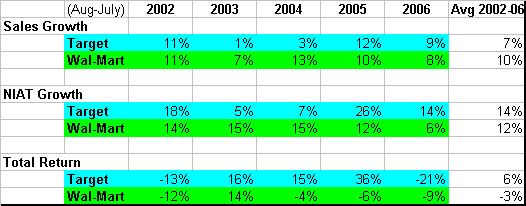 Looking more closely at the last two years, though, as the table on the left shows, Wal-Mart's Net Income After Tax growth underperformed Target's, meaning the former has suffered margin pressure or SG&A costs increases that it can't recover through its low prices.
According to the Journal article, Target's same-store sales are now outpacing Wal-Mart's, 6% vs. 3%.
If you think back to mid-2005, the general business media sentiment was that Wal-Mart was in trouble for two reasons. On the one hand, high gasoline prices were thought to be crimping the discretionary purchasing power of the average Wal-Mart customer, who is generally typified as among the lower income groups. On the other hand, when the pundits admitted that there has been a consistently healthy, growing US economy for the past three years or so, they worried that Wal-Mart's customers were moving upmarket to.....Target.
And so it seems they were. In fact, it appears as if both assessments were true.
Around that time, in mid-late 2005, Lee Scott, the CEO of Wal-Mart, heralded the company's commitment to move upmarket, too. There was a presence established on New York City's upper 5th Avenue, in order to tap into America's upscale fashion pulse.
At the time, I wrote this post to go on record opining that it would not work. Nothing in the WSJ piece has changed my mind. If anything, it's made me even more convinced that Wal-Mart is about to commit a marketing disaster of Edsel proportions.
Here's why I think this.
First, the architect of the strategy is Eduardo Castro-Wright, the former chief of Wal-Mart stores in Mexico. He did something similar there, stratifying store types based solely on incomes. Sales rose.
Now, Mr. Castro Wright is attempting to apply consumer marketing from Mexico to the more complex US market. Interesting approach. The article states that Wal-Mart has hired various PhDs in ethnicity and food disciplines. And some types of 'research,' though precisely what type is not mentioned.
I don't think transferring a simple, one-dimensional segmentation scheme, based upon income, from the Mexican market to the much more diverse and sophisticated US market, will work. Adding the simplistic dimension of race.....er...ethnicity, won't do much better. The Journal piece lists the ethnic store variants as including those targeted at Black and Hispanic populations.
Most modern market segmentation work involves oceans of data, immense amounts of sophisticated multivariate analysis and modeling, usually done by a well-respected professor from a reputable Graduate School of Business somewhere in the US, and results in a few, less clear-cut segmentation dimensions. This is what factor analysis does- it loads many relevant segmentation bases onto a few operationally-addressable ones. But never have I seen a segmentation strategy expressed in dimensions so crude and tired as, solely, race and income.
Nevermind that Wal-Mart has enough problems with its images among certain ethnic groups already. And, am I the only person who finds it too ironic that Wal-Mart unveils a racially-oriented segmentation strategy only weeks after their now-departed ethnic ambassador, Andrew Young, embarrassed himself and the company with his on-air ethnic slurs against Koreans and Indians?
My second reason for believing Wal-Mart's new strategy will fail is that it undercuts the company's main competitive weapon, which is low cost supply. With product assortments being tailored by segment, volumes will necessarily fall, and costs, predictably, rise. The WSJ piece refers to a Bain & Co., study concluding just that. So Wal-Mart is departing from its historic strength, in quest of higher sales, while margins have already been under pressure lately.
My third reason for predicting the failure of the new store strategy is that it flies in the face of brand theory. The penultimate reason for the establishment of a brand franchise is to communicate one or two key values as identified with the brand. For Wal-Mart, it has been "every day low prices." Now, it's six different messages. Which means much of the historically-built brand value will be blurred and cease to exist. This would seem to fly in the face of most modern brand management theory.
Another related reason which I believe will lead to the multi-store concept's demise is basic consumer behavior regarding luxury and upscale goods, and "the wheel of retailing." I mentioned this latter concept in my previously linked post from last fall. The concept suggests that there is always a lowest-priced retailer, and others gradually try to move upmarket.
However, as I noted in that prior post, it's rarely, if every, been done successfully. In soft goods, both Sears and K-Mart failed with celebrity designers Cheryl Tiegs, Jaclyn Smith, and Martha Stewart. American consumers don't tend to buy luxury goods on price, or to frequent low-end stores for luxury items. Upscale consumers may, and do, head to Sam's Clubs and Costco for low prices on basic staples. But I doubt many real wine connoisseurs will be rushing to Wal-Mart for their $500 bottles of wine. Last I saw, the big move there is into online, out-of-state purchasing of wine at significant discounts.
I could go on in this vein. And I may in a later post. But for now, let me stop and suggest the following. This is one case in which I'd expect, and approve of, a company like Wal-Mart, with its in-bred, home-grown management, to hire outside market research consultants, social trend seers, and maybe even a team from Bain & Co., or McKinsey & Co., to provide some objective, experienced perspectives on the very important question of if, and how, to become a segment-oriented retailer.
Instead, I seriously believe that all Wal-Mart did was promote its most successful country manager to revamp US operations just like he did in Mexico. And being home-grown and in-bred, the senior executives in Bentonville see nothing wrong in rejiggering their marketing approaches without any outside help.
They seem to be clueless as to just how far they are departing from the formula that made them so successful. It may not be an engine of consistently superior total returns, but it is at least fulfilling its mission of dominating the low-priced retail niche.
Moving out of that niche, willy-nilly, with a crudely-designed, racially-oriented market segmentation strategy, to compete with much more nuanced marketers such as Les Wexner's Limited Brands lines, and others, seems to me like a recipe for disaster.
Nothing about this strategy makes sense to me. Not the segmentation, nor the cost implications, or the consumer behavior assumptions.
Time will tell if I am right.
Thursday, September 07, 2006
More on Viacom: Freston and Redstone
So much has happened in the business world that a few items almost slip into the cracks. Between Ford's new CEO, Intel's restructuring, and Chevron's new oil find, not to mention HP's board leak fracas, I almost forgot about Viacom's CEO, Tom Freston being fired, or retired, depending on technicalities, by his boss, Sumner Redstone.
 In terms of total return performance, it would appear that Freston was giving the lie to Redstone's reason for the recent breakup of CBS and Viacom. As the Yahoo-sourced chart on the left illustrates, Viacom has plunged straight downward since its reincarnation in late 2005. It now has a -20% return, relative to the S&P500's single-digit positive gain, for the period.
Of course, with only a year's worth of separate performance, it's hard to tell if Freston really was failing at his task, or if Redstone was simply following up on reactions to his Tom Cruise dismissal, clearing out anyone who objected to his unilateral move over Freston's head.
From the details of yesterday's Wall Street Journal article, it's not clear what to expect of Viacom going forward. The two cronies that Redstone has re-installed at Viacom, CEO Phillipe Dauman and COO-like Tom Dooley, have a track record of tripling Vicacom's stock price when they last worked with him at the firm. Put that way, it's not clear Freston ever really had a chance. So I wasn't surprised to read that he had been reluctant to take the Viacom CEO job in the first place last year.
Reading further, it sounds unconvincing that Dauman is going to simply "foster innovation within the company," and stress aggressiveness with its "multiplatform" strategy. Couldn't Freston have done that? Wasn't he doing that? My sense has been that Viacom is simply another network whose assets have recently been rendered less valuable by the simple, inexpensive outflanking maneuvers of MySpace and YouTube.
Welcome to the truly "innovative" world, Mr. Dauman. Unlike the more formalized, corporate nature of old media, the new online media world seems to move much more quickly and decisively.
In the final analysis, I'm wondering now whether 82 year-old Sumner Redstone is the new Jack Welch. The cult celebrity Chairman for the decade. He is suddenly all over the papers, and even on a very flattering cable channel semi-bio a few days ago, hosted/narrated by director Brian Grazer, who has worked with Viacom and for Redstone before.
But, like Welch, he's now worried about his legacy. And this past year has apparently, at least in Redstone's mind, seriously jeopardized his image as the media mogul with the Midas touch.
 In terms of total return performance, it would appear that Freston was giving the lie to Redstone's reason for the recent breakup of CBS and Viacom. As the Yahoo-sourced chart on the left illustrates, Viacom has plunged straight downward since its reincarnation in late 2005. It now has a -20% return, relative to the S&P500's single-digit positive gain, for the period.
Of course, with only a year's worth of separate performance, it's hard to tell if Freston really was failing at his task, or if Redstone was simply following up on reactions to his Tom Cruise dismissal, clearing out anyone who objected to his unilateral move over Freston's head.
From the details of yesterday's Wall Street Journal article, it's not clear what to expect of Viacom going forward. The two cronies that Redstone has re-installed at Viacom, CEO Phillipe Dauman and COO-like Tom Dooley, have a track record of tripling Vicacom's stock price when they last worked with him at the firm. Put that way, it's not clear Freston ever really had a chance. So I wasn't surprised to read that he had been reluctant to take the Viacom CEO job in the first place last year.
Reading further, it sounds unconvincing that Dauman is going to simply "foster innovation within the company," and stress aggressiveness with its "multiplatform" strategy. Couldn't Freston have done that? Wasn't he doing that? My sense has been that Viacom is simply another network whose assets have recently been rendered less valuable by the simple, inexpensive outflanking maneuvers of MySpace and YouTube.
Welcome to the truly "innovative" world, Mr. Dauman. Unlike the more formalized, corporate nature of old media, the new online media world seems to move much more quickly and decisively.
In the final analysis, I'm wondering now whether 82 year-old Sumner Redstone is the new Jack Welch. The cult celebrity Chairman for the decade. He is suddenly all over the papers, and even on a very flattering cable channel semi-bio a few days ago, hosted/narrated by director Brian Grazer, who has worked with Viacom and for Redstone before.
But, like Welch, he's now worried about his legacy. And this past year has apparently, at least in Redstone's mind, seriously jeopardized his image as the media mogul with the Midas touch.
Wednesday, September 06, 2006
Ford's New CEO: Pros and Cons
Yesterday, Ford announced that its Chairman and CEO, Bill Ford, is relinquishing his CEO title to Alan Mulally, late of Boeing.
It looks like my prediction of last October has now partially come true. I thought that one of the companies would be gone within 5 years. Instead, one of the CEOs among Detroit's auto producers is gone. Oddly, in this case, by his own hand. So, technically, while there is not "one less CEO in Detroit," one of the sitting CEOs is gone.
From what I've read about Mulally, he is quite likely a good choice for Ford. Whether even he can save the company is anybody's guess. However, as noted in my post in June on Boeing v. Airbus, here, Boeing's commercial aircraft division, with the 787 Dreamliner, executed fundamentals and out-designed Airbus. Mulally gets the credit for that.
It's easy to see why Ford wants Mulally. He successfully turned Boeing's commercial division around. Bill Ford badly needs to save his family's company, and he's not too proud to fire himself and hire the best senior exec he can find to do it. Mulally led a decidedly marketing-oriented resurgence at Boeing, and Ford is no doubt hoping there is enough time left for a similar magic act at the auto maker.
It's not too hard to see why Mulally will jump to Ford, either. He did the heavy lifting at Boeing, only to have McNerney flee 3M and replace Harry Stonecipher as CEO. Talk about ingratitude. Whether Mulally can succeed at Ford is almost immaterial. Like Lou Gerstner at IBM, or Art Ryan at Prudential, he'll get credit if he turns it around, but the company's bad shape will be blamed if he doesn't. And he'll doubtless still be handsomely rewarded. Most importantly, though, is that he is now a "CEO." And regardless of Ford's outcome, he's in the major leagues now.
It's a very interesting end to a musical chairs game that began with Jack Welch's retirement 5 years ago. As the linked post about McNerney, contained in the prior post about Boeing and Airbus, notes, McNerney hadn't really done anything to write home about while leading 3M. Now, at Boeing, the guy who rescued it prior to his arrival is gone.
So, Alan Mullaly gets to be CEO of something, if not a healthy company. Jim McNerney has to show he can stay in one place and actually create superior shareholder value. And Rick Wagoner can breathe a sigh of relief that he isn't the first automotive CEO to get canned this year. He was noticeably smug about the Mullaly news on an interview with CNBC today. Wagoner's probably just happy everyone's focusing on the other ailing Detroit-based auto company for a while.
In the final analysis, Mulally is probably as good a choice to lead Ford as anyone else, and better than most. Despite many pundits crying for a "car guy" at Ford now, Mulally has actually succeeded at producing a customer-focused new product, the Dreamliner, and then beating the hell out of his competitor, Airbus, with it. And he wants to lessen Ford's dependence on trucks and SUVs, returning to designing and building compelling cars.
I'm not at all sure Mullaly has the time and resources to pull it off, but I will enjoy seeing if he can. And I'll enjoy seeing how much more consolidation, CEO change, etc., continues to occur in the auto industry in the months ahead.
It looks like my prediction of last October has now partially come true. I thought that one of the companies would be gone within 5 years. Instead, one of the CEOs among Detroit's auto producers is gone. Oddly, in this case, by his own hand. So, technically, while there is not "one less CEO in Detroit," one of the sitting CEOs is gone.
From what I've read about Mulally, he is quite likely a good choice for Ford. Whether even he can save the company is anybody's guess. However, as noted in my post in June on Boeing v. Airbus, here, Boeing's commercial aircraft division, with the 787 Dreamliner, executed fundamentals and out-designed Airbus. Mulally gets the credit for that.
It's easy to see why Ford wants Mulally. He successfully turned Boeing's commercial division around. Bill Ford badly needs to save his family's company, and he's not too proud to fire himself and hire the best senior exec he can find to do it. Mulally led a decidedly marketing-oriented resurgence at Boeing, and Ford is no doubt hoping there is enough time left for a similar magic act at the auto maker.
It's not too hard to see why Mulally will jump to Ford, either. He did the heavy lifting at Boeing, only to have McNerney flee 3M and replace Harry Stonecipher as CEO. Talk about ingratitude. Whether Mulally can succeed at Ford is almost immaterial. Like Lou Gerstner at IBM, or Art Ryan at Prudential, he'll get credit if he turns it around, but the company's bad shape will be blamed if he doesn't. And he'll doubtless still be handsomely rewarded. Most importantly, though, is that he is now a "CEO." And regardless of Ford's outcome, he's in the major leagues now.
It's a very interesting end to a musical chairs game that began with Jack Welch's retirement 5 years ago. As the linked post about McNerney, contained in the prior post about Boeing and Airbus, notes, McNerney hadn't really done anything to write home about while leading 3M. Now, at Boeing, the guy who rescued it prior to his arrival is gone.
So, Alan Mullaly gets to be CEO of something, if not a healthy company. Jim McNerney has to show he can stay in one place and actually create superior shareholder value. And Rick Wagoner can breathe a sigh of relief that he isn't the first automotive CEO to get canned this year. He was noticeably smug about the Mullaly news on an interview with CNBC today. Wagoner's probably just happy everyone's focusing on the other ailing Detroit-based auto company for a while.
In the final analysis, Mulally is probably as good a choice to lead Ford as anyone else, and better than most. Despite many pundits crying for a "car guy" at Ford now, Mulally has actually succeeded at producing a customer-focused new product, the Dreamliner, and then beating the hell out of his competitor, Airbus, with it. And he wants to lessen Ford's dependence on trucks and SUVs, returning to designing and building compelling cars.
I'm not at all sure Mullaly has the time and resources to pull it off, but I will enjoy seeing if he can. And I'll enjoy seeing how much more consolidation, CEO change, etc., continues to occur in the auto industry in the months ahead.
Hollywood Struggles: Tom Cruise Is Just The Tip of The Iceberg
Last week's dismissal of Tom Cruise from Viacom's stable of stars by Sumner Redstone turned heads in Hollywood, by all accounts. Once again, we were treated to a display of the glaring differences between how the financial and entertainment communities view the classic Hollywood business style of spending anything to retain and satisfy the "talent."
Saturday's Wall Street Journal carried a timely piece discussing the entertainment industry's woes regarding DVD sales. It seems they are finally cresting, and no replacement vehicle is in sight. The article quoted numerous film execs as focusing on and cutting costs, as well as being more selective in their choice of properties to develop. The role of outside investment partnerships, including hedge funds, was even blamed for bringing too much capital into the sector, causing movies to be made which were best left as only screenplays.
What really shocked me, though, was the realization that Disney studios had, only just last fall, analyzed the contribution of their non-children-oriented films to the studio's profitability, and found them unsustainable.
Which brings me to the title of this post. With this backdrop, does Sumner Redstone really seem so off his rocker? The WSJ piece alleges that Viacom barely broke even on "Mission Impossible III," while Cruise earned a reputed $80 million.
Given Wall Street's harder-nosed approach to business than Hollywood's, is it really likely that a hedge fund is going to pick up funding for Tom Cruise's ventures at the same price that Viacom did? After the allure of Tom visiting a few trading floors, I think reality will sink in.
Remember Kevin Costner's fame some years ago? He began making his own movies, irrespective of the advice of others, critics, or even box office sales. Last time I saw him, he was co-starring with the venerable Robert Duval on a cable channel western movie special. So much for lasting fame and fortune in Hollywood.
Meanwhile, back to the film companies. The other interesting development is how companies as diverse as Apple and Wal-Mart are squaring off over the prices they will pay for online distribution of video content from the studios. Everyone can see the potentials among various distribution channels, and nobody wants to be left out. Wal-Mart, with its 40% of DVD sales, has enormous clout right now. And they appear to be using it.
As I have said before about the digitalization of media, whichever ways things develop, it looks like the consumer is going to make out very well, with great product available at competitively-tested, affordable prices.
Saturday's Wall Street Journal carried a timely piece discussing the entertainment industry's woes regarding DVD sales. It seems they are finally cresting, and no replacement vehicle is in sight. The article quoted numerous film execs as focusing on and cutting costs, as well as being more selective in their choice of properties to develop. The role of outside investment partnerships, including hedge funds, was even blamed for bringing too much capital into the sector, causing movies to be made which were best left as only screenplays.
What really shocked me, though, was the realization that Disney studios had, only just last fall, analyzed the contribution of their non-children-oriented films to the studio's profitability, and found them unsustainable.
Which brings me to the title of this post. With this backdrop, does Sumner Redstone really seem so off his rocker? The WSJ piece alleges that Viacom barely broke even on "Mission Impossible III," while Cruise earned a reputed $80 million.
Given Wall Street's harder-nosed approach to business than Hollywood's, is it really likely that a hedge fund is going to pick up funding for Tom Cruise's ventures at the same price that Viacom did? After the allure of Tom visiting a few trading floors, I think reality will sink in.
Remember Kevin Costner's fame some years ago? He began making his own movies, irrespective of the advice of others, critics, or even box office sales. Last time I saw him, he was co-starring with the venerable Robert Duval on a cable channel western movie special. So much for lasting fame and fortune in Hollywood.
Meanwhile, back to the film companies. The other interesting development is how companies as diverse as Apple and Wal-Mart are squaring off over the prices they will pay for online distribution of video content from the studios. Everyone can see the potentials among various distribution channels, and nobody wants to be left out. Wal-Mart, with its 40% of DVD sales, has enormous clout right now. And they appear to be using it.
As I have said before about the digitalization of media, whichever ways things develop, it looks like the consumer is going to make out very well, with great product available at competitively-tested, affordable prices.
Tuesday, September 05, 2006
Ron Gettelfinger's Flawed Logic On Pensions
Friday's Wall Street Journal contained an editorial by Ron Gettelfinger, current president of the UAW.
Gettelfinger's topic is, of course, the funding of labor union worker pensions in the modern world. He begins by describing the 1950 negotiations between GM and the UAW. In Gettelfinger's world, there are only two possible positions- those of GM's Charles Wilson and the UAW's Walter Reuther. The former wanted company-based benefits, while the latter, not surprisingly, favored "universal" benefits for all workers, meaning, one supposes, a sort of societally- or governmentally-funded approach.
Actually, it turns out that both were probably wrong.
However, back to Gettelfinger. He draws exclusively on one Malcolm Gladwell, a writer who authored a piece entitled "The Risk Pool," in the August 28th issue of the New Yorker. According to Gladwell, European social policy, in which there is universal, state-run pension management and liability, is preferred to the US private system. He further alleges that "....individual companies (are) responsible for the care of their retirees. It is this fact, as much as any other, that explains the current crisis."
Near the end of the article, Gettelfinger argues, based upon Gladwell and his sources, that US companies carry a 15% cost disadvantage because of the lack of a universal pension system. Then, in his logical climax, he opines that the only way American pensions can ever be "safe" is to have a publicly-funded universal program.
The trouble with Gettelfinger's position begins at the very beginning. He puts up private pension schemes as the only straw man alternative to a public pension system.
In one of my first posts on this blog, here, written on September 15, 2005, I argued that the real problem is that anyone ever took anyone else's IOUs, instead of cash on the barrel head in the then-present day.
Simply put, anytime any worker accepts promises of future contributions, in lieu of cash, whether accruing in a personal account or general fund, that worker is assuming counterparty funding risks that no banker would ever take for free. Or on anything like the totally unsecured terms involved in an employment agreement.
Gettelfinger is wrong. The best alternative for any worker is for him, or his union, to demand cash payments, whether as current compensation or contribution to his retirement account, from the funding entity. That way, the funder has to solvently provide the payment, and cannot promise future contributions or payments which it may never actually possess.
Both universal and private pension schemes suffer from the human tendency to promise more than one may be able to certainly deliver. And, in the case of pensions, there is no realistic alternative remedy for the funding entity's breach of contract.
No worker should have to bear the risk of funding promised retirement compensation. He might risk the investment performance of those funds, but that is not the liability of the funding organization. If employers, or the government, had to pay cash, rather than than promises, into retirement accounts, then the "risk pool" concept would evaporate.
Problem solved. Without complete universal, publicly-provided pensions.
Gettelfinger's topic is, of course, the funding of labor union worker pensions in the modern world. He begins by describing the 1950 negotiations between GM and the UAW. In Gettelfinger's world, there are only two possible positions- those of GM's Charles Wilson and the UAW's Walter Reuther. The former wanted company-based benefits, while the latter, not surprisingly, favored "universal" benefits for all workers, meaning, one supposes, a sort of societally- or governmentally-funded approach.
Actually, it turns out that both were probably wrong.
However, back to Gettelfinger. He draws exclusively on one Malcolm Gladwell, a writer who authored a piece entitled "The Risk Pool," in the August 28th issue of the New Yorker. According to Gladwell, European social policy, in which there is universal, state-run pension management and liability, is preferred to the US private system. He further alleges that "....individual companies (are) responsible for the care of their retirees. It is this fact, as much as any other, that explains the current crisis."
Near the end of the article, Gettelfinger argues, based upon Gladwell and his sources, that US companies carry a 15% cost disadvantage because of the lack of a universal pension system. Then, in his logical climax, he opines that the only way American pensions can ever be "safe" is to have a publicly-funded universal program.
The trouble with Gettelfinger's position begins at the very beginning. He puts up private pension schemes as the only straw man alternative to a public pension system.
In one of my first posts on this blog, here, written on September 15, 2005, I argued that the real problem is that anyone ever took anyone else's IOUs, instead of cash on the barrel head in the then-present day.
Simply put, anytime any worker accepts promises of future contributions, in lieu of cash, whether accruing in a personal account or general fund, that worker is assuming counterparty funding risks that no banker would ever take for free. Or on anything like the totally unsecured terms involved in an employment agreement.
Gettelfinger is wrong. The best alternative for any worker is for him, or his union, to demand cash payments, whether as current compensation or contribution to his retirement account, from the funding entity. That way, the funder has to solvently provide the payment, and cannot promise future contributions or payments which it may never actually possess.
Both universal and private pension schemes suffer from the human tendency to promise more than one may be able to certainly deliver. And, in the case of pensions, there is no realistic alternative remedy for the funding entity's breach of contract.
No worker should have to bear the risk of funding promised retirement compensation. He might risk the investment performance of those funds, but that is not the liability of the funding organization. If employers, or the government, had to pay cash, rather than than promises, into retirement accounts, then the "risk pool" concept would evaporate.
Problem solved. Without complete universal, publicly-provided pensions.
Monday, September 04, 2006
Laptop Shopping: Dell's Miscalculation
Saturday saw the East Coast of the US hit with the monsoon-like fallout from hurricane Ernesto. With outdoor activities out of the question, my daughters and I, as many other denizens of the area did, went shopping.
As it happens, I had promised them upgraded personal computer facilities this year. This decision necessitated a long-delayed commitment to a wireless network, so that gear was also on the shopping list. With fall "back to school" sales in full flower, we set off on a rainy, overcast afternoon to buy electronics gear.
At our first stop, Costco, my daughters found several laptops their liking. Upon discussing the array of models displayed with the helpful Costco assistant, I rapidly came to realize that there was a fairly uniform set of features and capabilities available within a $200 price range. Being the first store at which we looked, we held off a purchase decision for later.
The next stop was Staples. I went there for networking gear. As I made sure that the components I selected were appropriate for the intended network setup, my daughters busied themselves with trying out the various laptops on display among the shelves in the back of the store. There must have been at least 20 different models on offer. Soon, they called out to me that they found one which they would like me to buy.
Amazingly, they had chosen a very good machine at a great price. I say "amazingly," not because my daughters chose it, but because we were at Staples. This was about the last place I expected to purchase a computer.
However, they found an HP Pavilion notebook on sale, for about $900. It had the typical 1GB of RAM, 100GB HD, wireless capability, XP operating system, DVD burner/reader, that most machines in the price range possess. Plus an in-lid camera and various additional software titles.
As I wrote in my prior post, here, Dell has seriously miscalculated how consumers buy PCs nowadays. I am a good example. Never before have I purchased a PC in person, at a retail store. Four Gateways and one Dell were bought over the phone, after customization.
Now, however, the typical off-the-shelf notebooks contain nearly-identical features and components, at very similar prices. Thanks to the evolution of various manufacturers' distribution policies, many retailers carry a wide variety of brands: HP, Toshiba, Gateway, Lenovo, and Acer, to name just a few. With this sort of product choice at similar prices, it doesn't take a genius to realize that spending more for marginal customization, while waiting a week for the product, is hard to justify.
Really, about the only option left nowadays is your choice of how much RAM to buy. Otherwise, notebooks in the $1,000 price range are all very similar.
The conclusion which I draw from all of this is that Dell has seriously missed the boat in terms of its understanding of the consumer segment's buying behavior evolution. This notebook, on which I'm writing this post, is intended to provide my daughters with their own computing platform, as well as wireless internet access. As a second (or, in my case, more) computer purchase, sufficient information and product choices are available at retail to obviate the need to custom design a solution.
Dell did very well in the 1990s with their custom-design, fast delivery business model. Now, however, with Saturday's experience fresh in my mind, I see how and why they are outdated in their distribution methods.
One can't denigrate their prior success. But I don't really think they possess any unique competitive advantages anymore to drive further consistently superior total return performance in the years to come.
As it happens, I had promised them upgraded personal computer facilities this year. This decision necessitated a long-delayed commitment to a wireless network, so that gear was also on the shopping list. With fall "back to school" sales in full flower, we set off on a rainy, overcast afternoon to buy electronics gear.
At our first stop, Costco, my daughters found several laptops their liking. Upon discussing the array of models displayed with the helpful Costco assistant, I rapidly came to realize that there was a fairly uniform set of features and capabilities available within a $200 price range. Being the first store at which we looked, we held off a purchase decision for later.
The next stop was Staples. I went there for networking gear. As I made sure that the components I selected were appropriate for the intended network setup, my daughters busied themselves with trying out the various laptops on display among the shelves in the back of the store. There must have been at least 20 different models on offer. Soon, they called out to me that they found one which they would like me to buy.
Amazingly, they had chosen a very good machine at a great price. I say "amazingly," not because my daughters chose it, but because we were at Staples. This was about the last place I expected to purchase a computer.
However, they found an HP Pavilion notebook on sale, for about $900. It had the typical 1GB of RAM, 100GB HD, wireless capability, XP operating system, DVD burner/reader, that most machines in the price range possess. Plus an in-lid camera and various additional software titles.
As I wrote in my prior post, here, Dell has seriously miscalculated how consumers buy PCs nowadays. I am a good example. Never before have I purchased a PC in person, at a retail store. Four Gateways and one Dell were bought over the phone, after customization.
Now, however, the typical off-the-shelf notebooks contain nearly-identical features and components, at very similar prices. Thanks to the evolution of various manufacturers' distribution policies, many retailers carry a wide variety of brands: HP, Toshiba, Gateway, Lenovo, and Acer, to name just a few. With this sort of product choice at similar prices, it doesn't take a genius to realize that spending more for marginal customization, while waiting a week for the product, is hard to justify.
Really, about the only option left nowadays is your choice of how much RAM to buy. Otherwise, notebooks in the $1,000 price range are all very similar.
The conclusion which I draw from all of this is that Dell has seriously missed the boat in terms of its understanding of the consumer segment's buying behavior evolution. This notebook, on which I'm writing this post, is intended to provide my daughters with their own computing platform, as well as wireless internet access. As a second (or, in my case, more) computer purchase, sufficient information and product choices are available at retail to obviate the need to custom design a solution.
Dell did very well in the 1990s with their custom-design, fast delivery business model. Now, however, with Saturday's experience fresh in my mind, I see how and why they are outdated in their distribution methods.
One can't denigrate their prior success. But I don't really think they possess any unique competitive advantages anymore to drive further consistently superior total return performance in the years to come.
Friday, September 01, 2006
Dell's Collapse No Mystery, Just Simple Marketing Mistakes
 Wednesday's front-page column in the Wall Street Journal recounted Dell's recent missteps. Sad to say, much of what is related in the piece describes a simple failure of sensible marketing.
As I've been reflecting on the piece, considering what perspective to apply to understand Dell's debacle, I think it is one of growth into ineptitude. Another story of a business model that successfully grew for quite some time, inadvertently sowing the seeds of its own destruction.
 The charts at the left of this post illustrate the end of the company's era of consistently outperforming the S&P 500 index, with its performance worsening in the past 2 years. Over five years, it has been flat, while the S&P eked out a small gain. Over two years, Dell has fallen 40%, while the Index has risen almost 20%. In just the last 12 months, the Index has risen around 5%, while Dell has still declined about 40%.
In Dell's case, there seem to be three classic sources of that destruction of their successful business model.
 First is an all-too typical case of what I refer to as "sand in the gears." Like Intel and Amazon, Dell must have begun rapidly assimilating the merely-average as employees. Seat-warmers who liked to boast, "yeah, I work at Dell," when that was a cool thing to say. However, witness what some of those customer management mavens did for Dell. They actually outsourced the retail phone order-taking function to temporary workers. Then refused to promote or "hire" any of them into the Dell workforce. The article states that turnover at these outsourced call centers reached 300%.
Let me see if I have this picture right. You take a group of people and tell them they aren't going to be "real" Dell employees, with Dell status and benefits level. Then you assign them the task of fielding calls from interested potential retail buyers. When they do a good job, you tell them they get nothing but "paid." And then Dell wondered why they lost ground in the retail segment.
That's a classic example of someone in charge being totally inept, and not caring a whit about the results of their ineptitude. Nor, apparently, for at least a few years, did their immediate and two-levels-up superiors.
Next, we have Dell's success in placing PCs into American homes become a factor in its own demise. By raising the bar with market penetration, the next buying decision for many families was approached differently than that of their first PC. Perhaps their needs changed, and grew. Or, perhaps they taught themselves that now, having successfully bought and used one PC, online or by phone, they knew enough to go to a locally sited big box retailer and buy "any" brand which satisfied their now-savvy technical/application needs and price points.
Lesson for marketing executives. When a market is immature, a brand can be worth quite a bit in terms of quelling customer post-sale cognitive dissonance. When the customer gets confident in his knowledge of the product, the rebuy decision won't be the same. And the customer may well value "brand" much less than when he was ignorant of the product.
So that seems to be another factor in Dell's lagging performance. Its marketing executives didn't keep their finger on the pulse of retail consumers, and, as a result, they missed important changes in that segment's buying behaviors. Score one for the bricks and mortar retailers, and the companies that elected to collaborate with them, like HP.
Finally, Dell has, I think, simply run out of road for its once-vaunted business model. This might be mostly a business development issue, rather than a marketing one. However, good marketing intelligence would have seen this coming, with the aforementioned changes in consumer buying behavior, as the changes were occurring, rather than two years later.
Would opening a chain of Dell stores have mattered? Maybe not. I've been looking around their website lately, and the cupboard's pretty bare for consumer products. In this case, I think one could fairly cast the issue as one of poor segment choice. The consumer segment seems to still be buying PCs, but Dell didn't really keep pace with features and price points, as its competitors did. They bet on the business segment, and it didn't provide sufficient growth and profitability to sustain Dell's formerly consistently superior total return performance.
It's not about exploding batteries, so much as just poor marketing in the swollen, mediocre ranks of Dell. And, thus, perhaps an unfixable problem, given the mature nature of the sector, and Dell's important and longstanding mistakes which have hurt it now for several years. It may well be the GM of the computer sector, going from dominant producer to an also-ran with product nobody really wants to buy anymore, and little room for a comeback.
Time will tell. And I don't think it will take all that much time, either.
Subscribe to:
Posts (Atom)

